

Two days ago, ChatGPT started booking real restaurant tables — pulling live availability from Yelp, OpenTable, and Resy, then confirming a reservation without the diner ever leaving the chat. Every guide about this feature so far is written for the diner. Nobody’s written the version for the person on the other side of that reservation: you, the owner wondering whether your restaurant is even in the running.
Here’s the honest answer, backed by what OpenAI, Yelp, OpenTable, and Resy have actually published (not what a hype thread implies): what it takes to be bookable, what data decides whether you’re offered, what you can and can’t control, and what genuinely isn’t documented yet.
What just changed
On August 10, 2026, OpenAI turned on in-chat restaurant reservations inside ChatGPT, through three partners. A diner types something like “sushi in Beverly Hills tomorrow at 7, party of four,” and ChatGPT checks live availability and lets them book right there. OpenAI’s own announcement put it plainly: “Ask. Book. Eat. Repeat.” The coverage differs by partner and matters for whether you’re even eligible tonight:
- Yelp — available in the US and Canada, and the only one of the three that also supports joining a waitlist
- Resy — US only
- OpenTable — global
It runs on every consumer ChatGPT plan — Free included — on mobile, web, and desktop. It’s not available on ChatGPT Work, Enterprise, Edu, or Business.
What this actually is, in plain terms
This is not a new “list your restaurant with ChatGPT” program. There’s no separate ChatGPT onboarding form, no ChatGPT-specific dashboard, and — per OpenAI, Yelp, and Resy’s own documentation — no published ranking algorithm you can optimize against. What it actually is: a distribution channel layered on top of systems you may already use. If your restaurant already has live, bookable inventory in Yelp Guest Manager, OpenTable, or Resy, ChatGPT can now surface and book that same inventory. If you’re not already live with one of those three, ChatGPT has nothing to offer on your behalf — connecting isn’t optional, it’s a prerequisite that either already exists or doesn’t.
That reframe matters. The question isn’t “how do I get into ChatGPT” — it’s “am I already properly set up on the provider ChatGPT is reading from, and is that setup accurate today.”
Why this matters more than it looks like it should
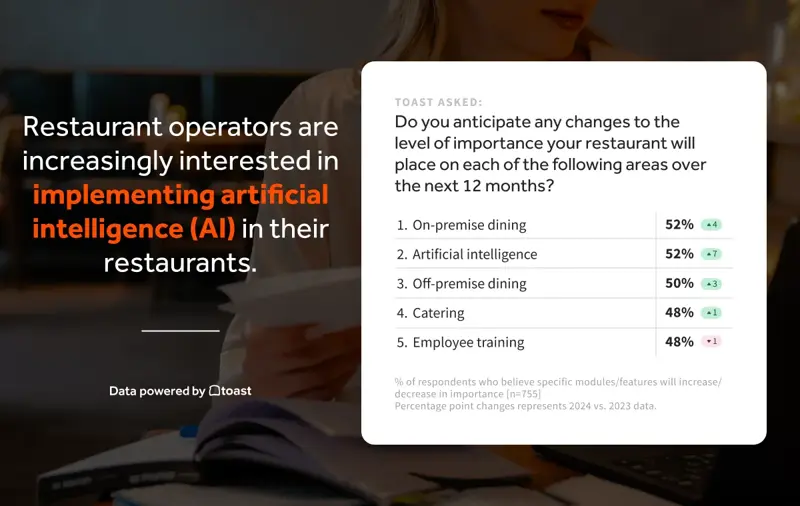
It’s tempting to read “ChatGPT can now book restaurants” and file it under novelty — a nice-to-have, not something that changes how your restaurant gets found. That undersells it. A growing share of “where should I eat tonight” queries are shifting from a Google Maps search to a conversational one, inside whatever assistant someone already has open. Toast’s own research (a survey of 755 US restaurant decision-makers) found over half were already using AI tools or actively planning to — menu optimization was the most common current use, with booking assistance and FAQ-answering named as near-term priorities for smaller full-service restaurants specifically.
There’s a sharper way to say what’s actually happening here, and it comes from an unexpected source: a widely-shared X post from a developer, not a restaurant person, framed it as reservation platforms becoming “the structured data and fulfillment layer” behind AI agents — doing the hard operational work of managing tables and availability while becoming, in the post’s words, “increasingly invisible” to the person actually making the decision. That’s not doom-and-gloom. It’s just accurate. Your restaurant’s competitive asset was always your food and your service. It’s now also the accuracy of the real-time data sitting behind whichever reservation platform you use — because that data is what an AI reads before a human ever sees your name.
The owner’s setup checklist
Here’s exactly what each path requires, based on what each company has actually published — not assumption.
If you use Yelp
You need Yelp Guest Manager, Yelp’s paid front-of-house reservation and waitlist product, actively configured — not just a claimed Yelp business listing. Yelp’s own launch post ties the ChatGPT reach directly to Guest Manager customers.
What to check:
- Reservations and/or Waitlist are turned on and live in the Business Owner App
- Your reservation capacity, accepted party-size limits, and interval-level party capacity are set accurately (Yelp manages this in 15-minute intervals)
- Any pre-booking notes are current
- Your Yelp business page itself — reviews, ratings, photos, business details — is accurate, since Yelp’s ChatGPT integration surfaces this content alongside booking
Cost: Yelp’s own materials aren’t perfectly consistent (pricing pages differ by promotion and date), but the defensible range is $99–$299/month for Guest Manager, with Yelp’s launch materials also referencing a $249 unlimited-covers tier and free upgrades for existing Yelp Reservations customers. There’s no separately published ChatGPT transaction fee or setup fee — the cost is the Guest Manager subscription itself, which you may already be paying if you use Yelp for reservations today.

If you use OpenTable
Be an active OpenTable restaurant with bookable inventory. ChatGPT retrieves availability directly through OpenTable’s existing database — the same one powering OpenTable’s own AI Concierge, which OpenTable says uses your menus, reviews, and descriptions to answer diner questions (vegan options, outdoor seating, noise level, group suitability). There’s no published OpenTable announcement describing a separate ChatGPT-specific activation step or eligibility tier for this release — normal OpenTable listing, service, and inventory rules are the operating prerequisite until OpenTable says otherwise.
What to check: the same fundamentals that already drive your OpenTable bookings — live availability by date, time, and party size; accurate menus and descriptive copy; current photos.
If you use Resy
Be an active US Resy restaurant with online availability. Resy’s launch post says ChatGPT surfaces its restaurants with real-time availability, pulling from the same operator-managed data you already control in Resy OS/Dashboard: shifts, hours, reservation availability, table access, pacing, and booking windows.
What to check: your “About” and “Need to Know” sections, tagline, images, and featured menu items are current — Resy explicitly lists these as operator-editable fields that shape the consumer listing.
The practical version, in one paragraph
Confirm online booking is genuinely enabled on whichever platform(s) you use. Audit your live availability by date, time, and party size — an empty or stale calendar means you simply won’t be offered, no matter how good your reviews are. Set realistic pacing and large-party rules. Review your public copy and menu for accuracy. Then test it yourself: open ChatGPT and ask for a table at your own restaurant, the way a stranger would. This is inventory and data-quality work you may already be doing for your existing platform — not a new ChatGPT integration project.
A worked example: a 40-seat Italian restaurant checking itself
Say you run a mid-size Italian place, on OpenTable for three years, decent reviews, nothing fancy. You open ChatGPT and type: “Italian restaurant in [your neighborhood], tomorrow at 7pm, party of 2.” Nothing comes back with your name on it.
Before assuming something’s broken, walk the checklist in order. First: is 7pm actually open in your OpenTable calendar for tomorrow, or did a manager block that slot weeks ago for a private event that already happened? Second: does your party-size configuration actually accept parties of 2 at that hour, or is your system quietly set to prioritize larger tables during peak service? Third: when’s the last time anyone touched your OpenTable menu and description — is “handmade pasta” from three years ago the only detail there, while a competitor two blocks away has a current menu with dietary tags and photos updated last month?
In this scenario, the fix is rarely a ChatGPT problem. It’s almost always one of those three things — inventory, pacing, or stale content — and all three are things you already had the power to fix before ChatGPT reservations existed. The AI just made the cost of leaving them broken more visible, faster.
What data actually decides if you’re offered
This is the part worth being precise about, because there’s a real gap between “documented input” and “ranking algorithm.” OpenAI and its partners describe what data feeds the system. None of them publish the scoring logic, and none guarantee that filling out every field improves your odds.
| What ChatGPT reads | What it’s used for | What it means for you |
|---|---|---|
| Location, date/time, party size | Matching live availability to the diner’s request | If your inventory is closed or full for that slot, you simply can’t be offered — this is the one truly binary factor |
| Cuisine, price, dietary needs, atmosphere | Filtering which restaurants match the diner’s stated preferences | Keep your cuisine tags, price tier, and public descriptions accurate — these are user-facing match criteria, not proven ranking weights |
| Menus, reviews, descriptions | OpenTable’s Concierge explicitly uses these to answer diner questions | Detailed, current menu and description copy has documented value for the AI layer, even if the exact ChatGPT weighting isn’t published |
| Yelp reviews, ratings, photos | Surfaced alongside booking as part of Yelp’s existing ChatGPT content integration | Your Yelp presence is doing double duty — reservations and discovery both draw from the same profile |
| Resy operator fields (About, tagline, images, menu items) | Shapes the consumer-facing listing | Directly editable by you, in the same dashboard you already use |
The one-line takeaway from all three companies’ own documentation: availability is determinative for booking; accurate content helps discovery; the actual ranking mechanics are not published anywhere. Be skeptical of anyone promising that a specific tag or keyword guarantees you’ll surface — no provider has made that claim.
The gap between “documented input” and “ranking algorithm” — why it matters for your time
It’s worth dwelling on this distinction for a second, because it’s where a lot of well-meaning advice goes wrong. When OpenTable says its AI Concierge “uses restaurant menus, reviews, and descriptions” to answer diner questions, that’s a real, sourced fact — OpenTable published it. But it is not the same statement as “filling out every field in your menu increases your ChatGPT booking rate by X%.” Nobody has published that second claim, because nobody has published the ranking formula at all.
This distinction should change how you spend your time. Spend it on the things that are unambiguously required — live, accurate availability; correct pacing; current menus — because those are documented as inputs the system actually reads. Don’t spend real money or hours on a “ChatGPT SEO” service that claims to know a secret ranking trick none of the three underlying platforms have disclosed. If a vendor pitches you specifically on “getting your restaurant ranked higher in ChatGPT,” ask them directly which company’s documentation they’re basing that on. If they can’t name one, that’s your answer.
Can you opt out?
Here’s the honest limitation nobody’s advertising: there is no universal “don’t show my restaurant in ChatGPT” switch documented by Yelp, OpenTable, or Resy. What you do have is real operational control:
- Yelp Guest Manager managers can adjust minimum/maximum reservation size, accepted party sizes in 15-minute intervals, and pre-booking notes
- Resy operators can disable all online reservations for a shift, close an entire day or service, or change booking windows and availability at will
- All three keep post-booking changes (cancellations, modifications) inside their own system, not inside ChatGPT — the reservation record and downstream service stays under your control, not OpenAI’s
So: you can’t flip a single “exclude me from ChatGPT” toggle. You can close your online inventory entirely on a given provider, which removes you from every AI surface reading that data, not just ChatGPT specifically. If you need a true, provider-specific channel opt-out rather than simply closing inventory, that’s a real open question — ask your account manager directly rather than assuming an answer, since it isn’t resolved in any of the three companies’ launch documentation.
Yelp vs. OpenTable vs. Resy: the honest comparison
If you’re choosing where to focus — or deciding whether a second platform is worth adding — here’s how the three stack up on what actually matters for ChatGPT eligibility and beyond:
| Yelp Guest Manager | OpenTable | Resy | |
|---|---|---|---|
| Geographic coverage for ChatGPT | US and Canada | Global | US only |
| Waitlist support in ChatGPT | Yes — the only one of the three | Not documented | Not documented |
| Cost | $99–$299/month (varies by source/promo) | Standard OpenTable restaurant fees apply | Standard Resy operator fees apply |
| Owned by | Yelp (independent) | Booking Holdings | American Express |
| What ChatGPT reads from it | Reviews, ratings, photos, business details, live reservation/waitlist inventory | Menus, reviews, descriptions, live availability | About/Need-to-Know copy, tagline, images, featured menu items, live availability |
| Post-booking changes | Handled in Yelp, not ChatGPT | Handled in OpenTable, not ChatGPT | Handled in Resy, not ChatGPT |
| Opt-out mechanism | None dedicated — close inventory entirely | None dedicated — close inventory entirely | Can disable online reservations per shift/day |
| Best fit | Restaurants wanting waitlist support and existing Yelp review traffic | Restaurants prioritizing global reach and an established AI Concierge layer | US restaurants already in Amex’s dining ecosystem |
None of these is strictly “better” for ChatGPT purposes specifically — the feature is a pass-through on top of whichever platform you already use, and the platform decision should still be made on its own merits (existing customer familiarity, cost, waitlist needs, POS integration) rather than on ChatGPT access alone.
A useful contrast: how Square does this differently
Square runs a comparable AI-ordering integration for food-and-beverage sellers with Square Online Ordering, and it’s worth knowing about because it shows what a more owner-friendly version of this looks like. Square automatically syncs hours, location, menu, inventory, and ordering data, reports which orders originated from AI, and — critically — offers a dedicated AI-assistant channel toggle to opt out, with no additional marketplace commission beyond normal processing rates. That’s the transparent, controllable model Yelp, OpenTable, and Resy haven’t published yet for reservations specifically. If you use Square for anything adjacent to your restaurant’s ordering, it’s a useful reference point for what to ask your reservation provider for next.
What this means for you
If you’re already live on Yelp Guest Manager, OpenTable, or Resy with accurate data: You’re already eligible — there’s no separate signup. Spend fifteen minutes auditing your live inventory and public copy this week, then test a real query yourself. First action: open ChatGPT and search for your own restaurant the way a diner would.
If your online booking has been neglected — stale hours, an outdated menu, capacity limits nobody’s touched in months: This is now costing you more than it used to, because a diner asking ChatGPT will simply be shown a competitor with cleaner data. First action: audit your live availability and party-size rules before doing anything else.
If you’re not on any of the three platforms yet: There’s no ChatGPT-specific reason to sign up beyond the reasons you’d already have — reach, reservation management, a public listing. Evaluate Yelp, OpenTable, and Resy on their existing merits; ChatGPT eligibility is a side effect of joining one, not a standalone product.
If you manage multiple locations: Each location’s inventory and profile data needs the same individual attention — there’s no bulk “sync all locations to ChatGPT” step beyond what your existing multi-location tools in Yelp/OpenTable/Resy already provide.
If you’re privacy- or control-conscious about AI surfacing your business: Understand clearly that closing your online booking inventory on a given provider is currently your only real lever — there’s no ChatGPT-specific exclusion. If that’s a dealbreaker, that’s worth raising directly with your provider’s account team.
If you’re a fine-dining or reservation-scarce restaurant that’s often fully booked: The “availability is determinative” rule cuts both ways — if you’re consistently sold out, ChatGPT (like every other channel) simply won’t have anything to offer for those slots. This doesn’t change your positioning; it just means the AI-discovery angle matters less for you than it does for a restaurant with open capacity to fill.
If you’re evaluating whether to invest in Yelp Guest Manager specifically for this: Don’t buy it purely for ChatGPT access — evaluate it on its existing reservation and waitlist merits (the $99–$299/month range, per Yelp’s own materials) and treat ChatGPT distribution as a bonus, not the main event.
If you’re a restaurant marketing consultant or agency working with multiple restaurant clients: This is a genuinely new line item for your standard local-visibility audit — add “confirm live inventory + accurate menu/description copy on the client’s booking provider” to whatever checklist you already run, since it now affects a new discovery surface beyond Google and Yelp search directly.
If you’re deciding between adding a second reservation platform for broader reach: Weigh it the way you always would — cost, features, existing customer familiarity — and treat wider AI-assistant coverage as a secondary factor. Being on two platforms with accurate data beats being on three with neglected ones.
Edge cases and troubleshooting
“My restaurant has open tables tonight but ChatGPT didn’t offer it when I tested.” Check your provider-side pacing and party-size rules first — an overly narrow “max party size” or an unusual booking-window setting can silently exclude requests that would otherwise fit. This is the single most common reason a technically-open table doesn’t surface.
“I’m on Yelp but not Guest Manager specifically — am I eligible?” Based on Yelp’s own launch materials, no — the ChatGPT benefit is tied specifically to Guest Manager customers, not general Yelp business listings. A claimed, unclaimed, or basic Yelp page without Guest Manager isn’t part of this integration.
“Does having great reviews guarantee I’ll be recommended over a competitor?” No — and be wary of anyone who tells you otherwise. None of the three companies have published that reviews or ratings directly drive ranking priority in ChatGPT’s reservation results. Reviews are part of the content surfaced (especially via Yelp), but “surfaced alongside a booking” and “ranked higher because of” are different claims, and only the first is documented.
“I don’t see a National Restaurant Association or major trade-body statement on this — is that a bad sign?” Not necessarily. As of this writing, no contemporaneous public statement from the NRA specifically addressing this launch could be found — that’s a research gap, not evidence of a stance one way or the other. The absence of formal industry-body commentary this early is normal for a two-day-old feature.
“Can I see which of my bookings came from ChatGPT specifically?” This isn’t clearly documented across all three providers the way Square’s AI-order-source reporting is for food ordering. If attribution matters to you, ask your Yelp, OpenTable, or Resy account contact directly whether booking-source reporting distinguishes ChatGPT from other channels.
“What if a diner’s ChatGPT booking doesn’t show up correctly in my system?” Treat it exactly like any other online booking discrepancy through that provider — the reservation record lives in Yelp, OpenTable, or Resy’s system, not inside ChatGPT, so your existing support channel with that provider is the right first call.
“I’m on all three platforms — do I need to keep them consistent with each other?” Yes, and this is worth checking specifically. If your hours or menu differ between Yelp, OpenTable, and Resy (a common drift when different staff manage different platforms), a diner could get contradictory answers depending on which provider ChatGPT happens to pull from for that query. Treat cross-platform consistency as part of the same audit.
“How is this different from the consumer-side guide everyone else is writing about ChatGPT restaurant booking?” Most coverage — including our own guide to how diners use the feature — focuses on the booking experience itself: how to ask, what to expect, how it compares to opening the app directly. This piece is specifically about the other side of that transaction: what determines whether your restaurant is even in the pool of options a diner sees.
“Will this feature expand to other reservation providers beyond these three?” Nothing has been announced beyond Yelp, OpenTable, and Resy as of this writing. If you use a fourth platform not covered here, there’s currently no path into ChatGPT’s reservation feature through it.
What this can’t do (yet)
There’s no published, provider-neutral ranking dashboard. You can’t see a “ChatGPT visibility score” anywhere — because none of the three companies have built or published one.
There’s no dedicated ChatGPT opt-out toggle. Your only lever is closing inventory on the underlying provider entirely, which is a blunter tool than a dedicated switch would be.
It doesn’t reward keyword-stuffing or tag manipulation. Providers describe data categories used for matching, not a formula you can game — treat accuracy, not optimization tricks, as the actual lever.
It doesn’t attribute bookings to ChatGPT specifically in most systems. Unlike Square’s AI-order-source reporting, Yelp/OpenTable/Resy haven’t published clear ChatGPT-specific attribution in owner dashboards as of this writing.
It doesn’t replace the need for accurate service-level data. Pacing, party-size limits, and booking windows still have to be genuinely correct — an AI reading bad data just surfaces bad data faster.
FAQ
Do I need to sign up separately for ChatGPT to be bookable? No. If you’re already live and bookable on Yelp Guest Manager, OpenTable, or Resy, you’re already in the eligible pool — there’s no separate ChatGPT enrollment.
How much does Yelp Guest Manager cost? Yelp’s own materials range from $99–$299/month depending on the page and promotion referenced, with a $249 unlimited-covers tier also mentioned at launch. Existing Yelp Reservations customers can reportedly upgrade for free. Confirm current pricing directly with Yelp, since public materials aren’t fully consistent.
Is there a fee specifically for ChatGPT bookings? No published transaction fee or setup fee tied specifically to ChatGPT exists across any of the three providers — the cost is the underlying platform subscription (e.g., Yelp Guest Manager) you’d need regardless.
Can I stop my restaurant from appearing in ChatGPT specifically? Not through a dedicated toggle — that doesn’t exist yet on any of the three platforms. Closing your online booking inventory entirely is currently the only lever, and it affects every channel reading that data, not just ChatGPT.
Does OpenTable require anything special for this to work? No separate activation step has been published — an active OpenTable listing with live, bookable inventory is the operating requirement, same as it’s always been for OpenTable’s other discovery surfaces.
What data does ChatGPT actually use to decide which restaurant to suggest? Location, date/time, party size, and stated preferences (cuisine, price, dietary needs, atmosphere) drive matching; menus, descriptions, and reviews inform richer answers. None of the providers publish exact ranking weights.
Is this the same as OpenTable’s or Resy’s own AI features? Related but distinct — OpenTable’s AI Concierge and Resy’s existing discovery tools already used similar data. ChatGPT’s reservation feature is a new distribution surface reading from the same underlying inventory, not a replacement for those tools.
Will my restaurant automatically show up if I do nothing? Only if you’re already properly set up and current on one of the three platforms. Stale hours, closed inventory, or an inactive listing means there’s simply nothing for ChatGPT to offer, regardless of how good your restaurant actually is.
What happens if a customer’s reservation details are wrong after booking through ChatGPT? Changes and corrections happen through the original provider (Yelp, OpenTable, or Resy) — ChatGPT doesn’t retain or manage the booking after it’s placed, so your existing support process with that provider applies.
Should I switch reservation platforms just to be on all three? Not on this basis alone. Evaluate each platform for its core reservation and marketing value first; broader ChatGPT reach is a genuine bonus, not a strong enough reason by itself to add a second platform’s ongoing cost.
Is there a way to test how my restaurant currently appears in ChatGPT without waiting for a real customer to try? Yes — open ChatGPT yourself (any free account works) and ask for your own restaurant the way a diner naturally would: your cuisine, your neighborhood, a specific time and party size. This is the single most useful five-minute check in this entire guide, and it’s the one most owners haven’t done yet.
Does a restaurant’s price tier or star rating affect whether ChatGPT includes it as an option at all? Not documented as an inclusion filter by any of the three providers — price and cuisine are described as diner-side matching preferences, not eligibility gates. A restaurant isn’t excluded from consideration for being expensive or having a 3.5-star average; it’s excluded by having no matching available inventory for the request.
Who should actually own this at your restaurant
For most independent restaurants, this doesn’t need a new hire or a consultant — it needs a clear owner among the people already touching your reservation platform. If you have a general manager who already handles OpenTable or Resy settings, the fifteen-minute audit in this guide belongs on their existing task list, not a new one. For restaurants where the owner personally manages the Yelp or OpenTable dashboard (common at smaller independents), block fifteen minutes this week rather than treating it as a someday task — stale inventory compounds quietly, and you won’t get an alert telling you it’s costing you bookings.
If you work with an outside marketing consultant or agency, this is a reasonable item to hand them directly: “confirm our booking platform data is accurate and test how we show up in ChatGPT” is a clear, checkable deliverable, not a vague ask. Avoid agencies pitching a standalone “ChatGPT optimization” retainer separate from your existing reservation-platform management — as covered above, there’s no published ranking algorithm to optimize against, so that service is, at best, the same data-hygiene work you could verify yourself in the time it takes to read this guide.
The bottom line
The honest read: this isn’t a new marketing channel to chase — it’s your existing reservation data getting a new, larger audience for free. The restaurants that benefit are the ones already doing the boring, unglamorous work of keeping their online inventory accurate. If that’s not you yet, the fifteen-minute audit above is worth more than anything you could do specifically “for ChatGPT.”
Want to go deeper on making AI tools work for your restaurant — not just this one feature? Our Restaurant AI Front Door course covers the rest, and a free account opens the first two lessons.
Sources
- OpenAI — ChatGPT Release Notes (Aug 10, 2026 entry: restaurant reservations)
- Yelp — Yelp Brings Reservations and Waitlist to ChatGPT
- Yelp — Introducing Yelp Guest Manager: Bringing Yelp for Restaurants front-of-house
- Yelp for Business — Yelp Guest Manager vs OpenTable: Restaurant reservation comparison
- Yelp for Business — Yelp Guest Manager maximizes your restaurant’s reach
- Resy / American Express Newsroom — Resy launches reservations in ChatGPT
- OpenTable — AI Concierge: OpenTable’s dining assistant for restaurant discovery
- Toast — How Restaurants Are Embracing AI to Drive Efficiency (755-operator survey)
- Square — AI-assistant ordering channel and opt-out documentation
- Android Authority — ChatGPT can now help secure your spot at a restaurant
- @ChatGPT on X — official launch post, Aug 10, 2026
- @irentdumpsters on X — “clean your Yelp account up” reaction, Aug 12, 2026