Sam Altman posted eight words on X on August 6: “unlimited text chat for free users!” No press release fanfare, just a line dropped into a longer thread about a model update. By the next morning it had over 9,000 likes and a wave of “wait, is this real?” replies. It’s real. And it’s a bigger deal than the casual announcement made it sound.
Here’s what actually happened, what it means for your everyday ChatGPT use, and — because the headlines are already getting this part wrong — exactly what’s still capped.
What just changed
On August 6, 2026, OpenAI announced two things at once. First: free ChatGPT users (both the Free and Go tiers) are getting unlimited text chats, no more “you’ve hit your limit, try again in 3 hours” wall. Second: a new Think button that lets you ask ChatGPT to spend more time reasoning on a hard question before it answers.
The timing isn’t random. OpenAI had just crossed 1 billion weekly active users — a milestone it originally hoped to hit by the end of 2025, so it arrived about seven months late. According to reporting picked up by Perplexity’s research on this story, ChatGPT’s share of the AI-chatbot market had also slid from a peak of 69% down to around 45% over the past year, as Gemini and Claude both picked up ground. Making the free tier more generous right as competitors are gaining is not a coincidence — it’s a retention play, and OpenAI’s co-founder Greg Brockman came close to saying so directly, posting that the move was about “making ChatGPT simpler and more intuitive” for people who’ll never pay $20 a month.
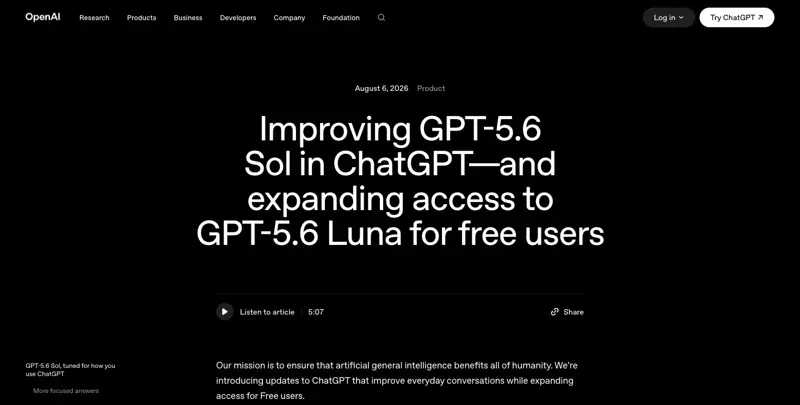
The rollout is staggered, not instant. The updated model for paying users — GPT-5.6 Sol, plus a new thinking-effort slider — went live for Plus and Pro on August 6 itself. For Free and Go users, GPT-5.6 Luna became the new default model “this week,” and the unlimited text chats plus the Think button are rolling out gradually starting around August 7–10. If you don’t see it in your app yet, that’s normal — some accounts get it days before others.
Why “Luna” and “Sol” instead of just “GPT-5.6”
OpenAI split its 5.6 model family into different-sized versions, the same way earlier GPT-5 generations had a full model and a lighter “mini” or “nano” version. Luna is the smaller, cheaper one — it’s what free users get, running your everyday text chats. Sol is the bigger model, and it’s exclusive to Plus and Pro; after this update, Sol also does double duty, handling both quick “Instant” replies and deeper reasoning in one unified model rather than routing you between two separate models like before.
That distinction matters more than it sounds like. A few free users, understandably excited about “unlimited,” assumed they’d suddenly gotten access to the same model paying customers use. They haven’t. You get unlimited Luna. Sol stays behind the paywall.
Why OpenAI did this now
To understand why this change landed on August 6 specifically, it helps to look at the numbers OpenAI has been quietly reporting all year. In February 2025, ChatGPT had around 400 million weekly users. By September 2025, that had grown to 700 million. By February 2026, it hit roughly 900 million weekly users and 50 million paying subscribers. And by late July 2026, OpenAI’s models overall — across ChatGPT and other surfaces — had crossed 1 billion active users and 2 million businesses.
That last milestone came about seven months later than OpenAI had internally hoped to hit it. Growth was still happening, just not fast enough for a company that’s raising money on the promise of continued dominance.
At the same time, the ground was shifting under ChatGPT’s feet. Reporting cited in research on this story put ChatGPT’s share of the generative-AI chatbot market falling from a peak of 69% down to around 45% within about a year, as Google’s Gemini closed in and Anthropic’s Claude carved out its own space — particularly among people willing to pay for quality over brand recognition. By around June 2026, some trackers had ChatGPT’s overall market share dipping below 50% for the first time. The Wall Street Journal reportedly noted that OpenAI leadership had grown specifically concerned about Claude undercutting them on price, with pricing becoming “a genuine friction point” for both enterprise customers and everyday users.
So the free-tier giveaway isn’t just generosity — it’s economically rational, too. Around the same time as this announcement, GPT-5.6 Luna’s underlying API price reportedly dropped 80%, and Terra (a related model) dropped 20%. When the cost of running Luna falls that much, giving it away unlimited to free users becomes a lot cheaper to sustain than it would’ve been a year earlier. Cheaper compute plus slipping market share equals an unlimited free tier — not a hard equation to solve, once you see both sides of it.
There’s a pattern here that’s bigger than just OpenAI, too. The reasoning-effort dial — this idea of letting a model spend variable amounts of “thinking” time on a given question — has quietly existed in developer-facing APIs at OpenAI, Anthropic, Google, and xAI for months. What actually changed in August 2026 wasn’t the underlying technology. It’s that regular consumers, not just developers building apps, are now expected to operate that dial themselves. Each company is doing it with different terminology and different scales — Think button here, thinking slider there — which means, as one analyst put it, no two vendors ship quite the same version of this idea. If you’ve felt a little lost trying to figure out what “reasoning mode” even means across different AI tools lately, that’s not you being behind. It’s genuinely inconsistent across the industry right now.
The walkthrough: using unlimited chat and the Think button
None of this requires you to change any settings — unlimited text chat just happens automatically once it’s rolled out to your account. The Think button is the one piece that’s genuinely new to learn, so here’s how to actually use it.
Step 1: Ask your question like normal. Type into ChatGPT exactly as you always have. Nothing about starting a conversation changes.
Step 2: Look for the Think button near the message box. Once it’s live on your account, you’ll see a small “Think” toggle you can tap before — or sometimes after — sending a message. It’s a per-message choice, not a setting you turn on once and forget. You decide, question by question, whether this one’s worth the extra time.
Step 3: Tap Think before you hit send on a genuinely hard question. Good candidates: multi-step math, “should I take this job offer” style decisions with several tradeoffs, debugging a gnarly piece of logic, or planning something with a lot of moving parts (a trip itinerary juggling budget, dates, and preferences, for instance).
Step 4: Wait a bit longer than usual. This is the whole point — Think tells Luna to spend more computing time working through the problem internally before it shows you an answer. Expected result: a slower reply, but one that’s worked through more of the reasoning instead of pattern-matching to a quick response. On a genuinely hard question, you’ll notice the answer is more structured, catches edge cases a fast answer would’ve missed, or shows its work more clearly.
Step 5: Skip it on simple stuff. Ask Luna to summarize a paragraph, rewrite a sentence, or answer “what’s the capital of Peru” with Think turned on, and you’re just making it slower for no benefit. One X user summed up the annoyance well after testing it: press Think on a trivial question and you’ve wasted your own time waiting.
One copy-paste example to try: “I have $8,000 saved, I’m deciding between paying down a 6.5% student loan faster or investing it in an index fund — think through the actual math for both paths over 5 years and tell me which one wins and why.” That’s exactly the kind of multi-variable question Think is built for. Ask it once without Think, then again with Think on, and compare — most people notice the difference immediately.
Three more example prompts worth testing
A planning problem: “I’m moving from a 2-bedroom apartment to a 1-bedroom in 6 weeks. Build me a week-by-week plan that covers decluttering, notifying utilities, hiring movers, and updating my address, accounting for the fact that I work full-time and only have weekends free.” Think helps here because there are real dependencies between steps (you can’t book movers before you know what’s staying vs. going).
A “check my reasoning” question: “I’m about to tell my landlord I’m breaking my lease early because of a job relocation. Here’s my argument for why I shouldn’t owe the full early-termination fee: [paste your reasoning]. Poke holes in this before I send it.” This is exactly the kind of task where a model that’s rushed to a quick, agreeable answer isn’t useful — you want it to actually slow down and look for the weak points.
A comparison with real tradeoffs: “Compare getting a home equity loan vs. a personal loan for a $15,000 kitchen renovation, given I have decent credit and 12 years left on my mortgage — walk through the actual numbers, not just generic pros and cons.” Skip Think on anything where you already basically know the answer and just want it typed out faster — a cover letter first draft, a text message reply, a grocery list. Save it for the moments where getting it wrong actually costs you something.
If you’re on Plus or Pro
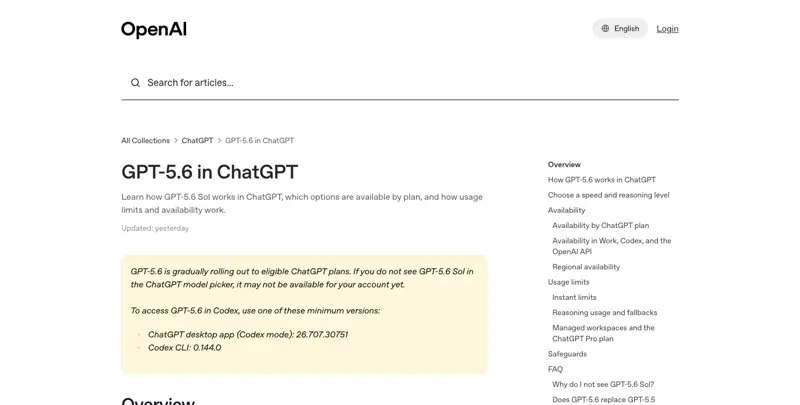
You don’t get a Think button — you get a thinking slider instead, bundled into the retuned GPT-5.6 Sol that shipped the same day. Rather than a single toggle, you can dial reasoning effort up or down across a whole conversation: low for quick back-and-forth, high for research or planning. Functionally it’s the same underlying idea — more compute time before an answer — just implemented as a continuous dial instead of a one-time button press, and running on the more capable Sol model instead of Luna.
What’s still capped (the part the headlines skip)
“ChatGPT is free and unlimited now!” is the headline making the rounds, and it’s not quite right. Here’s the accurate version, gathered from OpenAI’s own materials and cross-checked against outlet reporting:
| Feature | Free/Go tier status after Aug 6 |
|---|---|
| Text chats | Unlimited (subject to anti-abuse limits if you’re clearly running a bot) |
| File uploads | Still capped — separate limit, unchanged |
| Image uploads | Still capped |
| Voice conversations | Still capped |
| AI image generation | Still capped, unchanged |
| Model access | Luna only — Sol stays Plus/Pro-exclusive |
| Tools (browsing, etc.) | Unaffected — same limits as before |
So: talk to ChatGPT in plain text as much as you want. Upload a dozen PDFs, generate a batch of images, or have a long voice conversation, and you’ll still bump into the old limits. One widely shared post from a smaller creator (@krisolo7) put it bluntly: “the unlimited part is the cheapest part to serve” — text is the cheapest thing for OpenAI to give away, which is exactly why it’s the thing that went unlimited first.
ChatGPT free vs. Gemini free vs. Claude free — the real comparison
Free-tier limits across the big three AI chatbots have always been murky, half-published in help docs and half-discovered by users hitting walls. Here’s where things actually stand, post-August 6:
| ChatGPT (Free/Go) | Google Gemini | Anthropic Claude | |
|---|---|---|---|
| Text chat limit | Unlimited | Compute-based, resets every 5 hrs + a weekly cap | Roughly 15–40 messages per rolling 5-hour window |
| Default model | GPT-5.6 Luna | Standard Gemini app model | Claude Sonnet 5 |
| Top-tier model access | No (Sol is Plus/Pro only) | Limited (Gemini Pro capped even via developer access) | No (Opus is paid-only) |
| Image generation | Capped, unchanged | ~100/day on the standard image model, 3/day on the higher-end one | Not a core free feature |
| File uploads | Capped separately | Included, size-limited | Up to 20 files, size-limited |
| Reasoning control | Think button (per-message) | Automatic, complexity-based routing | No comparable consumer toggle |
A few things jump out. Gemini doesn’t use a hard message count at all anymore — as of a May 2026 change, it measures usage by compute, meaning a short factual question costs you less “budget” than a long, complex one, and that budget resets every five hours with a weekly ceiling on top. Claude, by contrast, still runs the old-school rolling-window message cap, and depending on how heavy your usage is (long conversations, lots of file uploads), that effective ceiling can shrink to as few as 20 or so messages in a window. One person on X who pays $200 a month for Claude’s top Max plan pointed out, only half-joking, that Anthropic’s own pricing page still says “there’s no fixed message count” for something they’re paying for — while ChatGPT’s free tier now has an actual number you can plan around: unlimited.
That doesn’t mean ChatGPT’s free tier “wins” outright. Gemini’s free image generation is genuinely generous (100 images a day is a lot), and Claude’s free tier includes web search, file uploads, and Projects that ChatGPT’s free tier doesn’t match feature-for-feature. But on the single specific metric of “can I just talk to it as much as I want,” ChatGPT free now leads clearly.
This isn’t the first time free ChatGPT got a boost — but it’s the biggest
If this feels familiar, it’s because OpenAI has quietly upgraded the free tier before. Back when GPT-5.5 Instant became the free default, it was a meaningful jump in quality but came with the same message-limit ceiling as always — you got a better model, but you’d still hit a wall after enough messages. This time is different in kind, not just degree: the wall itself is gone for text chat, not just moved further back. That’s a bigger structural change than a model swap, even a good one.
It’s also worth sitting with how fast this pace of change has been. Four model generations — well, four named releases within the 5.x line — in roughly a year, each with its own free-tier implications. If you’ve felt like you can’t keep track of which model you’re even talking to on a given day, that confusion is legitimate. You’re not missing something obvious; the naming and rollout cadence genuinely outpaces most people’s ability to track it casually.
What this means for you
If you’re a student on a budget: This is the best free AI-tutoring deal that’s existed. Unlimited text chat means you can work through practice problems, get essay feedback, or talk through a confusing concept for as long as you need without watching a counter. Use Think for genuinely hard homework — a proof, a multi-step chemistry problem — and skip it for quick fact-checks.
If you’re a small business owner or solo freelancer: You can now lean on ChatGPT for drafting emails, brainstorming, and thinking through decisions all day without hitting the old wall mid-task. It’s not a reason to cancel Plus if you rely on file uploads, image generation, or Sol’s extra capability — but for pure text-based thinking-out-loud work, the free tier just got a lot more usable.
If you’re already paying for Plus: Your $20/month buys you Sol (the stronger model), the thinking slider, higher file/image/voice limits, and priority access during high-traffic periods. Free users don’t get any of that — they get unlimited access to the smaller model. Whether that’s still worth $20 to you depends on how often you actually hit Sol’s advantages versus Luna’s ceiling. A few Plus subscribers on X have started asking exactly this question out loud.
If you’re a casual, occasional user: You probably won’t notice a difference day to day — you likely weren’t hitting the old free-tier caps anyway. The real upside for you is peace of mind: no more anxiety about “saving up” your messages before a big task.
If you’re someone who tried ChatGPT free months ago and gave up because of the limits: This is worth a second look. The single biggest complaint about ChatGPT’s free tier — the hard wall mid-conversation — is gone for text chat specifically.
If you’re deciding between ChatGPT, Gemini, and Claude for the first time: For pure conversational use with no message anxiety, ChatGPT free is now the simplest option to reason about. If you need heavy free image generation, Gemini’s free tier is stronger. If you want Claude’s writing style and don’t mind a lower ceiling, its free tier still works fine for occasional use.
If you use ChatGPT for coding through Codex: Don’t expect this update to help you. Multiple developers pointed out on X that Codex usage limits are unaffected — the unlimited-text change is specific to the ChatGPT chat interface, not OpenAI’s coding tools.
Edge cases and things that trip people up
“I thought everything was unlimited now, and then I hit a wall generating images.” This is the single most common confusion right now, and it’s an easy one to walk into given how the headlines read. Unlimited applies to text chat only. Image generation, file uploads, and voice all kept their separate, existing limits.
“I’m on Plus and I ran out of Sol messages — can I switch to unlimited Luna instead?” No. Several Plus users asked this exact question on X after hitting their Sol limit, hoping they could fall back to the free tier’s unlimited model. OpenAI hasn’t built that bridge; Plus and Free are separate tracks, and running out on Sol doesn’t unlock Luna access as a workaround.
“Does pressing Think mean I get GPT-5.6 Sol for free?” No — and this is worth being very clear on, because it’s the second-most common misread of this update. The free Think button gives Luna more time to reason. It does not switch you to Sol. The reasoning ceiling for free users is Luna’s ceiling, not Sol’s — Think just lets Luna get closer to its own ceiling on a specific question, not exceed it.
“The rollout hasn’t hit my account yet — is something broken?” Probably not. OpenAI is rolling this out gradually across accounts rather than flipping a single global switch, so a delay of a few days after the August 6 announcement is expected, not a bug.
“Is the 62% fewer factual errors claim real?” It’s real, but it comes with an asterisk worth knowing. OpenAI ran its own internal test on financial, medical, and legal prompts and found GPT-5.6 Luna produced factual errors 62% less often than the older GPT-5.5 Instant model (68% less often for Sol). That’s OpenAI grading its own homework — the methodology, sample size, and exact prompt set haven’t been published, and no outside group has independently verified the number. Treat it as “meaningfully improved,” not “hallucination-proof.” Double-check anything genuinely high-stakes regardless.
“I heard free ChatGPT is now better than what I pay for elsewhere — is that fair?” It depends what you’re comparing. Purely on message volume, unlimited beats a metered plan, full stop. On raw model capability, Luna is still the smaller sibling to Sol (and to Anthropic’s or Google’s top-tier models) — you’re trading capability ceiling for volume, not getting both for free.
“My messages are getting throttled even though it’s supposed to be unlimited.” OpenAI has said the unlimited policy is “subject to abuse guardrails” — accounts that show clearly bot-like or automated usage patterns can still get rate-limited. If you’re a normal human having normal conversations, this shouldn’t affect you.
What it can’t do
It doesn’t make the free tier equal to Plus. Sol, the higher-capability model, higher file/image/voice limits, and priority access during busy periods all stay behind the paywall. Unlimited text on a smaller model isn’t the same product as a paid subscription.
It doesn’t eliminate hallucinations. The error-reduction claims are directional improvements over an older model, not a guarantee. Luna and Sol will both still get things wrong sometimes, especially on anything requiring very current information or highly specialized expertise.
It won’t help with anything outside text chat. If your bottleneck was ever image generation, file analysis, or voice mode rather than message count, this update does nothing for you.
It doesn’t apply to OpenAI’s other products. Codex (OpenAI’s coding assistant) and other separate tools run on their own limits, unaffected by this change to the main ChatGPT chat interface.
The Think button won’t fix a poorly written prompt. More reasoning time helps the model work through a genuinely hard problem — it doesn’t compensate for a vague or incomplete question. Garbage in, slower garbage out.
FAQ
Is ChatGPT actually free and unlimited now? Text chats, yes — as of the rollout completing around August 10, 2026, free users can chat as much as they want. Images, files, voice, and image generation are still limited.
What model do free users get now? GPT-5.6 Luna, replacing the older GPT-5.5 as the default. It’s OpenAI’s smaller, cheaper-to-run model in the 5.6 family.
What’s the difference between the Think button and the thinking slider? The Think button (Free/Go) is a per-message on/off toggle. The thinking slider (Plus/Pro) is a continuous dial you can adjust to control how much reasoning effort GPT-5.6 Sol puts into a response. Same underlying idea, different implementation, different model tier.
Do I need to turn anything on to get unlimited chats? No. It rolls out automatically to your account — there’s no setting to enable.
Why isn’t unlimited chat live on my account yet? The rollout is staggered across users rather than instant for everyone. If you don’t see it by mid-August, check for an app update, but otherwise just give it a few more days.
Does the Think button make ChatGPT smarter overall? It makes Luna spend more time reasoning on a specific message, which tends to produce better answers on genuinely complex questions. It doesn’t change the model’s underlying knowledge or give you access to a more capable model.
Is Google Gemini or Claude’s free tier better than ChatGPT’s now? Depends what you need most. ChatGPT wins on pure message volume. Gemini’s free tier is stronger for image generation. Claude’s free tier includes some features (web search, Projects) ChatGPT’s free tier doesn’t match, but its message cap is lower and less predictable.
Should I cancel my ChatGPT Plus subscription now that free is unlimited? Only if you rarely used Sol’s extra capability, high file/image/voice limits, or priority access. If those mattered to your workflow, unlimited Luna access doesn’t replace them.
Is the “62% fewer factual errors” claim independently verified? No — it’s from OpenAI’s own internal testing, not a third-party benchmark. Treat it as a meaningful but self-reported improvement, not a verified guarantee.
Will this unlimited policy ever get walked back? OpenAI hasn’t signaled that, and the move appears tied to broader price cuts (Luna’s underlying API costs reportedly dropped 80% around the same time), which makes the free unlimited offer more sustainable for them than it might look at first glance. Still, “subject to abuse guardrails” gives OpenAI room to throttle unusual usage if needed.
The bottom line
The message cap that made free ChatGPT frustrating to rely on is gone for text chat, replaced by an honest tradeoff: unlimited access to the smaller Luna model, plus a Think button for the moments a question actually deserves more thought. It’s a real upgrade, not a marketing trick — just a narrower one than “ChatGPT is unlimited now” headlines suggest. Know what’s still capped, use Think selectively instead of on every message, and you’ll get the most out of it.
If you want to get more out of ChatGPT beyond just knowing the limits — better prompts, knowing when to switch models, structuring multi-step requests — our ChatGPT vs. Claude course walks through exactly that, free to start.
Sources
- The Verge — OpenAI is giving ChatGPT free users unlimited text chats
- TechCrunch — ChatGPT brings unlimited text chats to free users
- MacRumors — Free ChatGPT users get unlimited text chats and GPT-5.6 Luna
- CNET — You can now have unlimited text chats without paying for ChatGPT
- PYMNTS — OpenAI drops ChatGPT limits for free users and upgrades paid tiers
- OpenAI — Improving GPT-5.6 Sol in ChatGPT and expanding GPT-5.6 Luna access to free users
- OpenAI Help Center — GPT-5.6 in ChatGPT
- @OpenAI on X — official announcement thread, Aug 6, 2026
- @sama on X — Aug 6, 2026
- @gdb on X — Aug 6, 2026
