Anthropic handed its new model a puzzle with a trap inside it.
The task: here’s a drawing of a machine part, write code to rebuild it as a 3D model in FreeCAD (free engineering software that designers use to model real objects). The catch — the model was given no way to actually see the drawing. No vision. Just a file it couldn’t open the normal way.
A lot of AI would stop there, or make something up. Claude Opus 5 did neither. It wrote its own little computer-vision program from scratch — code to read the raw pixels, find the edges and shapes, and pull the geometry out of an image it technically couldn’t look at. Then it used that to rebuild the full part in 3D. Repeatedly. Anthropic says no competing model, given the same setup, could solve it in five tries.
That’s the thing worth paying attention to in this launch. Not the price, not the benchmark bragging. The fact that the model, when it hit a wall, built its own tool to get around it. Let’s get into what Opus 5 actually is, how good it really is, and — honestly — how it stacks up against ChatGPT, because that answer is messier than the headlines suggest.
What Claude Opus 5 actually is
Claude Opus 5 is the newest model from Anthropic, the company behind Claude. It went live on July 24, 2026, and you can use it right now on Claude.ai, in the Claude API, in Claude Code, and in Claude Cowork.
Here’s the plain-language version. Anthropic makes a few tiers of AI. Fable 5 is its smartest, most expensive one — the frontier model. Opus is the tier just below it: still very capable, meant to be the workhorse you actually run all day. The pitch for Opus 5 is that it gets close to Fable 5’s intelligence while costing a lot less to run. Or as one of Cursor’s founders put it, “near Fable 5 intelligence at Opus speed and cost.”
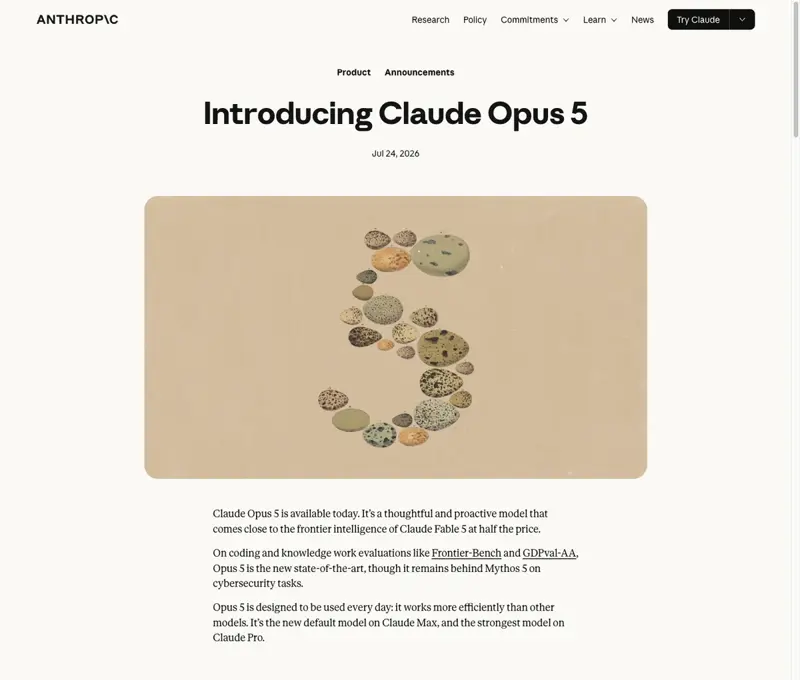
Anthropic’s launch page, July 24, 2026. Opus 5 is the new default on Claude Max and the strongest model on Claude Pro. Source: Anthropic.
For the people who want the numbers:
- Model ID:
claude-opus-5 - Price: $5 per million input tokens, $25 per million output tokens — exactly the same as the model it replaces, Opus 4.8. (A “token” is roughly three-quarters of a word. A million tokens is about 750,000 words.)
- Where it lands: it’s the new default model on Claude Max, and the strongest model you can pick on Claude Pro.
Two smaller features shipped alongside it, and they matter if you build things. You can now swap the tools a model has access to mid-conversation on the Claude platform, instead of restarting. And the API can automatically fall back to the older Opus 4.8 if something goes wrong with an Opus 5 request — a safety net for anyone running Claude inside a live app.
So if you pay for Claude Pro or Max, the short version is: the brain behind your chats just got smarter, and your bill didn’t change.
Solving problems it was never handed a tool for
Back to that FreeCAD story, because it’s the most interesting part of this release and the easiest to breeze past.
Most benchmarks measure whether a model knows things. This measures something different — whether it can improvise. The model wasn’t given a vision tool, so it wrote one. It treated a dead end as a problem to engineer around, not a reason to quit. That’s the behavior that separates “a very good autocomplete” from “something that can actually finish a messy real-world job.”
Anthropic backs this up with a benchmark called ARC-AGI 3, which is built specifically to test reasoning on problems a model hasn’t seen before — the stuff you can’t memorize your way through. On that test, Opus 5 scored about three times as high as the next-best model. Not three percent higher. Three times.
Why should you care if you don’t write code? Because “novel problem” describes most of real work. The weird customer complaint that doesn’t fit any script. The spreadsheet that’s broken in a way no tutorial covers. The project where step three turns out to depend on something nobody planned for. A model that only handles textbook cases is a party trick. A model that can reason through the case nobody wrote down is a tool you can lean on when things get strange — which they always do.
The benchmarks, honestly
Every launch post cherry-picks its wins, and this one is no different — so here are Anthropic’s own published numbers, with the caveats left in.
The pattern is consistent: a big jump over Opus 4.8, and on several tests it brushes right up against Anthropic’s top-tier Fable 5 while costing far less. Anthropic also calls it state-of-the-art on GDPval-AA, a test of practical knowledge work.
But read that axis label again, because it’s the whole ballgame: every one of those comparisons is against Anthropic’s own models. Not against ChatGPT. Which brings us to the question everyone actually types into search.
So does it beat ChatGPT?
Here’s where most write-ups get lazy, so let’s be precise. Anthropic did put Opus 5 head-to-head with OpenAI’s GPT-5.6 — the “Sol” version — right on the launch page. It’s the fourth column of their official benchmark chart.
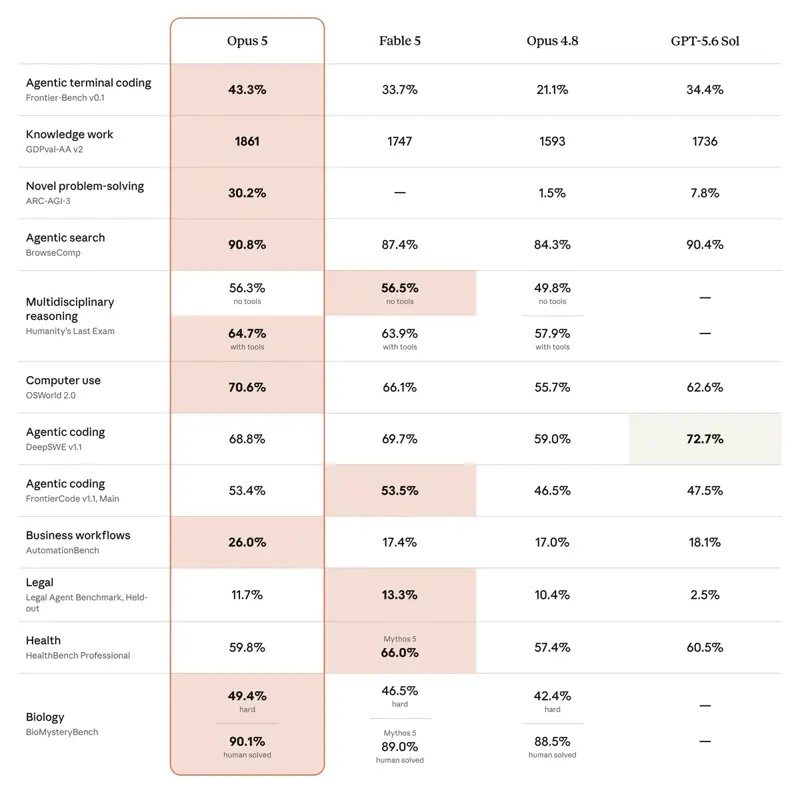
Anthropic’s official comparison, with GPT-5.6 Sol in the right-hand column. Opus 5 leads most tests — but not all. Source: Anthropic.
Read it straight and it’s a real result, not a clean sweep. On the tests Anthropic picked, Opus 5 leads GPT-5.6 Sol on most:
- Agentic terminal coding (Frontier-Bench): 43.3% vs 34.4%
- Knowledge work (GDPval-AA): 1,861 vs 1,736
- Novel problem-solving (ARC-AGI-3): 30.2% vs 7.8%
- Computer use (OSWorld 2.0): 70.6% vs 62.6%
- Business workflows (AutomationBench): 26.0% vs 18.1%
On agentic web search, they’re basically tied (90.8% vs 90.4%).
But here’s the part a press release would bury: GPT-5.6 Sol wins where a lot of developers actually live. On DeepSWE, a real-world coding benchmark, GPT-5.6 Sol scores 72.7% to Opus 5’s 68.8% — beating not just Opus 5 but Fable 5 too. It also edges Opus 5 on a professional health test (60.5% vs 59.8%). So “Opus 5 crushes ChatGPT” is not what this table says. It says Opus 5 is ahead on most of Anthropic’s chosen tests, ChatGPT’s model is genuinely better at some coding, and the gap is small.
Two caveats before you tattoo any of this on your arm:
- Anthropic picked the tests and the matchup. Every lab benchmarks itself in its best light. That’s not cheating — it’s exactly why you wait for outsiders.
- The independent scorekeepers haven’t rated Opus 5 yet. On Artificial Analysis’s intelligence index — which belongs to neither company — Fable 5 sits at 60, GPT-5.6 Sol at 59, Opus 4.8 at 56. Opus 5 isn’t on it yet. When it lands there, that’s the number to trust over anyone’s launch-day chart.
And that post going around claiming “Opus 5 beats GPT-5.6 on SWE-Bench Pro”? Anthropic’s table doesn’t use SWE-Bench Pro at all — and on the coding test it does show, GPT-5.6 Sol comes out ahead. Treat that one as an unconfirmed rumor, not a fact.
What this means for you
If you already pay for Claude Pro or Max: you’ve been upgraded, no action needed. Opus 5 is your default on Max and your best option on Pro. Just notice that answers should need less hand-holding. The move is to trust it with harder things — the messy report, the tangled spreadsheet — instead of breaking everything into baby steps.
If you write, plan, or analyze for a living: this is a strong daily driver at a price that won’t scare your finance team. Draft the email, summarize the meeting, untangle the data. And when a task is genuinely weird — no template, no clear path — this is exactly the kind of model built to reason through it instead of stalling.
If you write code or run automations: the coding and agent numbers are the loud ones here (within a hair of the frontier model at half the cost, plus that mid-conversation tool swap). It’s worth a real trial on your actual codebase, not a toy demo. Watch your token spend, though — a cheaper per-token model can still cost more if it thinks longer on every task.
If you’re stuck choosing between Claude and ChatGPT: don’t pick based on this week’s benchmark. Pick based on which one fits how you work — the interface, the writing voice, the tools you already live in. They’re close enough in raw ability that fit matters more than a two-point score. (If that’s the decision you’re wrestling with, our ChatGPT vs Claude course walks through it without the hype.)
What it can’t do, and what we still don’t know
Honesty section, because the trust is worth more than the sale.
It’s not Anthropic’s most powerful model. That’s still Fable 5. Opus 5 is the value play — most of the frontier for half the money — not the top of the mountain. For projects that run on their own for hours, Anthropic still points you at Fable 5.
It’s deliberately worse at one thing. On cybersecurity, Opus 5 is about as good as a specialized model called Mythos 5 at finding software weaknesses — but far behind it at actually building an exploit to abuse them. That gap is on purpose. You want a model that can spot the unlocked door without being great at kicking it in.
The context window isn’t officially confirmed. A “context window” is how much text the model can hold in mind at once. Anthropic’s launch post never states Opus 5’s number. The wider Opus line has run a 1-million-token window (roughly 750,000 words) for months, and early coverage assumes Opus 5 keeps it — but Anthropic’s own docs don’t name Opus 5 yet. So treat 1M as the likely-but-unconfirmed figure.
The benchmarks are self-reported. Every number above comes from Anthropic, on their chosen tests, at a specific version. That’s normal for a launch — but it’s direction, not gospel. The independent scores (like Artificial Analysis) usually land within a couple of weeks, and those are the ones to watch.
The bottom line
Opus 5 isn’t exciting because it’s the smartest AI on earth — it isn’t. It’s exciting because it drags near-frontier ability down to a workhorse price, and because it showed it can build its own way around a problem it wasn’t equipped for. For most real work, “most of the frontier at half the cost” is the better deal than “the absolute best, at a premium.”
The vs-ChatGPT question isn’t a knockout either way — Anthropic’s own numbers put Opus 5 ahead on most tests and GPT-5.6 ahead on some coding, and the neutral scorekeepers haven’t ruled yet. So the right response to a shiny launch isn’t to switch tools on faith. It’s to get good enough at the tools you already have that you can judge a new one on your own work, fast.
That skill — actually knowing how to put a model to work — is the one that pays off no matter which lab is winning this month. Our Become AI-Fluent course is built for exactly that: the four habits that make any of these models useful in your day, whichever one you end up choosing.
Sources:
- Introducing Claude Opus 5 — Anthropic
- Anthropic upgrades Claude with new Opus 5 model — 9to5Mac
- Anthropic’s New Claude Opus 5 Nearly Matches Flagship Fable 5 at Half the Cost — MacRumors
- Anthropic’s Claude Opus 5 AI model rivals Fable 5 and is cheaper — CNBC
- Anthropic launches Claude Opus 5, a cheaper AI model for coding, agents and enterprise workflows — VentureBeat
- Claude Opus 5 approaches Fable for half the price — Techzine
- GPT-5.6 benchmarks across Intelligence, Speed and Cost — Artificial Analysis
- Context windows — Claude Platform Docs
