If you screen candidates for any role based in the EU, you’ve probably seen the headline by now: “EU AI Act high-risk hiring rules take effect August 2, 2026.” A lot of recruiters read that, felt a jolt of dread, and moved on with a mental note to deal with it eventually.
Here’s what almost nobody’s telling you plainly: that deadline already moved. Six days before it was supposed to hit, the EU quietly pushed the core hiring-AI obligations back sixteen months, to December 2, 2027. If you’ve been bracing for an August 2 compliance scramble, you can exhale.
But — and this is the part that’s getting lost in the relief — four other rules that touch hiring AI are already fully enforceable, right now, and they were never part of the delay. Get this wrong in either direction (thinking everything’s live, or thinking nothing is) and you’re either wasting effort or carrying real legal exposure you don’t know about.
What actually happened
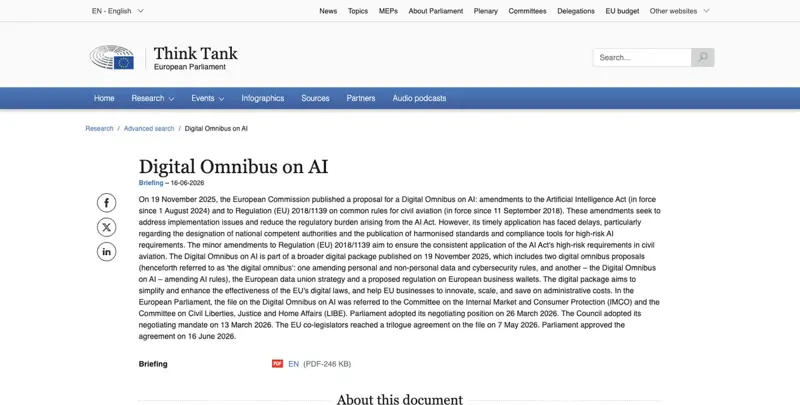
On July 27, 2026, a new piece of EU law called the Digital Omnibus on AI (formally Regulation (EU) 2026/1744) entered into force. It amends the original EU AI Act — the sweeping regulation that classifies AI used in recruitment, candidate ranking, and interview scoring as “high-risk” and requires bias testing, human oversight, and detailed documentation for those systems.
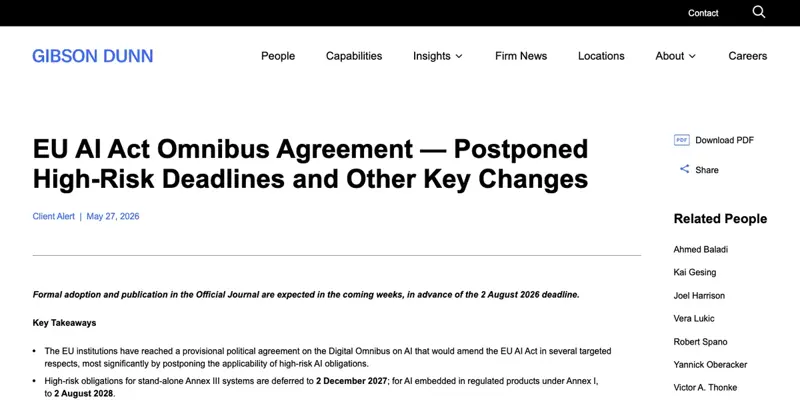
The Omnibus didn’t cancel any of that. What it did was push back when the heaviest compliance machinery has to be built. The obligations that were due August 2, 2026 — risk management systems, technical documentation, conformity assessments, formal registration — for AI systems used in recruitment, employee management, and a handful of other “Annex III” categories now apply from December 2, 2027 instead. A related category (AI embedded directly into physical products) got pushed even further, to August 2028.
The path to get here was genuinely fast by EU standards: the European Commission proposed the delay on November 19, 2025, after industry groups and the EU’s own standards bodies (CEN and CENELEC) warned they wouldn’t be ready in time. Parliament and Council reached a provisional deal on May 7, 2026, Parliament formally voted it through on June 16, and the Council gave final sign-off on June 29. It was published in the EU’s Official Journal on July 24 and took effect three days later — eight days before the original deadline it was racing to beat.
Why this isn’t a “pause button”
Here’s the sentence worth remembering, because it’s the one that separates people who actually understand this from people who read one headline: the AI Act’s general application date of August 2, 2026 was never changed. Only the high-risk Annex III obligations moved. Everything else in the law’s original timeline held, and some of it has been enforceable for a year and a half already.
What’s deferred vs. what’s already binding
This table is the entire practical takeaway of this article. Bookmark it.
| Provision | Status as of today | Effective since |
|---|---|---|
| Article 5 prohibited practices (includes banning AI that infers emotion at work) | In force, untouched by the Omnibus | February 2, 2025 |
| Article 4 — AI literacy requirement for staff | In force (wording softened, not delayed) | February 2, 2025 |
| Article 50 — transparency and AI-disclosure duties | In force, untouched by the Omnibus | August 2, 2026 |
| GDPR Article 22 — automated decision-making | In force, entirely separate from the AI Act | Since May 25, 2018 |
| High-risk Annex III obligations (recruitment, hiring, worker management) | Deferred | December 2, 2027 |
| High-risk Annex I obligations (embedded product AI) | Deferred | August 2, 2028 |
Four rows of that table are not waiting for you. Let’s go through what each one actually means for a recruiter or HR team doing normal work today.
The part that’s been law since February 2025: no reading emotion off a candidate
Article 5 bans a short list of AI uses outright — no risk assessment, no documentation path, no “manage the risk,” just banned. One of them is directly relevant to hiring: AI systems that infer a person’s emotional or psychological state — stress, engagement, mood — from biometric signals like facial expression, voice tone, or physiological data, when used in the workplace or in education. This has applied since February 2, 2025, was never touched by this summer’s deferral, and carries the Act’s steepest penalty tier: up to €35 million or 7% of global annual turnover, whichever is higher.
If you or your vendor runs any tool that analyzes a candidate’s tone, facial micro-expressions, or “vocal confidence” during an interview and turns that into a score — that’s not a 2027 problem. That’s a today problem. German and Dutch data-protection regulators have both explicitly confirmed that call-center voice-emotion tracking and webcam-based engagement monitoring fall inside this ban. If a vendor is selling you “AI emotional intelligence scoring” for interviews, ask them directly how they’re not violating Article 5 — and if the answer is vague, that’s your answer.
Also live since February 2025: AI literacy for your team
Article 4 requires that anyone operating an AI system on your behalf — recruiters, HR staff, hiring managers using AI tools — have a level of “AI literacy” appropriate to their role and to how the system is actually used. The Commission has said enforcement runs from August 3, 2026, but the underlying duty has technically been live since early 2025. The Omnibus softened the legal wording toward “make a genuine effort” rather than a strict guaranteed outcome, but it didn’t delay or remove it.
In practice: if nobody on your team can explain, in plain language, what your AI screening tool does and doesn’t do, you have a gap to close — and it’s cheap and fast to close. A one-hour training session and a written note of who attended goes a long way toward satisfying this.
Live as of exactly August 2, 2026: tell candidates when they’re talking to AI
Article 50 landed on schedule, completely unaffected by the deferral. It has four parts, but two matter most for hiring: if a candidate is interacting with a chatbot, screening bot, or AI voice assistant, you have to make clear — at first contact, and not buried in a privacy policy — that they’re talking to AI, not a person. And if you’re using AI-generated interview avatars, synthetic recruiter voices, or AI-written outreach that could pass as human, that needs labeling too.
Legal commentators are flagging something specific here worth knowing: this rule is narrower than most people assume. It doesn’t require you to disclaim a routine automated rejection email or your back-end CV-parsing algorithm. It’s aimed squarely at things a candidate directly interacts with — AI chatbots, screening bots, and AI-generated outreach — not silent back-office automation. But early drafts of the Commission’s guidance suggest the bar for “clear and distinguishable” disclosure is stricter than a lot of current chatbot implementations meet. If your candidate-facing bot introduces itself as “Alex from Talent Team” with no AI disclosure anywhere in the first exchange, that’s worth fixing this month, not in 2027.
The one that’s been true since 2018 and nobody talks about enough: GDPR Article 22
This is the rule that should actually keep you up at night more than the AI Act headlines do, because it’s the oldest, most tested, and most directly applicable to what recruiters do every day. GDPR Article 22 has restricted decisions “based solely on automated processing” that produce a legal or similarly significant effect on a person since 2018 — and automated candidate rejection, ranking, and shortlisting sit squarely inside that definition.
It’s not an absolute ban. There are narrow exceptions (contractual necessity, legal authorization, explicit consent), and even when one applies, you still need a real human safeguard — not a rubber stamp. “A person clicked approve” doesn’t satisfy this. The reviewing human needs to actually understand the AI’s reasoning, have genuine authority to override it, and meaningfully evaluate whether the output is appropriate. Notably, the European Data Protection Board convened specifically in July 2026 to examine whether current automated candidate-screening tools already violate this rule — a pointed reminder that no AI Act compliance timeline changes what GDPR already requires today.
If your process is “the AI ranks candidates, a recruiter skims the top ten,” you likely have a genuine oversight gap regardless of what the AI Act’s 2027 deadline says.
Your practical checklist, split honestly
Do this now — these are already enforceable
- Audit for emotion-inference tools. If any interview or screening tool scores tone, confidence, engagement, or “culture fit” from voice or video, stop using it or get written confirmation from the vendor on exactly how it avoids Article 5.
- Document real human review on every AI-influenced rejection, ranking, or shortlisting decision. Not “someone clicked approve” — an actual record that a person understood and could have overridden the output.
- Add AI disclosure to every candidate-facing chatbot or screening bot, at first contact, in plain language — not buried in terms of service.
- Label AI-generated recruiter outreach — synthetic voice calls, AI avatar interviewers, AI-written cold outreach that could pass as a human recruiter.
- Confirm your legal basis under GDPR for processing candidate data through any AI tool, with a higher bar for anything touching special-category data (health, ethnicity-adjacent inference, etc.).
- Document AI-literacy training for anyone on your team operating these tools — even a single internal session, recorded and dated, meaningfully helps.
Build toward this — you have until December 2027, use the runway well
- Formal risk-management documentation for any recruitment or candidate-screening AI classified as high-risk under Annex III.
- Bias audits and Fundamental Rights Impact Assessments for high-risk hiring tools — genuinely useful work to start early, since retrofitting bias testing onto a tool you’ve relied on for two years is much harder than building it in from the start.
- Formal conformity assessment and registration for qualifying systems.
- Assigned internal ownership for ongoing oversight of each AI system touching hiring decisions — someone whose job explicitly includes this, not an implicit assumption that “someone” handles it.
Penalties, by category
| Violation | Maximum fine | In force since |
|---|---|---|
| Prohibited practices (Article 5 — e.g., emotion recognition) | €35 million or 7% of global turnover, whichever is higher | February 2025 |
| High-risk and transparency breaches (once applicable) | €15 million or 3% of global turnover, whichever is higher | High-risk portion applies from Dec 2027 |
| Supplying misleading information to regulators | €7.5 million or 1% of global turnover, whichever is higher | August 2026 |
One detail that surprises a lot of US-based companies: these fines are calculated on global consolidated turnover, not EU-only revenue. A company doing modest business in Europe but large business globally faces a much higher ceiling than an EU-revenue-only calculation would suggest.
If you’re a US or UK recruiter, you’re probably in scope already
This is the part that catches people off guard. The AI Act reaches you if you’re a US or UK staffing firm or recruiter sourcing candidates for EU-based roles, even with zero legal entity, contract, or server in Europe. The rule is about where the output gets used, not where your company sits. If your AI screening tool scores or ranks a candidate physically located in an EU member state for an EU-based job, you’re in scope — full stop.
Practically, that means: if you’re screening for a role based in Germany, France, or anywhere else in the EU, treat yourself as fully covered by Article 5 (now), Article 50 (now), Article 4 (now), and the Annex III high-risk regime (from December 2027) — regardless of where your own office sits. And separately, GDPR obligations kick in the moment you’re processing an EU resident’s personal data, which is its own independent trigger with its own timeline that has nothing to do with the AI Act at all.
What lawyers and compliance teams are actually saying
The consistent theme across legal commentary right now is some version of “this is a planning window, not a compliance holiday.” DLA Piper’s briefing on the topic puts it bluntly: “enforcement starts on 2 August 2026. The high-risk obligations do not” — meaning regulators’ general enforcement powers are fully active even while the specific Annex III paperwork requirements aren’t yet triggered.
The recommended sequence from staffing-sector legal guidance is fairly consistent: map every AI system that touches a candidate or employee decision (including ones baked into your applicant tracking system that you might not think of as “AI”), figure out whether each one counts as high-risk under Annex III, formally ask every vendor about their EU AI Act readiness in writing, assign a real internal owner for oversight of each system, and start drafting candidate-notification language now rather than in late 2027.
One line from an EDPB-adjacent legal analysis is worth repeating verbatim, because it’s the single fact this whole article is built around: “the deferral does not alter a single provision of the GDPR.” Anyone treating the December 2027 date as cover for skipping human review on automated rejections today is exposed under a completely separate law that hasn’t moved an inch.
The AI adoption backdrop that makes this urgent
This isn’t a theoretical compliance exercise happening in a vacuum. AI in hiring has scaled up fast. SHRM’s 2025 Talent Trends survey of over 2,000 HR professionals found 43% of organizations now use AI somewhere in HR, up from just 26% the year before — with 51% specifically using AI to support recruiting, and 44% of those using it for resume screening. Among companies already using recruiting AI, 89% say it saves time or improves efficiency, and over half expect to increase their AI use over the next two years.
The volume pressure driving this is real: average applications per open role now regularly top 300, and some markets have seen year-over-year application growth exceeding 280%. Automated screening isn’t optional anymore for a lot of teams — it’s how they keep up.
Which is exactly why the oversight question matters so much. A University of Washington study found AI resume-ranking models favored white-associated names 85% of the time in testing — a finding cited repeatedly in EU regulatory discussions of why the Annex III bias-testing requirements exist in the first place, even with the extra runway to build them. The tools are being adopted faster than the safeguards, and that gap is precisely what both GDPR Article 22 and the eventual Annex III rules are trying to close.
A worked example: mapping one real tool against the checklist
Abstract rules are hard to apply cold, so here’s how this plays out against one specific, common setup: a mid-size company using an ATS (applicant tracking system) with a built-in AI resume-ranking feature, plus a separate AI chatbot that answers candidate FAQs on the careers page.
Step 1 — inventory. Two systems touch candidates with AI: the ranking feature inside the ATS, and the chatbot. Neither was purpose-built in-house; both came bundled with vendor platforms, which is normal and also exactly why most companies under-count how many AI touchpoints they actually have.
Step 2 — classify. The resume-ranking feature scores and ranks candidates for a job — that’s squarely Annex III employment-related high-risk activity, deferred to December 2027 for the heavy documentation, but still subject to GDPR Article 22 today. The chatbot doesn’t rank anyone; it answers questions. It’s not high-risk under Annex III, but it does interact directly with candidates, which pulls it under Article 50’s disclosure rule right now.
Step 3 — check today’s obligations. For the ranking tool: is there a documented human review step before any candidate gets rejected based on its output? If the honest answer is “a recruiter glances at the top 20,” that’s a real gap — the reviewer needs to understand the ranking logic and have genuine authority to override it, not just skim a shortlist. For the chatbot: does it identify itself as AI in its first message? If it opens with “Hi, I’m Sam from our talent team!” with no AI disclosure anywhere nearby, that’s a live Article 50 gap, fixable in an afternoon.
Step 4 — file the runway items. The ranking tool goes on the 2027 build-list: formal bias audit, risk documentation, vendor conformity confirmation. The chatbot doesn’t need Annex III work at all — its only obligation was the disclosure fix, which is now done.
Two systems, two completely different compliance paths, resolved in about a day of actual work once you know which questions to ask each one.
Edge cases and troubleshooting
“Our AI tool doesn’t score candidates, it just filters keywords — does that count?” Simple keyword filtering (matching “5 years experience” or “PMP certified”) generally sits outside Annex III’s high-risk definition, since it’s not really evaluating or ranking a person so much as applying a hard rule. The moment it starts weighting, scoring, or producing a ranked order based on inferred fit, it crosses into high-risk territory. When unsure, ask the vendor directly which category they consider it.
“We use AI to write job postings and outreach messages — is that covered?” Generating text isn’t itself a high-risk hiring decision. But if the AI-written outreach is sent in a way that could pass as a human recruiter without disclosure, that’s an Article 50 transparency issue, live today — not an Annex III issue.
“Our vendor says their tool is ’not high-risk’ — do we just take their word for it?” No. Get it in writing, and ask them to explain their reasoning against the actual Annex III criteria, not just assert the conclusion. Vendors have a financial incentive to under-classify their own risk category, and the legal obligation to classify correctly sits with you as the deployer, not just the provider.
“We’re a small company — do the same rules really apply to us?” Yes, with one softening: Article 99(6) allows proportionality in how fines are calculated for SMEs and startups, using the lower of the absolute euro figure or the percentage-of-turnover figure. The substantive obligations themselves — no emotion inference, human review, disclosure — apply regardless of company size.
“Our candidates are mostly in the US, but a few roles are EU-based — do we need a whole separate process?” Not necessarily a whole separate process, but you do need EU-specific handling for those roles: confirm human review is documented, confirm any candidate-facing AI discloses itself, and confirm you’re not running anything resembling emotion inference on those specific interviews. A per-role flag in your ATS for “EU-based role” is a lightweight way to trigger the extra checks only where needed.
“What counts as ’explicit consent’ for GDPR Article 22 purposes — can we just add a checkbox to the application form?” A buried checkbox in lengthy terms and conditions is unlikely to satisfy the “explicit” standard regulators expect — consent needs to be a clear, specific, informed, and freely given action, ideally separate from your general privacy policy acceptance. This is genuinely a question worth routing to actual legal counsel rather than guessing, since GDPR consent standards are strict and well-litigated.
“We already had a bias audit done last year — does that satisfy the coming Annex III requirement?” Possibly a strong head start, but likely not sufficient on its own — Annex III’s formal bias-testing and documentation requirements are more specific and ongoing than a one-time audit. Treat last year’s work as a foundation to build the 2027-ready documentation on, not a box already checked.
What this means for you
If you’re an in-house recruiter at a company that hires across the EU: Start with the “do this now” checklist above. It’s a few days of real work, not a project — mostly documentation of things you’re probably already doing informally.
If you’re at a US staffing agency that places candidates into EU roles: Don’t assume distance protects you. Confirm with your compliance or legal team whether any of your screening tools do anything resembling emotion inference, and get your candidate-facing bots properly disclosed this month.
If you’re evaluating a new AI recruiting tool right now: Ask the vendor directly, in writing, how their tool avoids Article 5 emotion-inference territory and what their Annex III readiness roadmap looks like for December 2027. A vendor with a clear answer is telling you something useful about how seriously they take this. A vendor who’s never heard the question is telling you something too.
If you manage a small team without a dedicated compliance person: You don’t need to hire a lawyer this week. You need one afternoon: audit your tools against the “do this now” list, write down who reviews AI-influenced decisions and how, and put a reminder in your calendar for mid-2027 to start the deeper Annex III work.
If you’re a hiring manager who just uses whatever tool HR gives you: This mostly isn’t your job to fix, but it is your job to ask. If you’re not sure whether your interview tool scores tone or confidence, ask HR directly — you might be the first person to actually ask.
If you’re outside the EU entirely and don’t hire for EU roles: This specific set of rules doesn’t reach you yet, but the pattern is worth watching. Similar frameworks are moving through legislatures in several US states and in the UK’s own evolving AI hiring guidance — the EU is usually early, not unique.
What this can’t fix for you
It can’t tell you whether your specific vendor’s tool qualifies as high-risk. Annex III classification depends on exactly what the tool does, and vendors don’t always describe their own products with legal precision. When in doubt, ask them to state in writing whether they consider their product high-risk under Annex III — and keep the answer on file.
It doesn’t replace GDPR compliance work you should already have done. The AI Act adds a layer on top of GDPR; it doesn’t substitute for it. If your GDPR program has gaps, the AI Act deferral doesn’t buy you time on those.
It can’t predict how strictly the transparency guidance will be enforced. The Commission’s draft guidance on what counts as sufficiently “clear and distinguishable” AI disclosure is still evolving — treat current compliance as a good-faith best effort, not a guarantee against future scrutiny.
It doesn’t cover every country’s separate hiring-AI rules. This is EU-specific. If you also hire in the US, UK, or elsewhere, those have their own, different frameworks running on their own timelines — this deferral has zero effect on any of them.
FAQ
Do I need to stop using AI screening tools until 2027? No. Nothing about this deferral requires you to stop using AI in hiring — it delays specific documentation and assessment obligations, not the ability to use the tools at all. What’s already required today is human oversight, candidate transparency where you interact directly with AI, and staying well clear of emotion-inference features.
Is this the same as the US AI hiring rules? No — this is EU-specific and runs on a completely separate legal framework from US state-level AI hiring laws (like those in Illinois, New York City, or Colorado) or the EEOC’s guidance. If you hire across multiple regions, you’re managing several parallel compliance tracks, not one.
What if my ATS vendor says they’re “AI Act compliant” — can I just trust that? Get specifics. “Compliant” is doing a lot of work in that sentence. Ask which specific obligations they mean — Article 5, Article 50, or Annex III readiness — since those are on completely different timelines and a vendor claim covering one doesn’t mean they’ve covered all three.
Does this deferral apply to AI used in performance reviews and promotions too, not just hiring? Yes — Annex III’s employment category covers the full employment relationship, not just recruitment. Performance evaluation, task allocation, and decisions about promotion or termination assisted by AI fall under the same deferred timeline, with the same live-now exceptions (Article 5, Article 50, GDPR Article 22) applying throughout.
Why did the EU delay its own flagship AI law before it even fully took effect? The Commission’s own stated reason was that neither industry nor the EU’s technical standards bodies (CEN and CENELEC) would be ready with the conformity-assessment infrastructure the law assumed would exist. It’s a fairly candid admission that regulation moved faster than the technical apparatus needed to check compliance against it.
Where can I read the actual text of the Digital Omnibus? It’s published as Regulation (EU) 2026/1744 in the EU’s Official Journal, and the European Parliament’s think tank has a public explainer summarizing the key changes in plain language if you want the policy version rather than the legal text.
Will this deadline get pushed again? Nobody can promise that, but there’s no indication of a further delay right now — the December 2027 and August 2028 dates in the current text are described as fixed backstops, not conditional on standards-readiness the way earlier drafts considered.
The bottom line
The headline version of this story — “EU hiring AI rules delayed” — is true but dangerously incomplete on its own. The accurate version is: the expensive, document-heavy part of compliance got a real, useful sixteen-month extension, while the parts that actually protect candidates today — no emotion-reading AI, real human review of automated decisions, and honest disclosure when someone’s talking to a bot — never moved at all. Treat the extra runway as exactly that: time to build the deeper compliance work properly, not a reason to stop paying attention until 2027.
If you want a structured walk-through of building AI hiring processes that hold up under EU and US scrutiny alike, FindSkill’s AI for HR Without Creating a Legal Mess course covers the practical side of exactly this.
Sources
- European Parliament Think Tank — Digital Omnibus on AI briefing
- Gibson Dunn — EU AI Act Omnibus Agreement: Postponed High-Risk Deadlines and Other Key Changes
- Secure Privacy — EU AI Act Digital Omnibus: The New High-Risk AI Deadlines After Council Approval
- TechTimes — Automated Hiring Has Broken GDPR Article 22 Since 2018, EU Regulators Confirm
- DLA Piper GENIE — EU Commission publishes draft guidelines on high-risk AI in employment
- Crowell & Moring — Artificial Intelligence and Human Resources in the EU: a 2026 Legal Overview
- Bundesnetzagentur — Prohibited AI practices under the EU AI Act
- ArtificialIntelligenceAct.eu — What the Act Means for Staffing Businesses
- Disclos — EU AI Act Article 99: penalties, fines, enforcement
- SHRM 2025 Talent Trends survey coverage
