“AI music just became legal.” That’s the line going around this week, and it’s wrong in a way that could actually cost you a channel. On September 10, 2026, Universal Music Group and ElevenLabs announced a deal. It’s real, it’s a big deal for the music industry, and it changes approximately nothing about what you can safely upload to YouTube today. Nothing is live. No app exists yet. If you make videos and background music is part of your workflow, the question you actually need answered isn’t “is AI music legal now” — it’s “what happens to my channel if I get this wrong.” That’s what this guide is for.
What Just Changed (And What Didn’t)
Here’s the announcement, stripped of the press-release language: Universal Music Group and ElevenLabs signed a multi-year strategic agreement. The centerpiece is a new AI music creation platform, still in development, that will let fans remix, mashup, and reinterpret tracks — but only from artists and songwriters who specifically opt in. Not the whole UMG catalog. Not automatically. Track by track, artist by artist, whenever the opt-in mechanism actually gets built.
ElevenLabs co-founder and CEO Mati Staniszewski framed it as giving fans “new ways to interact with our favorite music and artists” while making sure artists “are fairly compensated.” UMG’s Lucian Grainge said something similar — AI possibilities that put “artists, songwriters, and fans at the center.” Nice sentiments. Worth noting anyway: neither statement comes with a number attached. No revenue split. No opt-in mechanics. No word on whether a fan’s remix can be downloaded, distributed, or monetized on somebody else’s channel.
That last point matters more than anything else in this section, so let’s sit with it: as of today, September 13, 2026, this platform has no launch date, no public waitlist, no pricing, and no country availability. It is “now in development.” Nobody outside the two companies can use it. If you saw a headline this week implying AI music got some kind of blanket legal green light, that headline skipped the most important word in the announcement: participating.
And here’s the part that trips people up, because there are now three different things floating around with similar names, and social media has been merging them into one story.
This deal (UMG x ElevenLabs, Sep 10, 2026): brand-new, in development, no product yet, first major-label deal ElevenLabs has ever signed — and notably, signed without a lawsuit forcing the issue.
The UMG x Udio deal (Oct 29, 2025): older news, and a completely different animal. That one came out of settled copyright litigation — UMG sued Udio, they fought, they settled, and part of the settlement was Udio launching a “walled garden” licensed streaming and creation product with audio fingerprinting during the transition period. If you saw someone online conflating “Udio got sued and settled” with “ElevenLabs just got legal,” that’s the mix-up. Different company, different year, different legal path to get there.
ElevenLabs’ existing Eleven Music / Music API: this is ElevenLabs’ own generation tool that already exists today, lets you make original songs with granular vocal and instrument control, and has zero connection to UMG’s catalog. It was built through separate licensing arrangements with Merlin and Kobalt, not through this new deal. If you’ve already used ElevenLabs to generate a track, this week’s news doesn’t touch that product at all.
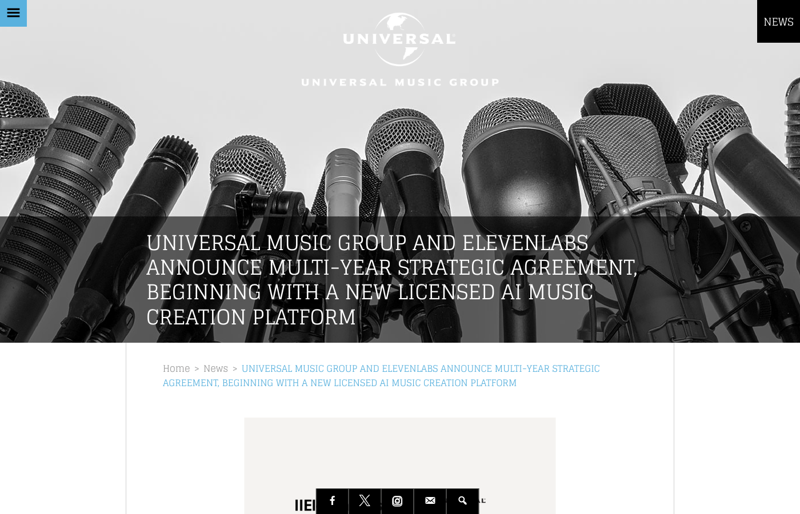
Worth saying out loud, because it’s the honest read of the room: this news is genuinely fresh — three days old as I’m writing this — and it hasn’t gone properly viral yet. The two official announcement posts got modest engagement.
A handful of replies underneath UMG’s own post asked the obvious question out loud. This is a label that has spent two years suing AI music companies into the ground. Is this a real shift, or is it “anti-AI-slop, pro-AI-slop-when-we-own-a-cut-of-it”?
And a sharper one still: if Suno and Udio built value by scraping copyrighted music without permission, and settlements or deals eventually flow money back toward labels, does that money reach the artists whose work got used? Or does it stop at UMG’s balance sheet? Nobody’s celebrating yet. That skepticism is worth keeping in your back pocket, because “fairly compensated” is a principle, not a contract term. We won’t know which one it turns into until the platform actually ships with real terms attached.
None of that is a knock on the deal. It might turn into something genuinely good for artists. But “might, eventually, once built” is a different sentence than “AI music is now legal,” and confusing the two is exactly how a creator ends up uploading something risky under the mistaken belief that the rules just changed in their favor.
They didn’t. So let’s talk about the rules that actually apply to you right now, today, on the platform where you’re probably trying to monetize a video.
The Framework: Safe, Risky, Never
Everything about whether AI music causes you a problem on YouTube comes down to one mechanical fact that almost nobody explains clearly: a Content ID claim and a copyright strike are not the same thing, they don’t have the same trigger, and they don’t have the same consequence. Get this distinction wrong and you’ll either panic over something harmless or walk straight into something that can end your channel.
Claim vs. strike, actually explained
A Content ID claim happens automatically. YouTube’s Content ID system scans every upload and checks it against a database of reference files that rightsholders have registered. If your video’s audio matches — even a segment of it — the system generates a claim automatically, no human review, often within minutes of upload. The claim attaches to that one video. It does not touch your channel. The rightsholder chose in advance what happens when a match occurs: monetize (route the ad revenue their way, sometimes split with you), track (just watch the numbers), or block (in specific territories, or everywhere). For music, “monetize” is overwhelmingly the default choice, because it’s free money for the rightsholder and doesn’t cost them anything to let your video stay up.
You can dispute a claim. You can mute the claimed audio segment. You can trim out just the offending section. You can swap in something from YouTube’s free Audio Library. None of those actions touch your channel standing. A claim, on its own, usually means less ad revenue on one video. That’s it.
A copyright strike is a completely different animal, and it’s not automatic. A strike happens when a rightsholder files an actual legal takedown request — the kind that invokes the DMCA or equivalent copyright law — and YouTube’s legal team reviews it and finds it valid. That’s a manual, human, legal process, not a database match. A strike attaches to your channel, not just one video. Your first strike requires you to complete “Copyright School” before it expires after 90 days. Get three strikes inside a rolling 90-day window and your channel — and any other channels you run — become eligible for termination. Gone. Not demonetized. Terminated.
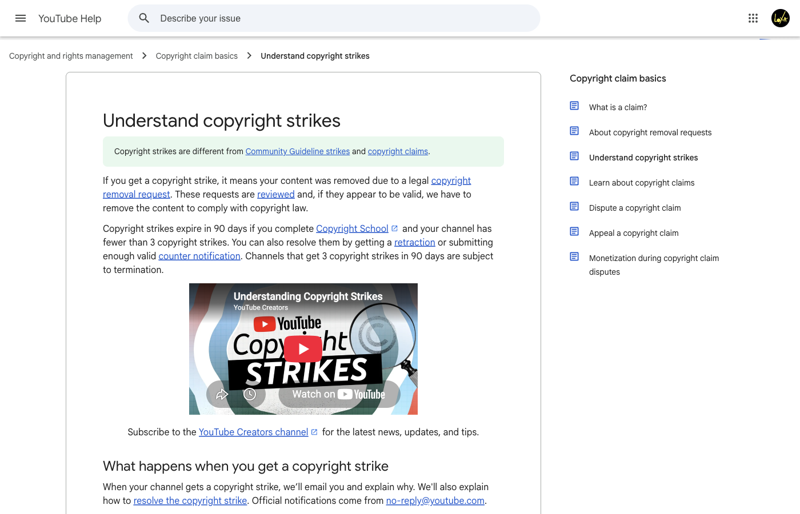
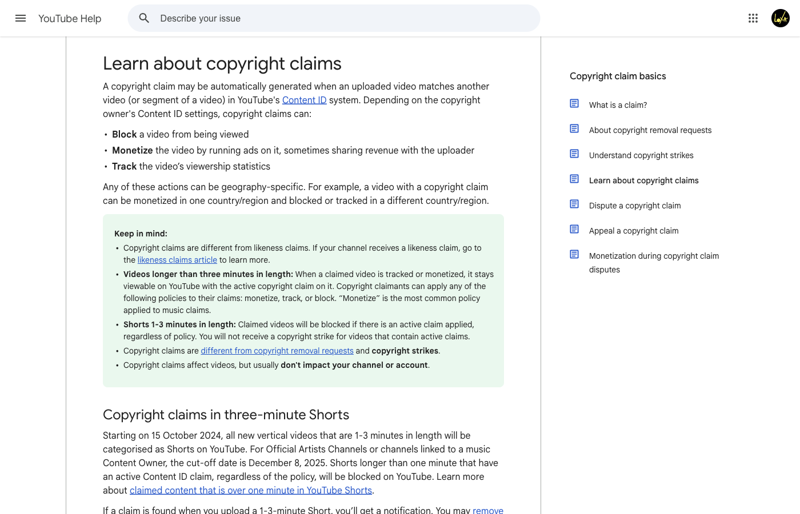
Here’s the sentence that should actually change how you think about this: a claim is not a step toward a strike, unless you mishandle it. If you get a claim and just leave it, dispute it honestly, or mute the audio, nothing escalates. Where people get hurt is disputing a claim in bad faith — clicking “dispute” and claiming you own audio you clearly don’t, hoping the rightsholder doesn’t notice. Sometimes they don’t. But if they do, disputing incorrectly can prompt the rightsholder to escalate from an automated Content ID claim to an actual manual legal takedown request. That’s how a claim becomes a strike: not by existing, but by getting disputed dishonestly and drawing real legal attention to something that was previously running on autopilot.
And YouTube’s own policy doesn’t single out AI as a special trigger for any of this. Read the actual help documentation and there’s no clause that says “AI-generated music gets extra scrutiny.” The system doesn’t know or care that a track was AI-made. It only cares whether the audio matches something in the reference database. A fully original AI-generated instrumental, with no melody or lyric lifted from an existing recording, has nothing to match against. It’s not “legal because it’s AI” — it’s unclaimed because there’s nothing for Content ID to recognize.
Worked example: two creators, same night, very different outcomes
Picture two people uploading videos on the same evening.
Creator A runs a faceless “oddly satisfying” channel. She generates a two-minute instrumental with an AI music tool, describing a mood — “lo-fi, mellow, no vocals” — and gets back something original. Nothing about it references an existing song. She drops it under her video, uploads, and hits publish. Content ID scans it. No match exists in the reference database, because nothing about her track resembles a registered recording. No claim appears. The video monetizes normally from minute one.
Creator B wants a specific vibe: “make it sound like [a well-known artist’s] style, similar melody to their 2019 hit.” The AI tool she’s using, trained on huge volumes of existing music, produces something that leans close enough to the real song’s melodic structure to trigger a match. She uploads. Within minutes — sometimes seconds — Content ID flags it. A claim lands on the video. If the rightsholder’s default policy is “monetize,” her video stays up but the ad revenue reroutes to them. If their policy is “block,” her video goes dark in some or all territories, immediately.
Now say Creator B panics and disputes the claim, insisting the track is “100% AI-generated and original” — technically true about the generation method, false about the outcome, since the output demonstrably echoes an existing composition. The rightsholder reviews the dispute, decides it doesn’t hold up, and this time doesn’t just reinstate the automated claim — they file an actual copyright removal request. That’s a strike. One strike doesn’t end a channel. Three in 90 days does. And now Creator B is one careless dispute closer to that number, over a background track that didn’t need to exist in that specific style in the first place.
Same night, same platform, same underlying technology — wildly different risk, because one person generated something original and the other tried to reproduce something recognizable.
The safe/risky/never table
| Scenario | Claim risk | Strike risk | Why |
|---|---|---|---|
| Fully original AI instrumental, no lyrics, no melody resembling an existing song | Low | Very low | Nothing in Content ID’s reference database to match against |
| AI-generated song with original lyrics and an original melody, made with a tool like Eleven Music | Low | Very low | Same logic — original output has no reference match, regardless of the tool used to make it |
| AI “in the style of” a genre or era (e.g., “80s synthwave,” “orchestral epic”) with no specific song referenced | Low–Moderate | Low | Style mimicry alone usually isn’t specific enough to trigger a match, but heavy prompting toward one exact track raises the odds |
| AI recreation of a known song’s melody or structure (prompted to sound like a specific existing track) | High | Moderate–High | Matches Content ID’s reference file; if disputed dishonestly, can draw a real takedown request |
| AI vocal “cover” of an existing song using the original composition, even with a synthetic voice | High | High | The underlying composition is still someone else’s copyrighted work, regardless of who (or what) is singing it |
| AI clone of a specific real singer performing someone else’s song, or a fake “duet” using their voice | Very high | Very high, plus a separate likeness/privacy issue | Two violations stacked: the composition’s copyright, and the artist’s voice/identity, which YouTube handles through a distinct privacy removal process |
| AI impersonation of a real person (not a musician) speaking or singing, implying they said/did something they didn’t | High — separate from music copyright | High, plus reputational and legal exposure beyond YouTube | This crosses into YouTube’s likeness and misinformation policies, not just copyright |
Read that table as a gradient, not three hard boxes. The further your output drifts from “something original” toward “something that sounds like a specific existing thing,” the more of Content ID’s teeth you’re walking into. And once a real human artist’s actual voice enters the picture, you’ve left copyright territory and entered identity-rights territory, which is a separate mess entirely — and honestly a worse one, since it’s not something a Content ID dispute process can even resolve for you.
Where the three platforms actually stand today
Since the names get thrown around interchangeably, here’s a side-by-side of what each one actually is:
| UMG × ElevenLabs (new) | UMG × Udio | ElevenLabs’ Eleven Music | |
|---|---|---|---|
| Announced | Sep 10, 2026 | Oct 29, 2025 | Already live |
| Status | In development, not launched | Live, licensed | Live, licensed |
| How it started | Negotiated deal, no lawsuit | Settlement of copyright litigation | Direct licensing with Merlin, Kobalt |
| What it lets you do | Fan remixes/mashups of opted-in UMG tracks (once built) | Licensed streaming + AI creation in a “walled garden” | Generate original songs with vocal/instrument control |
| Catalog access | Track-by-track opt-in only | Licensed UMG catalog within Udio’s product | Not UMG-catalog-based at all |
| Usable today? | No | Yes (Udio’s own product) | Yes |
If you take one thing from that table: the platform everyone’s talking about this week is the one column you can’t actually touch yet.
What This Means For You
If you make faceless YouTube videos with AI background music. You’re in the best position of anyone reading this. Stick to fully original generations — describe a mood and genre, not a specific song or artist — and your claim risk stays low without you doing anything else. First action: audit your last five uploads and check whether any of your prompts referenced a specific existing song or artist by name. If they did, regenerate those with a mood-only prompt instead.
If you’re a musician wondering whether to opt in once the UMG platform launches. Nobody can answer whether it’s a good deal for you yet, because the compensation formula, opt-in unit (track vs. catalog), and distribution rights haven’t been published. First action: don’t sign anything or make a public decision based on this week’s headlines. Wait for the actual terms, and if you’re independently signed or self-released, note that this deal is UMG-specific — it says nothing about how your label, if you have one, might follow.
If you run a business’s social media and use AI music in ads or reels. Commercial use raises the stakes, because a copyright dispute on a client-facing account is a worse look than on a personal channel, and ad platforms sometimes react faster to claims than YouTube does. First action: keep a folder of your generation records — the prompt you used, the date, and the tool’s commercial-use license terms — so you have paper evidence of origin if anything gets questioned later.
If you already got a Content ID claim on a video with AI music. Don’t panic, and don’t reflexively dispute it. First action: open the claim in YouTube Studio, check exactly what it’s matching (Studio usually shows you the timestamp and the matched reference), and decide honestly whether your track actually resembles that reference. If it clearly doesn’t, dispute with a clear explanation. If it does, muting or trimming that segment is the lower-risk move.
If you want AI to clone a specific artist’s voice or style. Don’t, at least not for anything you plan to publish. This is the single highest-risk category in the entire framework — you’re stacking a composition-copyright problem on top of a voice/likeness problem, and the second one isn’t something a Content ID dispute can fix. First action: if you want that artist’s sound, describe the sonic qualities (instrumentation, tempo, era, mood) instead of naming them, and never let an output imply it’s actually them singing.
If you’re waiting for the UMG-ElevenLabs platform to “solve” AI music licensing for you. It might, eventually, for opted-in artists’ catalogs specifically. It will not retroactively legalize anything you’ve already uploaded, and it won’t cover the other 99% of recorded music that isn’t from a participating UMG artist. First action: build your workflow around originality now, so you’re not depending on a product with no launch date to bail you out later.
If you’re a Shorts creator specifically. There’s a rule unique to your format: a 1–3 minute Short with an active Content ID claim gets blocked outright, regardless of the rightsholder’s chosen policy. Even a “monetize” claim, which would leave a long-form video up and running, will block a Short from being visible at all. First action: resolve any claim before publishing a Short, not after — check for it in Studio pre-upload if your workflow allows, since a blocked Short with zero views defeats the format entirely.
Edge Cases and Troubleshooting
You got a claim and you’re sure your track is 100% original. Check exactly what’s being matched first — Studio shows you the specific segment and sometimes the reference title. Occasionally Content ID flags a coincidental overlap (a chord progression or brief phrase that happens to resemble something registered). If you’re confident it’s a false positive, dispute it with a clear, honest explanation. Don’t lie about how the track was made; just explain why you believe it doesn’t match.
You disputed a claim and now you have a strike. This means the rightsholder reviewed your dispute, disagreed, and escalated to an actual legal takedown request rather than just letting the automated claim stand. Your options at that point: file a formal counter-notification if you genuinely believe the takedown was wrong (this is a real legal process with real legal consequences if you’re wrong), wait out the 90-day expiration if you have fewer than three strikes and complete Copyright School, or reach out to the claimant directly if there’s a retraction path available. Don’t dispute claims casually going forward — treat every dispute as a real assertion you’re making, not a “why not, worst case nothing happens” click.
Your Short got blocked and you don’t know why. Check for an active Content ID claim first — this is the single most common cause for 1–3 minute Shorts specifically, and it happens regardless of what monetization policy the rightsholder chose. A claim that would leave a long-form video up and monetized will still block a Short outright. Resolve or dispute the claim, then republish.
You’re confused about whether this is a copyright issue or a likeness issue. Copyright covers the composition and recording — the actual music. Likeness covers a person’s voice, face, or identity being used to make it look or sound like they did something they didn’t. AI-cloning a real singer’s voice onto a track triggers both, and they’re handled through entirely separate YouTube processes — copyright claims and strikes go through Content ID and the copyright removal system, while likeness issues go through a separate privacy-focused takedown request. Fixing one doesn’t fix the other.
You made an AI “cover” of an existing song using a synthetic voice. This is riskier than people assume, because the vocal being synthetic doesn’t matter — the underlying composition (melody, lyrics, arrangement) is still someone else’s copyrighted work. A Content ID match on the composition can occur even if the exact recording being used doesn’t match a specific reference file, because publishers register compositions separately from recordings. Treat any “cover,” AI-voiced or not, as carrying real claim risk.
You’re not sure if you need to disclose that your background music is AI-generated. YouTube’s disclosure requirement is about realistic content that could mislead viewers — a real person appearing to say or do something they didn’t, altered footage of a real event, or a fabricated realistic scene. A generic AI instrumental playing under your video doesn’t fall into that category and typically doesn’t require the “Altered Content” toggle. Where it gets closer to requiring disclosure: if you’re using an AI voice clone or a synthetic recreation of a real, identifiable person’s singing voice.
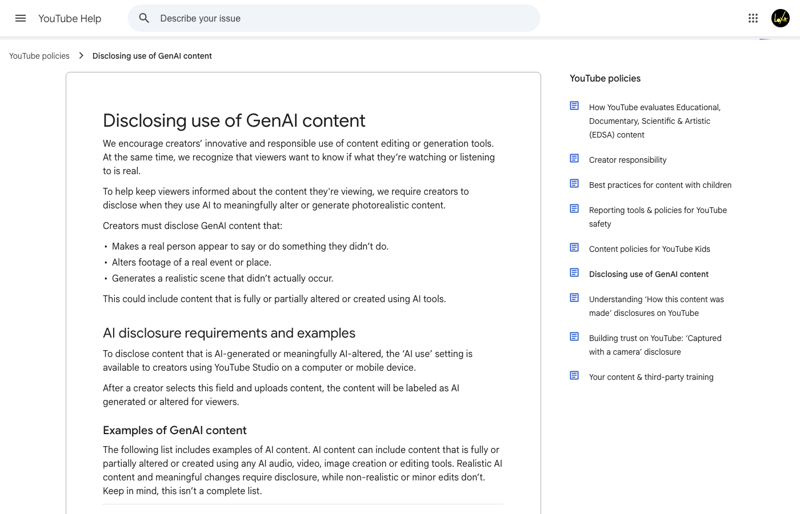
You’re worried AI music will get your channel demonetized even without a claim. That’s a separate policy entirely — YouTube’s “inauthentic content” rules (renamed from “repetitious content”) target mass-produced, templated, low-effort uploads regardless of whether AI was involved in making them. Using AI music doesn’t categorically block monetization. Cranking out dozens of near-identical videos with generic AI music and zero original commentary or editing is what triggers that policy, and it would flag the same way with royalty-free stock music.
You got a claim, muted the audio, and now the video feels dead without music. Swap in something from YouTube’s built-in Audio Library instead of trying to force the AI track back in through a workaround. It’s free, pre-cleared, and instant — a better use of your time than fighting a claim over one background track you can easily replace.
You want to know if a specific AI music tool is “safe” across the board. There isn’t a blanket answer, because the tool itself isn’t what Content ID checks — the output is. The same tool can produce a perfectly original, unclaimed track on one prompt and a closely-matching, claimed track on the next, depending entirely on how specifically you prompted it toward an existing song or artist.
What This Can’t Fix
It doesn’t change anything about your channel today. The UMG-ElevenLabs platform isn’t live. There’s no app to open, no waitlist to join, no button to click. Whatever you upload this week operates under exactly the same Content ID and copyright-strike rules that applied last month. Anyone telling you otherwise, based on this announcement, is wrong.
“Licensed” doesn’t mean blanket permission. Even once this platform launches, “licensed” will mean specific artists agreed to specific uses under specific terms — not that AI music in general became copyright-free. Training rights, your own uploaded reference material, an artist’s voice/likeness rights, commercial output rights, and distribution rights are separate legal layers that don’t automatically bundle together just because one company struck one deal with one label.
There’s no published compensation formula, so don’t assume anyone’s getting paid fairly yet. “Fairly compensated” is language from a press release, not a contract term. Until UMG or ElevenLabs publishes an actual revenue split, don’t repeat “artists get paid now” as settled fact — it’s an intention, stated by the two companies with the most incentive to make it sound settled.
Disclosure doesn’t grant you a license. Flipping on YouTube’s “Altered Content” toggle tells viewers your content used AI. It does nothing to clear the underlying copyright of anything you’ve reproduced. You can disclose an AI vocal clone of a real artist and still get a valid takedown request over it — disclosure and licensing are unrelated processes solving unrelated problems.
This doesn’t cover music outside UMG’s opted-in artist roster — which, at launch, will be almost all recorded music. Sony, Warner, independent labels, self-released artists who aren’t part of this specific deal — none of them are affected by this announcement at all. The safe/risky/never framework in this guide applies regardless of which label owns the song you’re tempted to recreate, because Content ID doesn’t check which company you read about in the news this week.
Frequently Asked Questions
Is AI music legal? AI-generated music that’s genuinely original — no copied melody, no cloned voice, no lyrics lifted from an existing song — isn’t illegal to create or use. The legal risk shows up when an AI tool’s output closely reproduces existing copyrighted material, whether that’s a melody, a composition, or a specific artist’s voice. “AI music” as a category was never illegal; specific outputs that infringe specific existing works are the actual issue.
Can I monetize AI music on YouTube? Yes, generally. Using AI-generated music doesn’t disqualify a video from monetization on its own. What can affect monetization is a Content ID claim (which reroutes ad revenue on that video specifically) or YouTube’s separate inauthentic-content policy, which targets mass-produced, low-effort uploads regardless of whether AI was involved.
Is AI music copyright-free? Not automatically. AI-generated output can carry no copyright risk if it’s original, but that’s a property of the specific output, not of AI music as a category. An AI tool can just as easily reproduce something copyrighted as create something original — it depends entirely on the prompt and the training data behind the tool.
What’s the difference between a Content ID claim and a copyright strike? A claim is automatic, video-specific, and usually just affects who gets ad revenue on that one video — it doesn’t touch your channel. A strike is a manual, legal consequence of a valid takedown request, attaches to your channel, and three strikes within 90 days puts your account up for termination. A claim doesn’t turn into a strike on its own; mishandling a dispute is usually what bridges the two.
Does the UMG-ElevenLabs deal mean I can use AI to remix any UMG song now? No. The platform isn’t live yet, and even once it launches, it will only cover tracks from artists and songwriters who specifically opted in — not UMG’s full catalog. Most UMG music will remain outside this platform’s scope indefinitely, since opt-in is voluntary and track-by-track.
Can I use AI to clone a singer’s voice for my video? This is the riskiest category covered in this guide. Cloning a real artist’s voice risks both a copyright claim (on the underlying composition, if you’re recreating an existing song) and a separate likeness/privacy issue (over using their actual voice or identity without permission). Avoid it for anything you plan to publish, especially anything monetized.
Do I have to disclose AI-generated music on YouTube? Generally no, for a straightforward original AI instrumental or song. YouTube’s disclosure requirement targets realistic content that could mislead viewers — footage of a real event that’s been altered, a real person appearing to say or do something they didn’t, or a fabricated realistic scene. Cloning a real, identifiable person’s singing voice moves closer to needing disclosure; a generic AI beat under your video generally doesn’t.
What happens if I get three copyright strikes? Your channel, and any other channels linked to your account, become eligible for termination. Strikes expire after 90 days only if you complete Copyright School and have fewer than three strikes total in that window — so a third strike arriving before the first one expires is the scenario that actually ends channels.
Is the UMG-Udio deal the same thing as this new ElevenLabs deal? No, and this mix-up is common right now. The Udio deal (October 2025) came out of settled copyright litigation and produced a licensed streaming and creation product. The ElevenLabs deal (September 2026) is brand new, wasn’t preceded by a lawsuit, and hasn’t launched a product yet. Different companies, different timelines, different legal origin stories.
Should I wait for the UMG platform before using AI music in my videos? No — there’s no reason to wait, because the platform won’t retroactively cover anything you’re already uploading, and it will only ever apply to a subset of opted-in UMG artists regardless of when it launches. The safer approach is building your workflow around originality now: describe moods and genres instead of specific songs or artists, and you’ll stay in the low-risk zone whether or not this platform ever ships.
The Bottom Line
The safest AI music workflow on YouTube right now looks almost boring: generate something original, don’t ask the tool to sound like a specific existing song or artist, and never clone a real person’s actual voice. Do that, and Content ID has nothing to match against, which means no claim, which means no path toward a strike. The UMG-ElevenLabs deal is a real and interesting shift in how the music industry is choosing to engage with AI — but it’s a future product for opted-in artists, not a rule change for what’s sitting in your upload queue tonight.
If you want to get genuinely good at using AI tools across your content workflow — not just music, but the editing, scripting, and distribution decisions that actually move a channel forward — our AI-Powered Content Creation course walks through the practical side of all of it. If music is more central to what you make, AI for Music Marketing & Distribution covers the licensing and platform side in more depth than one blog post can. And if you’re building out a broader creator business — multiple formats, multiple platforms — AI for Digital Creators is the wider-lens version of this same conversation.
Sources
- Universal Music Group — official press release: UMG and ElevenLabs announce multi-year strategic agreement
- YouTube Help — Learn about copyright claims
- YouTube Help — Understand copyright strikes
- YouTube Help — Disclosing use of GenAI content
- YouTube Help — Dispute a Content ID claim
- YouTube Help — YouTube channel monetization policies
- Music Business Worldwide — ElevenLabs’s $11B valuation and its global AI music deal with UMG
- Variety — Universal Music Group and ElevenLabs to launch AI-powered music platform
- Music Ally — UMG’s ElevenLabs deal is latest move to AI remix experiences
- PR Newswire — Universal Music Group and ElevenLabs announce multi-year strategic agreement
- Digital Music News — Universal Music & ElevenLabs ink ‘groundbreaking’ licensing deal
- PR Newswire — Universal Music Group and Udio announce Udio’s first strategic agreements (Oct 29, 2025)
- Social Media Today — YouTube clarifies monetization update on inauthentic, repeated content
