iOS 27 is live today, and somewhere in the fine print of Apple’s launch page is a sentence that matters more than anything Craig Federighi said on stage: expanded access to Siri AI “will be available for a fee in the future.” No price. No date. No tier. Just the word “fee,” sitting there like a check Apple hasn’t decided how to cash yet.
If you’ve searched “is the new Siri free” today and landed on either Apple’s vague support page or a June article written three months before any of this actually shipped, you’ve hit the same wall everyone else has. So let’s fix that. Here’s exactly what’s free, what’s capped, and what you’ll eventually pay for — using Apple’s own launch-day documents, not speculation.
What Just Changed
Apple shipped iOS 27 globally on September 14, 2026, as a free software update. The headline feature is Siri AI — a rebuilt version of Siri that holds actual conversations, remembers what you told it three messages ago, sees what’s on your screen, and can act across Mail, Messages, and Notes instead of just answering questions about them.
Under the hood, Apple paired its own on-device models with a customized Google Gemini model for the heaviest reasoning tasks, run through Apple’s Private Cloud Compute infrastructure rather than sent to Google directly. That’s the “Gemini-powered” story you’ve probably seen elsewhere, and it’s real — but it’s worth being precise: Gemini trained and powers the server-side brain, it isn’t a Google product living on your phone. Your requests still route through Apple’s stack.
Here’s the part that got buried under the demo videos: Siri AI launches as an English-only beta with daily usage caps, on a hardware floor that cuts out a lot of recently-sold iPhones, and with a paid tier Apple has confirmed is coming but hasn’t priced. Three separate constraints, three separate deadlines, and — as of this morning — zero articles that lay out all three in one place. That’s what this one does.
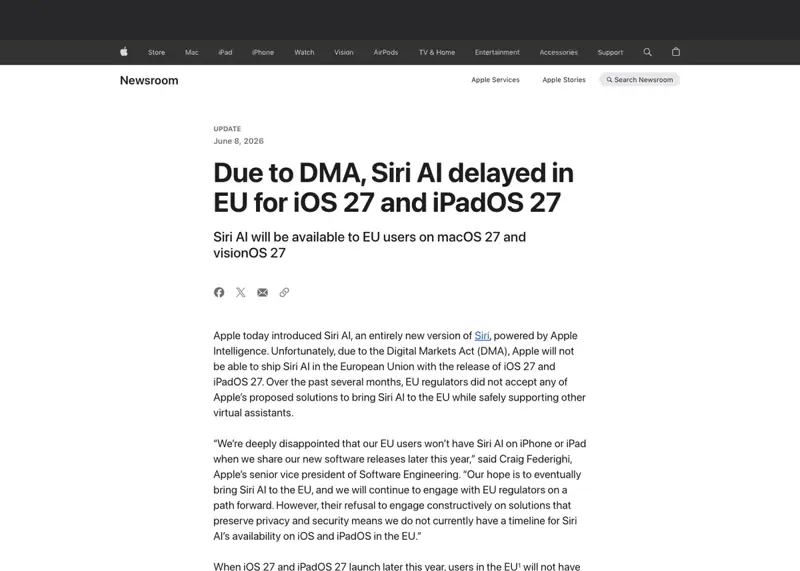
Apple’s own June 8, 2026 Newsroom post confirming the EU delay — the first official crack in the “everyone gets the same new Siri” story. Source: Apple Newsroom.
Free vs. Capped vs. Paid: The Actual Breakdown
Let’s start with the sentence that should be on every headline about this launch and somehow isn’t: installing iOS 27 is not the same thing as getting Siri AI.
iOS 27 itself is free and lands on anything back to the iPhone 11 and the second-generation iPhone SE. Siri AI — the conversational, agentic, screen-aware version everyone’s been waiting for — needs an iPhone 15 Pro or newer, English set as your device language, and it still comes with strings attached even once you qualify.
Layer 1: What’s free, no catch
- Classic Siri — timers, alarms, “call Mom,” on-device dictation. Unlimited, unmetered, unchanged from before. This has never touched the cap.
- Siri AI itself, at a base level — Apple isn’t charging a subscription just to unlock the conversational assistant. If your hardware and language qualify, you get it in the iOS 27 update at no extra cost.
- On-device processing — anything Apple’s local models can handle without leaving your phone doesn’t count against any limit Apple has described.
Layer 2: Free, but metered
This is the layer nobody explained clearly before today, and it’s the one that actually matters. Apple’s own September 11 launch materials say server-side Apple Intelligence features — and Siri AI is explicitly named on that list, alongside intelligent photo editing, Image Playground, and cloud-based Shortcuts actions — are “subject to daily usage limits.” Hit the limit, and Apple says the feature “may become unavailable” until a timeout resets it.
Apple’s dedicated usage-limits support page actually lists more than the Newsroom footnote does — and says even that longer list isn’t the full picture. The capped features, per Apple’s own documentation: Siri AI; Clean Up, Extend, and Spatial Reframing (the newer photo-editing tools); Image Playground; AFM 3 Cloud and AFM 3 Cloud Pro inside Shortcuts; and any third-party developer app that taps Apple’s Foundation Models through Private Cloud Compute. Apple explicitly flags this as non-exhaustive, meaning it can add features to the metered list later without warning.
Here’s what Apple has not told you, according to its own current documentation:
- The actual number. Not 20, not 50, not 200 — no figure exists in any Apple material as of this morning.
- What counts as one “use.” A single question? An entire back-and-forth thread? Each step of a multi-part agentic task, like “read my unread mail and draft three replies”?
- How long the timeout lasts, or when it resets — midnight local time, a rolling 24 hours, something else.
Apple’s language here is deliberately elastic: limits “may vary by feature, request complexity, system demand, system policies, and other factors.” That’s not a number. That’s a permission slip to change the meter whenever Apple wants.
Layer 3: The future paid tier
Apple has confirmed — twice, in two different ways — that heavier use will eventually cost money. It just hasn’t reconciled the two versions of that promise, and that gap is worth sitting with for a second.
Back in June, at WWDC, Apple’s language was present tense and generous: “Increased access is available with most iCloud+ subscription plans.” A day later, a services update sharpened it: “Most iCloud+ subscription plans offer higher daily usage limits for Apple Intelligence features.” Read that cold, and it sounds like paying for iCloud storage — something plenty of people already do — quietly buys you more Siri AI headroom, today.
Then September’s launch-week footnote shifted to future tense and vaguer: “Expanded access to such features will be available for a fee in the future.” No mention of iCloud+. No storage tier named. No price. Just an intention, dated for later.
MacObserver called this out directly on September 11, three days before launch, in a piece literally titled “Apple Has Given Two Different Answers on Paying for More Apple Intelligence.” That’s not us reading tea leaves — that’s a dated, on-record contradiction in Apple’s own materials that Apple has not walked back or clarified as of this morning.
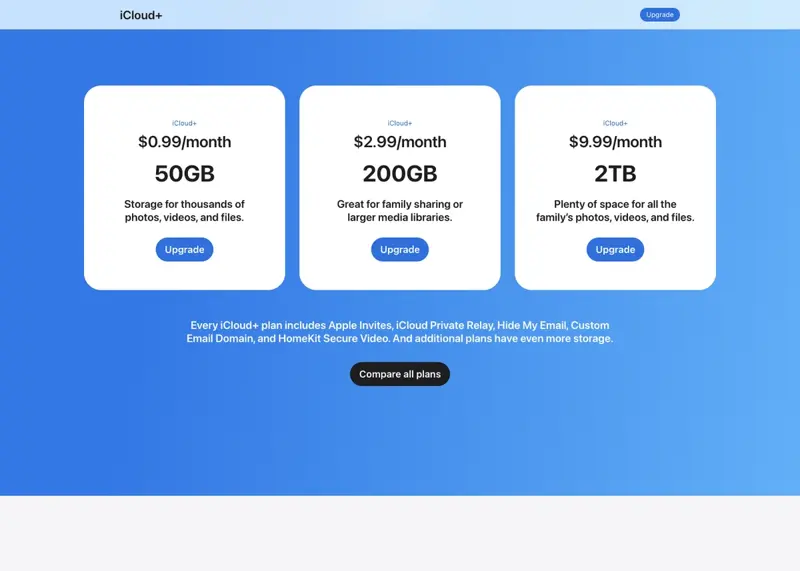
This is the entire public iCloud+ pricing page as of today. Notice what’s absent: any of these tiers being named as the one that unlocks expanded Siri AI access. Source: Apple.
Apple can name a number. It just didn’t, here.
Here’s the detail that undercuts any argument that a precise Siri AI quota is somehow technically impossible for Apple to publish: Apple already does exactly that for a different feature. Its Home-camera video-summary tool — the one that watches your security camera footage and gives you a written recap — comes with a published, storage-tier-specific limit: one camera covered on the 2TB iCloud+ plan, two cameras on 6TB, five cameras on 12TB. Exact numbers, exact tiers, no ambiguity.
That tells you the “it varies too much to quantify” framing around Siri AI is a choice, not a technical limitation. Apple knows how to write “X per Y” when it wants to. For Siri AI, as of launch day, it hasn’t wanted to.
Why not? The honest guess: running a conversational model at scale is expensive in a way running Siri’s old rules-based system never was, and Apple genuinely doesn’t yet know its own real-world usage curve on day one of a global launch. Publish a generous number now, and you might have to walk it back once millions of people start hammering the servers simultaneously — a worse look than staying vague from the start. Publish a stingy number, and you undercut the “it just works” pitch that sold the whole feature. Staying quiet lets Apple watch actual demand for a few weeks and set the real number, and the real price, once it knows what it’s actually paying for.
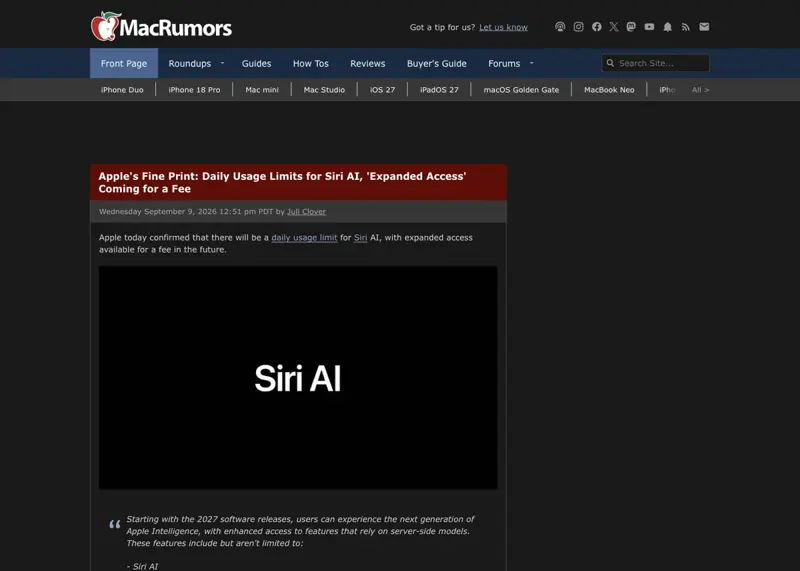
MacRumors broke the “for a fee” language five days before launch. Notice what’s missing even here: an actual number. Source: MacRumors.
A worked example: the Mail-summary test
Say you’re a heavy user. Every morning, you ask Siri AI to summarize your unread Mail and draft replies to the three that need answers. Here’s what that actually looks like across a month, based on everything Apple has and hasn’t disclosed.
Day 1: You ask Siri AI to read your inbox and draft replies. It works. It’s genuinely good — screen-aware, remembers you asked about a project an hour ago, doesn’t need you to repeat context. No warning, no meter, no friction.
Day 5: Still working. You’ve started leaning on it for more — drafting a Notes outline, asking it to cross-reference a calendar conflict. Nothing has told you how close you are to anything, because Apple hasn’t published anything to be close to.
Day 15 (hypothetical, based on Apple’s own language): If you’re a genuinely heavy user hitting Siri AI dozens of times a day for complex, multi-step requests — the “request complexity” Apple flags as a factor — you may hit a wall mid-morning. The feature pauses. Apple’s support page says it becomes available again “after a timeout”; it does not say how long that is.
Day 30: You’re still on the free tier. You’ve hit the cap more than once. Apple has, by now, either announced pricing for expanded access — or it hasn’t, and you’re stuck guessing whether upgrading your iCloud+ plan does anything at all, because Apple’s June and September statements still haven’t been reconciled.
That’s not a hypothetical edge case. That’s the default experience Apple has designed, on its own admission, for anyone who actually uses the thing they were promised.
Free vs. Paid vs. Blocked: The Full Table
Here’s the comparison every other piece on this topic is missing — built entirely from Apple’s own June, July, and September dated statements, not inference.
| Status | Source detail | |
|---|---|---|
| Classic Siri (timers, calls, dictation) | Free, unlimited | Unchanged, not on the metered list |
| Siri AI base access | Free (beta) | No separate purchase price; included in iOS 27 on eligible hardware |
| Siri AI heavy/complex use | Free, but capped | Daily limits apply; no published number; resets after an unspecified timeout |
| Expanded Siri AI access | Unreleased paid tier | “Available for a fee in the future” — no price, date, or plan named (Sept 9–11) |
| iCloud+ 50GB | $0.99/mo | No confirmed Siri AI entitlement tied to this tier |
| iCloud+ 200GB | $2.99/mo | June language implies “most” plans raise limits — this tier not named specifically |
| iCloud+ 2TB | $9.99/mo | Same — implied, not confirmed, by Apple |
| iCloud+ 6TB / 12TB | $29.99 / $59.99/mo | Same caveat; Apple has never published a Siri-specific tier matrix |
| iPhone 15 Pro / Pro Max and newer | Full Siri AI eligible | A17 Pro is the hardware floor Apple has set |
| iPhone 15, 15 Plus, and all 14/13/12/11 models | iOS 27 yes, Siri AI no | These get the update but stay locked out of the AI layer entirely |
| EU (iPhone/iPad/Apple Watch) | Blocked at launch | Apple cites DMA; no timeline given as of Sept 14 |
| EU (Mac, Vision Pro) | Available | Apple says macOS 27 and visionOS 27 are unaffected by the EU restriction |
| Non-English languages (FR, JA, KO, PT, ES) | Coming October 2026 | No exact date; does not override the EU block for French or Portuguese speakers in the EU |
The EU Standoff, in More Detail
If you’ve only seen “Siri AI isn’t available in the EU” as a one-line footnote, here’s the actual dispute, because the two sides tell genuinely different stories and both versions are worth knowing before you decide who’s right.
Apple’s account, published June 8: the company says it spent “several months” trying to get EU regulators to accept a proposal it calls Trusted System Agent — a kind of middleman layer that would let rival voice assistants get the same deep system access Siri AI has (reading messages, taking actions across apps) without Apple handing over that access directly and, in Apple’s view, unsafely. Apple says it offered to roll this out gradually over 18 months alongside Siri AI’s EU launch, and that the European Commission rejected every version of the plan.
The European Commission’s account, delivered June 9 through spokesperson Thomas Regnier: Apple’s framing is backwards. Commission officials characterized what Apple actually proposed as an exemption request, not a genuine compliant architecture — and said discussions around Trusted System Agent were, in their telling, thin on concrete technical detail rather than a fully-built solution regulators simply refused to look at.
Neither side has published documentation that settles this cleanly. What’s not in dispute: as of September 14, Siri AI does not run on iPhone, iPad, or Apple Watch inside the EU, with no announced date for that to change. Apple says the block doesn’t extend to macOS 27 or visionOS 27 — if you’re in the EU with a Mac or Vision Pro, Siri AI works there today, subject to the same hardware and language requirements as everywhere else. It’s specifically the phone-and-tablet experience that’s frozen.
One more wrinkle worth knowing: October’s language expansion doesn’t touch this at all. When French and Spanish support ship next month, that unlocks Siri AI for French and Spanish speakers outside the EU — Canada, Latin America, and similar markets. A French speaker in France, or a Spanish speaker in Spain, stays locked out regardless of language, because the restriction is about the EU as a regulatory region, not about which language you speak.
What Launch Day Actually Looked Like
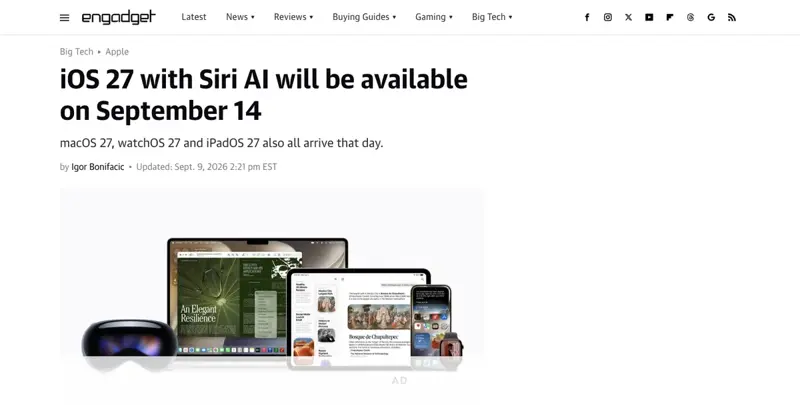
The launch is real and it’s today — but “iOS 27 shipped” and “Siri AI works on your phone” turn out to be two very different claims, as this piece breaks down. Source: Engadget.
We spent this morning watching how people are actually reacting as iOS 27 rolls out, and the mood is more resigned than angry — which tells you something about how these launches have trained everyone by now.
The most common reaction isn’t about price at all. It’s the realization that “iOS 27” and “the new Siri” are two different products wearing the same name. One post that captured it well put the hardware split like this: the update installs on everything back to the iPhone 11, but Siri AI “is the half that stops at the 15 Pro” — so the same software update means something completely different depending on which phone you’re holding. Base iPhone 15 owners have been especially vocal, pointing out they bought into “Apple Intelligence” branding just two years ago and now watch even cosmetic changes, like Siri living in the Dynamic Island, skip their phone entirely.
On the pricing question specifically, the sentiment is closer to weary recognition than outrage. Plenty of people have already clocked that Apple’s September footnote — daily caps now, an unpriced fee later — reads as the exact same playbook OpenAI and others have run this year: ship something impressive for free, then meter it once people are hooked. Nobody we found treats that as shocking anymore. A few called it out almost approvingly, in a “well, at least they’re honest about it” way, while noting that “honest” still means zero actual numbers.
The language rollout is generating its own small pocket of confusion, mostly among non-English speakers trying to figure out if switching their device language is worth the tradeoff. French-speaking users in particular have been untangling a specific wrinkle: French support technically arrives in October, but Siri AI still won’t work on iPhones in France itself because of the EU block — meaning a French speaker in Montreal gets a materially different experience than a French speaker in Paris, on the same date, for the same language. Japanese and Korean users have been sharing similar notes, with more than one joking that their language always seems to land in the “and everyone else” bucket after English ships first.
And notably, in the hours since launch, nobody has posted anything resembling a complete free-vs-paid explainer. The discussion is scattered across dozens of individual observations — the cap exists, the fee is coming, the hardware line is real — with no single place pulling it together. That gap is exactly why this piece exists.
What This Means for You
If you have an iPhone 15 Pro or newer: You’re in. Set your language to English, install iOS 27, and Siri AI should be live. Use it for real work for a week before you decide whether you’ll eventually pay for more — you genuinely might not need to.
If you have a base iPhone 15, 15 Plus, or anything from the 14, 13, 12, or 11 lineup: iOS 27 installs fine on your phone. Siri AI does not — full stop, regardless of what marketing implied when you bought that iPhone in the name of “Apple Intelligence.” If the new Siri was your reason to upgrade, you’re looking at an iPhone 15 Pro or newer, not a software update.
If you’re a heavy Siri user (dictating long notes, running multi-step tasks daily): Assume you’ll hit the daily cap at some point, because Apple has told you outright that “request complexity” affects the limit. Have a fallback plan — Notes’ built-in dictation, or a separate app like ChatGPT or Claude — for when Siri AI goes quiet mid-task.
If you’re weighing whether to buy iCloud+ storage right now specifically for Siri AI: Don’t, yet. Apple’s June statement implied “most” plans raise your limits, but never named a tier, and September’s language dropped the iCloud+ connection entirely. Buy storage if you need storage. Don’t buy it as a Siri AI bet until Apple actually prices the fee it’s promised.
If you’re in the EU: Siri AI is not coming to your iPhone or iPad today, and Apple has given no timeline. If you own a Mac or Vision Pro, you’ll get it there. If you’re desperate to test it on iPhone, some EU users are switching their region/language settings to a non-EU account — which technically works but violates Apple’s terms and can cause other App Store issues, so weigh that before you try it.
If English isn’t your primary language: French, Japanese, Korean, Portuguese, and Spanish are coming “in October,” per Apple’s September 9 announcement — with no exact date. Community reports already show confusion here: French speakers in Canada are expected to get Siri AI in French before French speakers in France do, because the EU block applies regardless of language. Set your device language to English now if you want to try Siri AI before your language ships, but know you’ll lose contextual awareness of anything written in your own language in Mail, Messages, and Notes.
If you don’t have an eligible iPhone and don’t plan to upgrade: You’re not missing a subscription — you’re missing a chip. No amount of iCloud+ spending unlocks Siri AI on an A16 or older processor. That’s a hardware wall, not a paywall.
If you’re considering buying an iPhone 15 Pro (used or refurbished) specifically to get Siri AI: It’s a defensible move — the A17 Pro is the actual floor Apple has set, and a used 15 Pro is meaningfully cheaper than the newer lineup. Just go in knowing you’re buying into the free-but-metered beta, not a finished product: the daily cap is real, the reset timing is undocumented, and the eventual fee for heavier use hasn’t been priced. Budget for the phone, not for a subscription you can’t yet estimate the cost of.
Edge Cases and Troubleshooting
“Siri AI is greyed out and I have an iPhone 15.” Check whether it’s the Pro or Pro Max. The base iPhone 15 and 15 Plus use a different chip (A16) than the Pro models (A17 Pro), and Apple draws the Siri AI line exactly there. This is the single most common point of confusion in early reports — Apple sold all iPhone 15 models under one “Apple Intelligence” marketing umbrella, and only half of them actually qualify.
“I set my language to English but Siri still won’t do the new stuff.” Make sure it’s both your Siri language and your device language — some users report partial functionality when only one is switched. A full restart after changing both settings has resolved this for several early testers.
“I hit some kind of limit and now Siri feels broken.” That’s very likely the daily cap. Apple says the affected feature becomes available again after a timeout; it hasn’t said how long. If it’s been more than 24 hours and nothing’s changed, that’s worth a report to Apple Support, since even Apple’s own documentation implies a reset should happen on some cycle.
“My iPhone 15 (not Pro) still can’t access Siri AI’s new look, either.” Correct, and it’s a separate annoyance from the AI features. Base iPhone 15 owners have flagged that even cosmetic changes — like Siri living in the Dynamic Island — didn’t come to non-Pro 15 models, on top of missing the AI layer entirely.
“I’m in France and switched my region to get Siri AI in French — now something else is broken.” Region-switching for AI features is a known workaround with real side effects: payment methods, subscriptions, and App Store availability can all shift with your region. If you go this route, understand you’re trading one problem for a different one, not solving it cleanly.
“Does asking Siri to set a timer count against my daily limit?” Almost certainly not, based on Apple’s own framing — it groups the capped features under “server-side models,” and basic commands like timers and alarms have always run on-device. But Apple has not published a definitive list of exactly which actions do and don’t count, so treat this as an educated read of the documentation, not a guarantee.
“I updated to iOS 27 and Siri AI isn’t there at all, even though I have a 15 Pro.” Give it time. Beta rollouts for AI features have historically staggered by region and account even on qualifying hardware. Check Settings for a pending Siri AI setup prompt before assuming something’s wrong.
“My data is all in German (or Japanese, or Portuguese) — does switching my device to English actually help?” Only partially, and this is a real limitation worth knowing before you try it. Siri AI’s contextual awareness depends on reading your Mail, Messages, and Notes — if that content is in a language Siri AI doesn’t yet support, setting your device to English gets you the conversational shell without the full contextual payoff.
What It Can’t Do
It can’t tell you the actual daily limit. Not because we couldn’t find it — because Apple has not published one, anywhere, as of this morning. Every number you see online right now is a guess.
It can’t guarantee your iCloud+ plan does anything for Siri AI. June implied it does. September dropped the mention entirely. Until Apple reconciles that, paying for more storage is not a confirmed way to get more Siri AI access.
It can’t reach EU users on iPhone or iPad, regardless of language settings, subscription level, or patience — that’s a platform-level block tied to the DMA dispute, not a feature toggle.
It can’t work in your language yet unless that language is English, even if you’re one of the hundreds of millions of French, Spanish, Portuguese, Japanese, or Korean speakers Apple named as “coming in October.”
It can’t run on last year’s non-Pro iPhone, no matter how new that phone is relative to Apple’s own AI-hardware marketing. The line is the A17 Pro chip, not the calendar year you bought your phone.
Frequently Asked Questions
Do I have to pay for Siri on my iPhone? No — not right now. Basic Siri AI is included free with iOS 27 on eligible hardware. Apple has confirmed a paid tier for expanded access is coming, but hasn’t announced pricing, a launch date, or which plan it will require.
Is Apple going to start charging for Siri? For heavy use, eventually yes — Apple has said expanded access “will be available for a fee in the future.” For normal, everyday use within the daily cap, no charge has been announced.
What’s the daily usage limit for Siri AI? Apple hasn’t published a number. It says limits vary by feature, request complexity, system demand, and Apple’s own policies — language broad enough to mean the limit could change without notice.
Does buying more iCloud storage give me more Siri AI access? Maybe, based on Apple’s June statements — but Apple’s September launch materials didn’t repeat that connection, and no specific storage tier has ever been named as the Siri AI unlock. Don’t buy iCloud+ storage assuming it solves this until Apple confirms it in writing.
Which iPhones actually get the new Siri? iPhone 15 Pro, 15 Pro Max, and everything Apple has released since (16 series, 17 series, 18 Pro). The standard iPhone 15 and 15 Plus, along with every iPhone 14, 13, 12, and 11 model, get iOS 27 but not Siri AI.
Why doesn’t Siri AI work in the EU? Apple says EU regulators wouldn’t accept its proposed way of giving competing assistants the same system access Siri AI has, without weakening privacy protections Apple considers essential. The European Commission disputes Apple’s framing, saying Apple sought an exemption rather than a compliant solution. Both sides have made public statements; neither has published a fix or a timeline as of today.
When will Siri AI support my language? French, Japanese, Korean, Portuguese, and Spanish are scheduled for October 2026, per Apple’s September 9 announcement — no exact date given. If you’re in the EU, language support won’t unlock Siri AI on iPhone or iPad regardless, since the DMA block applies separately.
Can I just switch my region to get Siri AI early? Some users are doing this, and it can work — but it also carries real side effects for payment methods, subscriptions, and App Store content tied to your account region. Treat it as a workaround with tradeoffs, not a clean fix.
What happens when I hit the daily cap? Based on Apple’s own documentation, the affected feature becomes temporarily unavailable until a timeout resets it. Apple hasn’t specified how long that timeout lasts.
Is this actually Google Gemini running on my iPhone? Not exactly. Apple used a customized Gemini model to power server-side reasoning, run through Apple’s own Private Cloud Compute infrastructure rather than directly through Google. Your requests aren’t being handed to Google’s servers — they’re processed on Apple’s, using a model Apple licensed and adapted.
Bottom Line
The honest read of today’s launch: Apple built something genuinely better than the Siri you’re used to, gave it away for free to start, then quietly reserved the right to meter it and eventually charge for more — without telling you the number, the price, or the date any of that happens. That’s not a scandal. It’s a company being cagey about a monetization plan it hasn’t finished building yet. But it means the smartest move right now is to use Siri AI, enjoy it, and hold off on any purchase — iCloud+ upgrade included — until Apple actually names a price.
Whatever Apple eventually charges for, the underlying skill that pays off either way is knowing how to actually get useful work out of a conversational AI assistant — phrasing requests so they land in one shot, giving it the right context, knowing when to hand off to a different tool. If you want to build that skill properly instead of guessing your way through it, FindSkill’s AI Fundamentals course walks through exactly that, free to start.
Sources:
- Apple Newsroom — Due to DMA, Siri AI delayed in EU for iOS 27 and iPadOS 27 (June 8, 2026)
- Apple Newsroom — Apple Intelligence brings powerful AI capabilities into everyday experiences (June 8, 2026)
- Apple Newsroom — Apple unveils innovative features and intelligence experiences across services (June 9, 2026)
- Apple Newsroom — Apple debuts iPhone 18 Pro and iPhone 18 Pro Max (September 9, 2026)
- Apple Newsroom — Get ready to experience iPhone 18 Pro, the new Apple Watch lineup, and AirPods 5 (September 11, 2026)
- Apple Support — iCloud+ plans and pricing
- Apple Support — Learn about Apple Intelligence usage limits
- Apple Support — Apple Intelligence Usage Terms
- Apple — Apple Intelligence and Siri hardware compatibility
- Apple — iOS 27 compatibility
- MacRumors — Apple’s Fine Print: Daily Usage Limits for Siri AI, ‘Expanded Access’ Coming for a Fee (September 9, 2026)
- MacObserver — Apple Has Given Two Different Answers on Paying for More Apple Intelligence (September 11, 2026)
- Engadget — iOS 27 with Siri AI will be available on September 14
