Until this month, most US and EU developers knew Moonshot AI as the company behind “that Chinese chatbot called Kimi.” Last week, that changed.
On May 7, Moonshot closed a $2 billion funding round led by Meituan, with China Mobile and CITIC participating, valuing the company at over $20 billion. That valuation roughly doubled the $10B mark Moonshot hit in February — and quadrupled from $4.3B at the end of 2025. Annual recurring revenue went from $100M in March to $200M in April. By Bloomberg’s count, it’s the fastest funding trajectory of any Chinese AI lab.
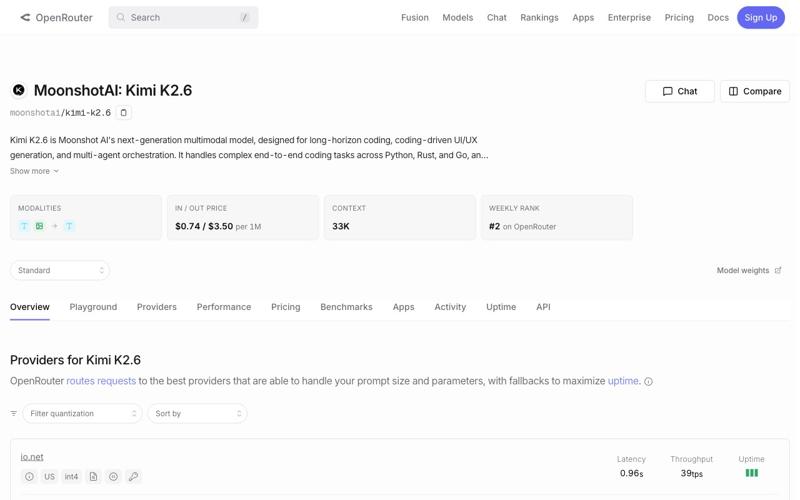
The reason is Kimi K2.6, the company’s flagship coding-focused open-weights model released in late April. It currently sits at #2 on OpenRouter by usage volume — sometimes #1 on a given day — with 1.88 trillion tokens served in its first week. Developers on X this week are publicly canceling Claude Pro and ChatGPT Pro subscriptions to switch.
If you’re a US or EU developer or business buyer who’s been ignoring Moonshot, this is the catch-up primer. What Kimi K2.6 actually does, where it wins and loses against Claude Opus 4.7 and GPT-5.5, the China-jurisdiction question that’s keeping it out of regulated industries, and whether (and how) to use it from the West.
What Kimi K2.6 is
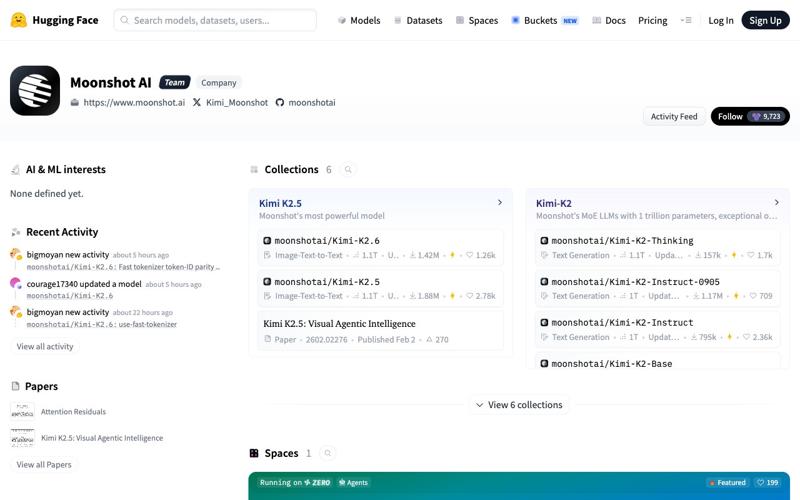
Kimi K2.6 is a 1-trillion-parameter mixture-of-experts model with a 262,000-token context window and open weights under a Modified MIT license, published to Hugging Face at moonshotai/Kimi-K2.6. It’s natively multimodal — text and image input — and optimized for what Moonshot calls “long-horizon coding”: multi-hour, multi-file, multi-tool agentic workflows of the kind that previously required Claude Code or careful Claude Cowork orchestration.
The model is API-available via Moonshot’s own Kimi API platform, the company’s hosted endpoints, and third-party hosts on OpenRouter, DeepInfra, and other inference providers. The API is OpenAI-SDK-compatible — point your existing OpenAI client at https://api.moonshot.ai/v1 and most code works unchanged.
The pricing is the headline number for cost-sensitive teams. Moonshot’s own pricing lists $0.55-$0.75 per million input tokens and $2.65-$3.50 per million output tokens (varies by tier and provider). For comparison, Claude Opus 4.7 runs roughly $5 input / $25 output, and GPT-5.5 Instant sits at about $1.25 input / $10 output. Kimi K2.6 is approximately 8-10× cheaper than Claude Opus and 3-4× cheaper than GPT-5.5 for the same workload.
Where it wins
The benchmark story for K2.6 is the reason for the OpenRouter ranking. On SWE-Bench Pro, the industry-standard agentic software-engineering benchmark, K2.6 leads at 58.6%, versus GPT-5.4’s 57.7% and Claude Opus 4.6’s 53.4%. On Terminal-Bench (a benchmark that measures real CLI-driven coding workflows), K2.6 hits 66.7%, again leading both Anthropic and OpenAI’s flagships. On HLE-tools (tool-augmented coding), it scores 54%. (Caveat: comparisons that pre-date the May 5 GPT-5.5 release reference the older GPT-5.4 numbers; full GPT-5.5 vs K2.6 head-to-head data is still being published.)
What’s behind the benchmark wins, per the Moonshot documentation and developer commentary on X this week:
- Long-horizon agentic stability. K2.6 can sustain 12-hour-plus agent sessions with thousands of tool calls without degrading. This is the failure mode Claude and GPT-5 still hit reliably — context-window erosion, instruction-drift after 500 turns, plan abandonment at the 8-hour mark.
- Agent Swarm architecture. K2.6 can launch up to 300 parallel sub-agents from a single root agent, each working on a separate decomposed sub-task. The use case is “build me a complete SaaS application” or “research and write 30 competitive intel briefs in parallel” — workflows where serial chain-of-thought hits a wall.
- Coding-driven UI/UX generation. K2.6 generates HTML/Tailwind/Next.js output that visually holds up — developer reports on X (notably @_avichawla on May 11) document one-shot generation of full websites with working interactions, where Claude and GPT typically require 3-5 follow-up prompts.
- Cost-driven viability of long-running agent runs. @ridark_eth on May 12 documented cutting a $2,550/month dev stack down to $85/month by replacing Claude API calls with K2.6 calls, with no quality regression on the coding benchmarks his team cared about.
Where it loses
Kimi K2.6 is not Claude Opus’s or GPT-5.5’s equal on every dimension. The honest gaps:
- Pure reasoning benchmarks. AIME (math), GPQA Diamond (graduate-level science), and the harder analytical reasoning evals still favor Claude Opus 4.7 and GPT-5.5. If your workflow is “verify this complex proof” or “reason through a multi-step economic argument,” K2.6 is a step behind.
- Multimodal / vision. K2.6 accepts image input but lags on the harder visual reasoning benchmarks. For workflows like “look at this chart and tell me what’s wrong with the methodology,” GPT-5.5 and Claude Opus produce noticeably stronger output.
- Creative writing and editorial judgment. Claude Opus retains the edge on prose quality, voice control, and editorial nuance. K2.6 writes correct, helpful, factual text. Claude writes text with style. For blog posts, marketing copy, and long-form essay work, this gap matters.
- English-language internationalization. K2.6’s primary training language is Chinese, with strong English secondary capabilities. The model occasionally produces subtly non-native English idioms in long outputs — fine for code comments, awkward for customer-facing English copy.
- Native English-language safety tuning. Anthropic’s investment in Constitutional AI and OpenAI’s investment in safety alignment produce more conservative refusal behavior on sensitive prompts. K2.6 is less conservative, which is sometimes useful (less false-refusal on legitimate technical questions) and sometimes risky (more willingness to produce content that may need careful review).
The China question
This is the conversation US and EU enterprises actually need to have, and it’s the reason K2.6 isn’t already #1 by usage in regulated industries.
Moonshot AI is headquartered in Beijing. Kimi’s hosted API runs on Alibaba Cloud. By law, data that touches infrastructure in mainland China is subject to the Data Security Law (DSL), the Personal Information Protection Law (PIPL), and the national-security disclosure regime. There is no equivalent of GDPR-style data-portability rights or CCPA opt-outs. For a US enterprise sending proprietary code or customer PII to Kimi’s hosted API, the legal exposure is non-trivial.
A specific recent incident sharpens the concern: prior versions of Kimi were documented to have exposed real resume data through a misconfigured retrieval pipeline. The K2.6 release supposedly addresses this, but the pattern — Chinese AI lab, data exposure incident, opaque post-mortem — is the pattern US enterprise risk teams flag every time.
The practical implications:
- For consumer-app or non-regulated dev work, the hosted Kimi API is fine. The price/performance is too good to ignore for projects that don’t involve PII, IP, or regulated workflows.
- For regulated industries (finance, healthcare, defense, government, legal), the hosted API is a non-starter. The data jurisdiction risk is too high; the procurement department will block it.
- For everything in between — startups, SMBs, internal dev tools, regulated industries’ non-sensitive workloads — the answer is self-host the open weights. K2.6’s modified MIT license permits commercial self-hosting; the model runs on 4×H100 (INT4 quantization) or 8×H100 (FP16) for production-grade inference. Cloud providers like CoreWeave, Lambda Labs, and Modal already have one-click K2.6 deployments live. Self-hosting eliminates the China-jurisdiction question entirely; the weights are open, the inference happens on infrastructure you control, and no data crosses a border.
The self-hosted path is the one US enterprise teams are quietly building toward. It’s also how K2.6 will most likely win the long game — by being the open-weights model serious developers can run wherever they want.
What this means for you
If you’re a solo developer or indie engineer, K2.6 is the highest-leverage cost optimization you can make this month. Try it via OpenRouter (no Moonshot account needed) on your next agentic-coding side project. The SWE-Bench Pro lead is real, the cost is 8-10× cheaper than Claude Opus, and you can switch back in 5 minutes if it doesn’t fit. The X consensus this week — including @akoskm on May 2 canceling his Claude Pro subscription — is that K2.6 handles 80% of coding agent workloads at 10% of the cost.
If you’re a startup CTO, the cost math is too good to leave on the table. Use K2.6 (hosted, via OpenRouter) for non-customer-data workloads — internal tooling, code review, doc generation, agentic pipelines. Keep Claude or GPT-5.5 for customer-facing inference where you need the multimodal polish and the higher editorial bar. The dual-vendor pattern is the answer; vendor-exclusivity is the wrong instinct.
If you’re an enterprise architect at a regulated firm, do not use the hosted Moonshot API. Pilot the self-hosted weights on your own infrastructure for non-customer-data internal workflows; engage your security/compliance teams about whether on-prem K2.6 can clear your DLP and IP-protection requirements. This is a real path for many firms but it’s not the casual-evaluation path.
If you’re a CIO or VP-Eng evaluating vendor consolidation, the right read on K2.6 is that the open-weights model just got good enough to genuinely threaten the closed-API vendor model. Anthropic’s response is the Managed Agents and Dreaming work; OpenAI’s response is the GPT-5.5 cost cuts. The competitive pressure works in your favor — negotiate accordingly with both Anthropic and OpenAI this quarter.
If you’re a product manager or business buyer who doesn’t write code, K2.6 is not yet a Claude Pro or ChatGPT Plus replacement for general business use. Stick with what you have for now. The model’s wins are concentrated in coding agents and multi-step automation — workflows your engineering team cares about more than your marketing team does.
If you’re a researcher or AI engineer building an agent product, K2.6’s open weights plus 262K context plus the agent-swarm architecture make it the most capable model you can fine-tune for a specific domain. The combination of “best-in-class agentic coding performance” plus “we can train this on our proprietary corpus” is a real differentiator. Several teams on X this week documented private fine-tunes of K2.6 outperforming Claude Opus on their specific evals.
What it can’t do
A few honest limits.
- It’s not a Claude Opus replacement for editorial work. The voice quality gap is real; Claude is still the prose model.
- It’s not GDPR/CCPA-compliant when used via the hosted API. Self-hosted, it’s whatever your hosting infrastructure complies with. Hosted, it’s subject to Chinese data law.
- It’s not currently English-native at the level Claude or GPT-5.5 is. Subtle English-idiom issues in long outputs are the most-reported quality regression vs the Western models.
- It’s not for vision-heavy workflows. Multimodal is supported but lags the leaders. If your product depends on parsing charts, screenshots, or complex visual data, K2.6 is not the model.
- It’s not turnkey for enterprise audit. Procurement teams at regulated firms will need a meaningful security review before approving K2.6 in any form, and the answer for the hosted API will likely be no.
- It’s not stable in the way enterprise SLAs require. The Moonshot API has had public availability gaps during peak demand windows in April and early May. For workloads that need 99.9% availability, plan for fallback to OpenRouter or self-hosted infrastructure.
The bottom line
Moonshot’s $20B valuation is not just a China story. Kimi K2.6 is genuinely the best open-weights model for agentic coding workloads as of mid-May 2026, by the benchmarks most coding-agent teams care about. The hosted API is dramatically cheaper than the Western alternatives. The open-weights path is genuinely production-viable.
The China question is real and will keep K2.6 out of regulated workloads in the West for as long as the hosted API is the only easy access path. But for the substantial middle of the market — startups, SMBs, indie developers, internal tooling teams — K2.6 is the model worth piloting this month.
If you want to go deeper on which model to pick for which workflow, our ChatGPT vs Claude course covers the model-selection framework that now needs a third column — Kimi K2.6 — for any team that builds agentic coding workflows.
Sources
- TechCrunch: China’s Moonshot AI raises $2B at $20B valuation
- Bloomberg: Kimi chatbot maker Moonshot AI valued at $20B in Meituan-led round
- Moonshot AI Kimi API platform
- Hugging Face: moonshotai/Kimi-K2.6 model card
- OpenRouter: Kimi K2.6 pricing and benchmarks
- DeepInfra: Kimi K2.6 pricing guide and deployment tradeoffs
- SiliconAngle: Open-source AI developer Moonshot AI raises $2B at $20B+ valuation
- The Next Web: Moonshot AI’s $20bn valuation seals one of China’s fastest AI funding trajectories
- CTOL Digital: Kimi’s $2B Funding and the $20B Paradox
