
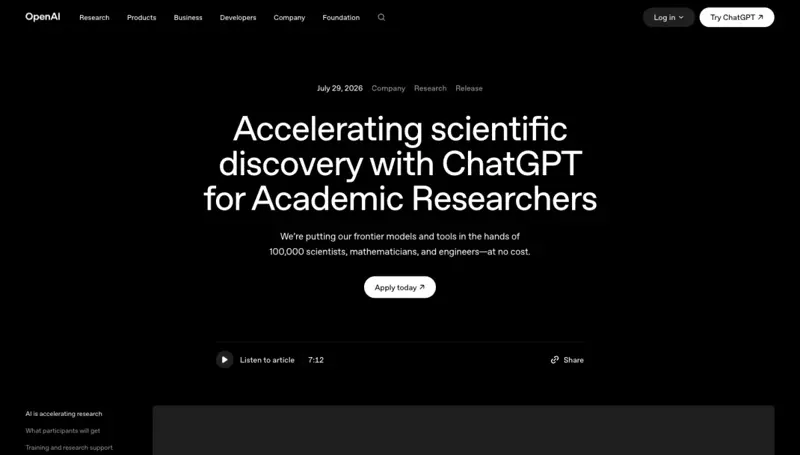
OpenAI is handing out its $200-a-month ChatGPT Pro experience for free — to scientists. The new ChatGPT for Academic Researchers program, announced July 29, starts with 10,000 researchers this summer and scales to 100,000 by the end of 2027. Each one gets a year of frontier-model access, and each can bring four colleagues along.
The catch is in the fine print: the eligibility bar is specific, the field list is short, and if you’re a grad student, an industry researcher, or at the wrong institution — or, apparently, in the wrong country — you’re not on the list. Here’s exactly who qualifies, how to apply, and the free-tier research setup that captures most of the value for the other 8.9 million researchers on Earth.

What you actually get
An approved application gets you a dedicated research workspace for 12 months (it doesn’t auto-renew), with:
- Pro-level usage limits — the equivalent of OpenAI’s $200/month ChatGPT Pro tier, without the bill
- The full GPT-5.6 model family, including GPT-5.6 Sol Pro, OpenAI’s current flagship
- Expanded Deep Research and larger context windows — the two features that matter most for literature-heavy work
- ChatGPT Work and Codex — the agentic mode and the coding assistant
- 75+ science skills and connectors — literature search, public genomic and clinical databases, satellite imagery, computational notebooks, reference managers
- Five seats total — you plus up to four collaborators from your institution, each verified separately
- Business-grade data terms — your research data isn’t used for training by default, with admin controls for retention, export, and deletion
That last point deserves a pause: it’s a better data arrangement than most academics currently have with the consumer ChatGPT they’re paying for out of pocket.
Who qualifies (read this before you get excited)
The requirements, straight from OpenAI’s application flow:
- You’re research faculty or a postdoc. Not a PhD student, not a master’s student, not a research assistant. Faculty and postdocs only.
- Your institution is a recognized, degree-granting university with high research activity. In practice: research universities of the R1/R2 flavor and elite institutes. The named launch partners are the Institute for Advanced Study in Princeton and the École normale supérieure in Paris — which tells you the tier they’re aiming at.
- You work in one of seven fields: Biological Sciences, Chemistry & Materials, Computer Science, Earth & Planetary Sciences, Engineering, Mathematics, or Physics. Social sciences, humanities, medicine-as-clinical-practice, economics — not on the list.
- You have a recent paper. An author credit on something posted to arXiv, bioRxiv, or ChemRxiv within the last three years, in an eligible field.
- Your country is on the eligible list. This one is generating real frustration: researchers in Spain report the application simply doesn’t offer their country, while colleagues in Portugal, Germany, France, Ireland, and the Netherlands can apply. Check the country dropdown before you invest time in the application.
How to apply: sign in with your institutional email at OpenAI’s academic-researchers page, verify your affiliation through SheerID, submit the paper link and a short description of how you’ll use it, and — if approved — complete a $0 checkout (a valid payment card is required, but nothing is charged). Review takes one to two weeks. Applications opened July 29; the first cohort fills this summer, so earlier is better.
The honest read: who this program is really for
The loudest reaction to the launch wasn’t gratitude — it was arithmetic. There are roughly 9 million researchers in the world; this covers about 1% of them, and disproportionately the 1% at institutions that already have compute budgets and enterprise deals. The postdoc at a well-funded R1 gets a free upgrade; the lecturer at a teaching college, the PhD student doing the actual bench work, and the scientist publishing from a university that doesn’t clear the “high research activity” bar get nothing new.
OpenAI, for its part, frames the program as one piece of a $250M+ commitment to external science through 2027. Both things can be true: it’s a genuinely valuable subsidy for the researchers who get it, and it’s aimed at the top of a pyramid most researchers aren’t standing on. The good news is that the gap between the free program and what anyone can do today is smaller than the $200/month price tag implies.
Didn’t qualify? The free-tier research workflow
Most of what makes AI useful for research doesn’t need Sol Pro. It needs good habits. Here’s the setup that gets a grad student or unfunded researcher 80% of the way, on tools that cost nothing:
1. Use Deep Research sparingly but deliberately. Free ChatGPT includes a small monthly allowance of Deep Research runs (and Gemini and Perplexity have free equivalents). Don’t spend them on “summarize this field” — spend them on the specific question blocking you: “What methods have been used since 2023 to measure X in Y conditions, with citations.”
2. Upload-and-interrogate beats search. The most reliable research use of any free AI tier: upload the actual paper PDF and ask pointed questions. “What’s the sample size and how was it justified?” “List every assumption in the methods section.” “What would a hostile reviewer attack first?” The AI is dramatically more trustworthy when the source is in front of it.
3. Make it your methods critic, not your author. The failure mode that gets people in trouble is asking AI to write the paper. The high-value, low-risk use is the opposite direction: paste your abstract and ask “what claims here aren’t supported by what I’ve described?” — a tireless, ego-free reviewer before the real ones arrive.
4. Verify every citation. Every one. AI-invented references remain the field’s most embarrassing failure, and “the chatbot said so” has now appeared in real retractions. The rule: any citation an AI gives you gets confirmed to exist — on Google Scholar or the publisher’s site — before it enters your draft. No exceptions, no matter which tier you’re on.
5. Check your library first. Many universities now have institutional AI deals (often Gemini or Copilot through campus agreements) that faculty and students simply don’t know about. One email to your librarian may be worth more than this entire program.
What this can’t do
It can’t do the science. Expanded Deep Research is a literature accelerant, not a lab. The program’s own framing — accelerating discovery — still puts the discovering on you.
It doesn’t cover the people doing most of the work. Grad students run academia’s engine room and are explicitly outside the eligibility line, unless a PI spends one of four collaborator seats on them. PIs: that’s exactly what the seats are for.
Twelve months is a research-cycle problem. The workspace expires and doesn’t auto-renew. If your workflow comes to depend on Pro-tier limits, budget for the cliff — or treat the year as a grant-funded experiment with an end date, because that’s what it is.
It’s one company’s ecosystem. A generation of scientists doing their literature work inside one vendor’s workspace is a dependency worth noticing, especially while the models’ weights stay closed. Take the free year; keep your methods portable.
Approval isn’t guaranteed. Meeting the criteria makes you eligible, not accepted — the summer cohort is 10,000 seats and the review is human. Apply early, be specific about your research use, and have a plan B (see the workflow above — it is the plan B).
The bottom line
If you’re eligible, this is the easiest $2,400-a-year decision in academia: apply this week, bring your four collaborators, and enjoy better data terms than your paid consumer account ever had. If you’re not eligible, you’re in the majority — and the majority’s toolkit is better than the headline suggests: upload-and-interrogate, spend Deep Research runs on blocking questions, verify every citation, and ask your librarian what’s already free.
Either way, the skill that separates researchers who benefit from AI from those who get burned by it is the same: knowing exactly what to trust and what to check. Our AI Fundamentals course builds that judgment from the ground up — first two lessons free, no eligibility requirements at all.
Sources
- OpenAI — Accelerating scientific discovery with ChatGPT for Academic Researchers
- OpenAI Help — ChatGPT for Academic Researchers: eligibility and application
- Axios — OpenAI launches free AI access program for academic researchers
- Engadget — OpenAI will provide free AI models to select researchers
- TechTimes — OpenAI Launches Free AI Access for Scientists: Apply Now
- Dataconomy — OpenAI Launches Free ChatGPT Research Program For 100,000 Scientists