

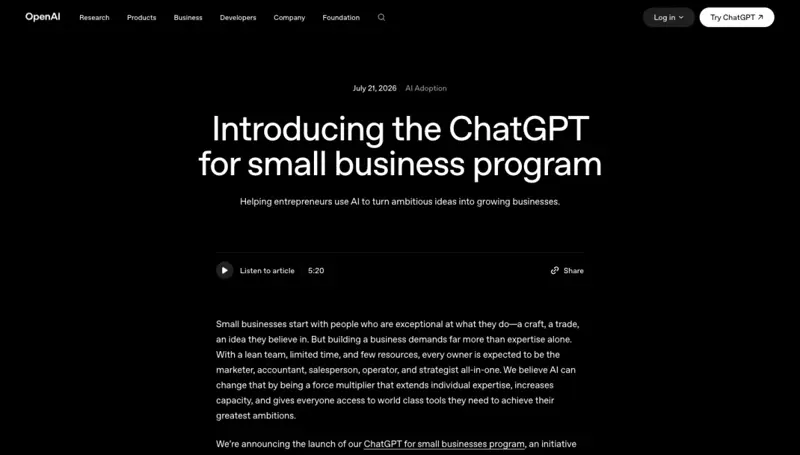
OpenAI has decided small businesses are the next frontier, and on July 21 it launched a whole program to prove it: free webinars, in-person “AI academies” around the US, starter guides, and partner plugins from Shopify, Intuit, Dropbox, Slack, Atlassian, and Wix. If you run a small business and you’ve been meaning to “figure out this AI thing,” someone just built you an on-ramp.
Here’s the thing, though. You don’t need to wait for a webinar seat to get the value. The workflows OpenAI is teaching are already doable today, in the ChatGPT you already have — free tier included. Below: what’s actually in the program, what’s genuinely free versus what’s an upsell, and the five workflows worth copying this week, prompts included.
What just launched (and what it costs)
The ChatGPT for Small Business program bundles four things:
- Free virtual webinars — product demos of ChatGPT Work for day-to-day small business use: accounting, marketing, and ecommerce workflows, with prompts to try and partner Q&As.
- In-person OpenAI Academy events — live training sessions running in cities across the US.
- Starter guides — customer stories, short videos, and interactive guides you can load straight into ChatGPT.
- Partner plugins and offers — integrations from Dropbox (files), Shopify (ecommerce), Intuit/QuickBooks (accounting), Slack (team chat), Atlassian (projects), and Wix (websites), plus assorted discounts.
The engine underneath is ChatGPT Work, OpenAI’s more agentic mode that can carry a multi-step task — take messy notes and produce a finished document, monitor something and report back — powered by the new GPT-5.6 models.
The honest cost breakdown: the education is free — webinars, academy events, guides, all of it. The business workspace it’s designed to funnel you toward is not: ChatGPT Business runs $25 per user per month (or $20 on annual billing) with a two-seat minimum. And the impressive stats in the launch — “78% of attendees built a working AI workflow in a day,” “42% saved five-plus hours a week” — come from OpenAI’s own earlier workshops, not independent research. Real signal, but graded by the teacher.
None of that makes the program bad. It makes it a well-funded free class with a gift shop at the exit. Take the class, know where the gift shop is.
The 5 workflows worth stealing (no webinar required)
These are the same categories the program teaches — accounting, marketing, ecommerce, operations, customer communication — as copy-paste prompts. They work in free ChatGPT, and most work identically in Claude or Gemini.
1. The weekly money check-in (accounting)
The workflow one program attendee reportedly used to save 10 hours of data entry on a single 30-page contractor quote — generalized:
I run a [type] business. Here's this week's financial data:
[paste from your bank export, invoices, or QuickBooks export].
1. Summarize money in vs money out, and the 3 biggest line items.
2. Flag anything unusual vs a typical week and any invoice older
   than 30 days I should chase.
3. Draft the polite payment-reminder email for each overdue one.
Show which rows you used, so I can double-check.
2. The content week in one sitting (marketing)
My business: [one sentence]. My customers: [who]. This month's
focus: [product/offer/season].
Create a 2-week content plan: 6 short posts (mix of tips, behind-
the-scenes, and one soft promotion), each with a first line that
works on [Facebook/Instagram/LinkedIn], and one email to my list.
Match this voice: [paste a paragraph you've written].
Nothing generic — every post must mention something specific to
my business.
3. The listing that answers questions before they’re asked (ecommerce)
If you sell on Shopify or anywhere online — this is the one where the “everyone uses the same AI” problem is real. The fix is feeding it what only you have:
Here are 5 real customer questions/reviews about my product:
[paste them]. Here's my current product description: [paste].
Rewrite the description so it answers the top questions
customers actually ask, keeps my voice, and includes a specs
section. Then write the 3 FAQ entries I should add below it.
Same tool as your competitors, different input. The input is the moat.
4. The meeting that writes its own follow-up (operations)
Here are my rough notes from today's [team meeting / client
call]: [paste]. Produce:
1. A clean summary in 5 bullets.
2. The action list — who does what, by when — as a table.
3. The follow-up email to [person], friendly but clear about
   the two decisions we need from them this week.
5. The complaint that becomes a customer for life (support)
A customer wrote this: [paste the complaint or review].
Context: [what actually happened, and what you're willing to
offer]. Draft a reply that: takes responsibility without
groveling, fixes the specific problem, offers [your remedy],
and sounds like a human who cares — not a corporation. Under
120 words. Then suggest one change to my process so this
doesn't happen again.
What this means for you
If you’re a solo operator: Skip the webinar queue, run the five prompts above on your real work this week. If two of them stick as habits, then browse the program’s guides for what to automate next. Education is worth more after you’ve hit a real wall.
If you have a small team (2–10 people): The academy events are genuinely worth a look — the in-person format exists because a team adopting AI together beats one enthusiast adopting it alone. Send two people, have them bring back one workflow per department. Whether you then need paid Business seats depends on one question: do you need shared workspaces and admin controls, or just five people with good habits?
If you’re a Shopify or Wix seller: The partner plugins are the most concrete part of the program for you — product data flowing directly into your AI sessions removes the copy-paste tax. Just remember the moat rule from workflow #3: when every seller in your category uses the same model, the seller feeding it real customer language wins.
If you already pay for accounting or marketing help: Nothing here fires your accountant. The pattern in the program’s own examples is drafts-and-data-entry moving to AI, judgment staying human. Your bookkeeper reviewing an AI-drafted categorization beats your bookkeeper typing it from scratch — that’s a bill that shrinks, not a relationship that ends.
If you’re skeptical of the whole thing: Fair — one X commentator summed the launch up as “training alone doesn’t build systems,” and that’s true. A webinar won’t wire AI into your operations. But the counter is that the wiring starts with one working workflow, and the five above cost you an afternoon to test. Skepticism that never runs the experiment is just a slower way to fall behind.
What this can’t fix
It can’t run your business. ChatGPT Work is genuinely more agentic, but every workflow above still ends with you reading the output before it touches a customer or a tax form. The AI drafts; the owner signs.
Free has a funnel attached. The program exists to grow paid ChatGPT Business seats. That’s not sinister — it’s Costco samples. Just don’t confuse “I attended a free academy” with “I need $25/seat/month.” Decide that on your own workload.
The stats are house numbers. “78% built a workflow” and “42% saved 5 hours” came from OpenAI’s own events, with attendees motivated enough to show up. Your mileage will be yours.
Partner offers are partner marketing. Some of the Shopify/Intuit/Wix integrations are excellent; all of them are also customer acquisition for those platforms. Evaluate each on whether it kills a real copy-paste step in your week.
It’s US-first. The in-person academies are US-based for now. The webinars, guides, and every prompt above work from anywhere.
The bottom line
The biggest AI company in the world just decided your five-person business is worth free training, which tells you where this is all heading: AI skills are becoming the small-business baseline, like having a website in 2010. Take the free education — it’s real. Skip the waiting, though: the workflows are copyable today, and the owner who tests five prompts this week learns more than the one who watches three webinars next month.
If you’d rather learn it structured — from first prompt to a full week of business workflows — our ChatGPT for Business course covers the same ground at your own pace, and the first two lessons are free. No gift shop at the exit.
Sources
- OpenAI — Introducing the ChatGPT for small business program
- Inc. — OpenAI Just Unveiled a Massive Push to Turn Small-Business Owners Into AI Power Users
- 9to5Mac — OpenAI launches small business program as it touts 10M ChatGPT Work and Codex users
- TechInformed — OpenAI adds hands-on AI support for small businesses
- OpenAI Help — ChatGPT Business pricing
- Forbes — New ChatGPT Training For Small Businesses