Forty-three resumes for one marketing coordinator role, and that’s a slow week. You’ll spend tonight sorting them into three piles by gut feel, and by resume thirty you won’t remember what was in resume four. Meanwhile, recruiters have quietly worked out how to make ChatGPT or Claude do the first sort — paste the job’s must-haves plus the stack, get a ranked shortlist with reasons in about fifteen minutes.
It works. It’s also the single easiest way to walk into a discrimination lawsuit if you do it carelessly. This post gives you both halves: the workflow and the fairness rule you can’t skip.
What’s actually happening out there
AI resume screening stopped being exotic a while ago — an estimated 99% of Fortune 500 companies already use some form of hiring automation, and the interesting shift in 2026 is downmarket: solo recruiters and small-business owners using the plain chatbot they already pay $20 a month for, instead of enterprise screening software. The playbooks circulating in recruiter communities converge on the same pattern: define a rubric, batch the resumes, force the AI to cite evidence, rank with reasons.
At the same time, the legal temperature is rising:
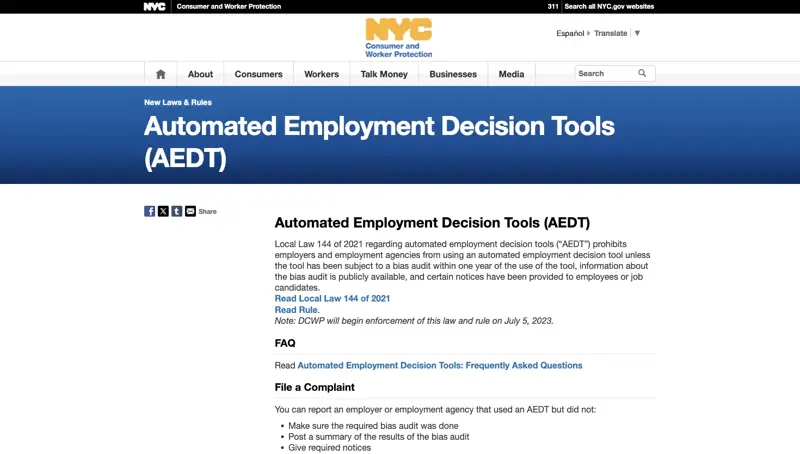
- NYC Local Law 144 requires an annual independent bias audit, a public audit summary, and 10 business days’ advance notice to candidates before an automated tool “substantially assists” a hiring decision on NYC-connected roles.
- Illinois HB 3773 (in force since January 2026) bars AI use that causes discrimination in employment decisions — intent doesn’t matter.
- Colorado’s AI Act took effect June 30, 2026, targeting algorithmic discrimination in hiring, though its final enforcement shape is still being fought over.
- The EEOC’s position under Title VII is the one that covers everyone, in every state: if your screening process disproportionately excludes protected groups, “the AI did it” is not a defense. The iTutorGroup case ended in a $365,000 settlement after software auto-rejected women 55+ and men 60+. And the Mobley lawsuit against Workday — a vendor, not just an employer — is still live as of June 2026.
So the question isn’t “can I use AI to screen resumes?” It’s “can I use it in a way I could explain to a judge?” Yes — here’s how.
The 15-minute workflow
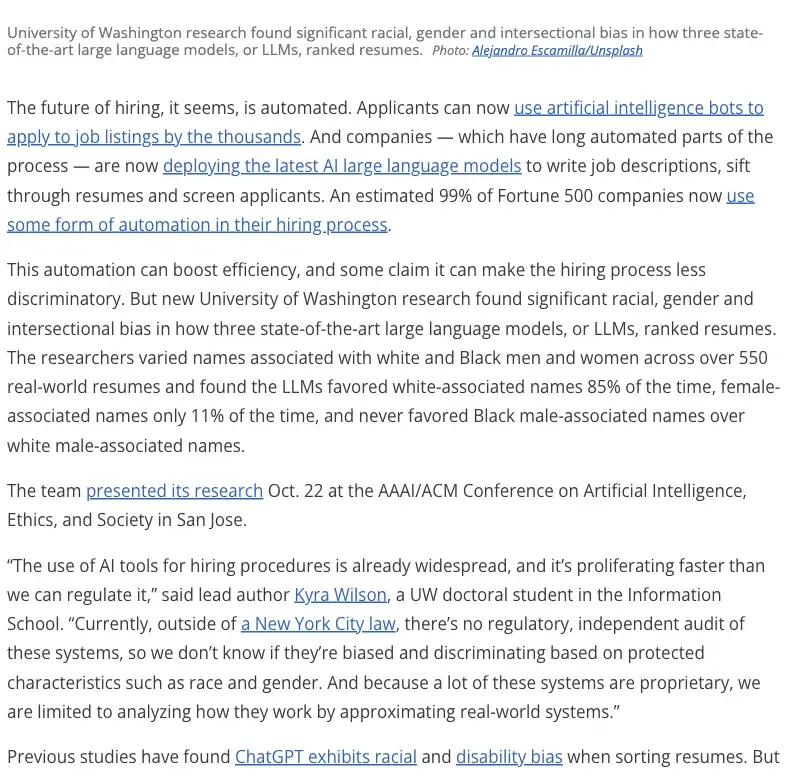
Step 0 — Redact first. Before any resume touches the chatbot, strip names, photos, addresses, birth dates, and graduation years. This isn’t paranoia; it’s evidence-driven. A University of Washington audit of AI resume screening found the models favored White-associated names 85% of the time vs. 9% for Black-associated names, and male-associated names 52% vs. 11% for female-associated. The name alone moves the ranking. Replace each name with “Candidate A/B/C” and keep your own key. (A find-and-replace in the exported PDFs-to-text takes five minutes and is the highest-value five minutes in this entire workflow.)
Step 1 — Build the rubric from the job, not from vibes. Paste the job description and ask:
“Extract the 4-6 genuinely job-related evaluation criteria from this job description. Only skills, experience, and demonstrable outcomes — no proxies like school prestige, employment gaps, or ‘culture fit.’ Suggest a percentage weight for each.”
Review the weights — you’re the recruiter, adjust them.
Step 2 — Score the stack with mandatory evidence. Paste the redacted resumes (Claude handles 20+ in one go comfortably), then:
“Score each candidate against this rubric. For every score, quote the specific resume evidence that justifies it. If there is no evidence for a criterion, write ‘No evidence found’ — do not infer or guess. Output a table: Candidate | Overall score | Per-criterion scores | Top 3 strengths | Top 2 gaps | Recommended next step (advance / hold / pass).”
The “cite evidence or say none found” line is what separates a defensible screen from an AI vibe-check. It kills most hallucinated qualifications on the spot.
Step 3 — Rank, then read the reasons, not just the order. Ask for the ranked shortlist. Then read the reasons for the top eight and the bottom five. You’re looking for two things: rankings driven by something your rubric didn’t ask for, and strong candidates penalized for non-traditional paths — career switchers, international job titles, unusual formats. These are exactly the resumes the research says AI mis-scores.
Step 4 — The human decision, on the record. No candidate is rejected by the AI. The AI produces a first-pass sort; you make every advance/reject call and note your confirmation or override. Save the whole packet — job description, rubric, exact prompt, model used, output, your decisions. That audit trail is what “we used AI responsibly” looks like when someone asks.
What this means for you
If you’re a solo or agency recruiter: this hands you back your evenings on high-volume roles. Do the redaction step even when nobody’s watching — especially when nobody’s watching. Your clients’ legal exposure is your reputation.
If you’re a small-business owner who hires twice a year: you’re the biggest winner here, because you have no ATS and no HR department — and also the person most likely to accidentally break a law you’ve never heard of. Use the four steps exactly as written, and check whether your state (or the candidate’s) has notice requirements before you screen. Our AI for HR: Legal & Safe course covers the disclosure side in plain English.
If you’re in-house HR at a company with NYC/Colorado/Illinois exposure: a chatbot screen that “substantially assists” decisions can qualify as an automated employment decision tool under LL144 — which triggers the bias-audit and notice machinery. Talk to counsel before making this a standing process, and read our breakdown of the AI resume screening disclosure laws.
If you’re worried candidates are gaming you: they are — most serious applicants now AI-polish their resumes, which is exactly why keyword matching is dead and the evidence-citation rubric matters. For the flip side of this arms race, see how to spot AI-written resumes.
What this can’t do
- It can’t make the final call — legally or practically. Every framework above assumes meaningful human review. “AI ranks, human decides” isn’t a slogan; it’s the compliance line.
- It doesn’t remove bias — it relocates it. Redaction and rubrics reduce the measured name effects, but research from 2025 found implicit bias (like educational-background preference) persists even in newer models. The rubric keeps you honest only if the criteria are genuinely job-related.
- It will miss great candidates who present unusually. Career changers, veterans translating military roles, immigrants with unfamiliar employer names — the models systematically underrate them. That’s why you read the bottom of the ranking, not just the top.
- It can’t verify anything. A confident score built on a fabricated credential is still fabricated. Reference checks and skills assessments live downstream, unchanged.
- A chatbot is not a compliant system of record. If you’re screening at real volume in regulated jurisdictions, you’ll eventually need proper tooling with audit support — the chatbot workflow is the on-ramp, not the destination.
The bottom line
The recruiters winning in 2026 aren’t the ones avoiding AI or the ones letting it run unsupervised — they’re the ones who turned it into a fast, documented first pass with a human firmly holding the reject button. Fifteen minutes to a ranked shortlist, five minutes of redaction to make it fair, one saved audit trail to make it defensible.
If hiring is part of your job, our HR & Recruiting with AI course builds the full workflow — screening, interview design, and the legal guardrails — and the first two lessons are free.
Sources
- University of Washington — AI tools show biases in ranking job applicants’ names by race and gender
- HR Dive — Workday can’t shake California AI discrimination claims (Mobley, Jun 2026)
- EEOC — iTutorGroup to pay $365,000 to settle EEOC discriminatory hiring suit
- NYC DCWP — Automated Employment Decision Tools (Local Law 144)
- ClearanceJobs — States requiring disclosure of AI use in hiring and recruiting (Jun 2026)
- NAACL 2025 — Evaluating Bias in LLMs for Job-Resume Matching: Gender, Race, and Education
