

On August 20, 2026, Anthropic quietly turned its internal employee-training program into a public website. Claude Academy went live at academy.claude.com — no credit card, no email required to browse — and within a day the launch post from @claudeai had racked up almost 35,000 likes and 8 million views. That’s a big number for a corporate training announcement. It’s an even bigger number when you notice who’s reacting: not just developers, but Spanish, Korean, Japanese, and Turkish accounts sharing course breakdowns nobody asked them to write, the kind of organic enthusiasm you can’t buy with an ad budget.
If you’ve been meaning to “finally learn AI properly” and kept putting it off because every option looked either too basic or too technical, this is worth five minutes of your attention. Not because it’s flawless — it isn’t — but because it’s genuinely free, genuinely comprehensive, and it just got a lot bigger than the version that existed in March.
What Claude Academy Actually Is
Claude Academy is a rebrand and major expansion of “Anthropic Academy,” the company’s original training hub that launched quietly back in March 2026. That first version lived on a third-party platform called Skilljar (anthropic.skilljar.com), required an email signup, and offered roughly 13 courses split across three tracks: a no-code “AI Fluency” track, a developer-focused API track, and a cloud-platform track.
The new version is a different animal. According to Anthropic’s own announcement post, Claude Academy now lives natively at academy.claude.com, needs no account at all to browse, and has grown to more than 289 individual resources — full courses, short tutorials, and role-specific “use case” walkthroughs. It’s also live in multiple languages, including a fully localized Japanese landing page, according to Japanese tech outlet Gigazine’s coverage of the launch.
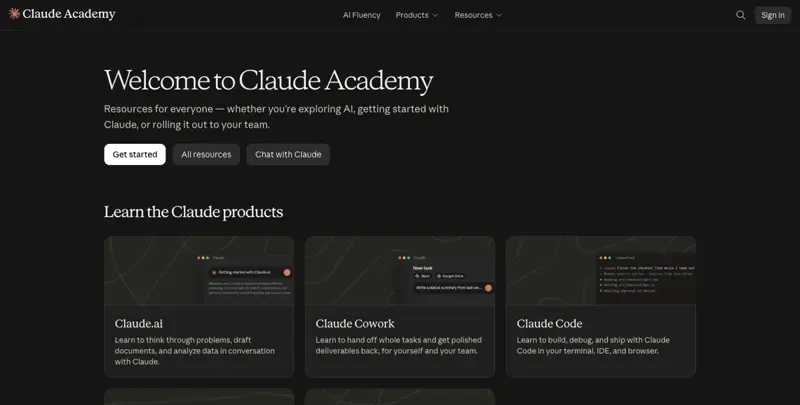
Anthropic frames the whole thing as an extension of how it trains its own staff. New employees at Anthropic learn a specific framework on day one, then keep learning it through what the company calls “ever-boarding” — continuous, on-the-job reinforcement rather than a one-time orientation. Claude Academy is that same internal curriculum, opened up to anyone who wants it.
The 4D Framework, in Plain English
Everything on Claude Academy is organized around something Anthropic calls the “4D AI Fluency Framework”: Delegation, Description, Discernment, and Diligence. It sounds like corporate jargon until you see it broken into two simple feedback loops:
- The big-picture loop (Delegation ↔ Diligence): should you even use AI for this task, and are you taking responsibility for the result?
- The moment-to-moment loop (Description ↔ Discernment): are you explaining what you want clearly, and are you actually checking whether what you got back is any good?
Here’s what each “D” looks like with a real example, pulled from the framework’s own course content:
- Delegation — deciding what work goes to the AI and what stays with you. Anthropic’s own example: a nonprofit worker who has Claude draft the outline of a grant report but keeps the actual donor-relationship judgment calls for themselves.
- Description — communicating your goal clearly enough that the AI can actually help. The course teaches a “Description Chain” that walks you from a vague need (“help me with this email”) to a precise instruction Claude can act on.
- Discernment — critically evaluating what the AI gives you back, instead of accepting it at face value. One exercise has learners judge AI output across five separate lenses: correctness, quality, fit, experience, and responsibility.
- Diligence — owning what you do with the AI’s output. The plain-English version: if a memo or analysis is substantially AI-written, you say so before you send it.
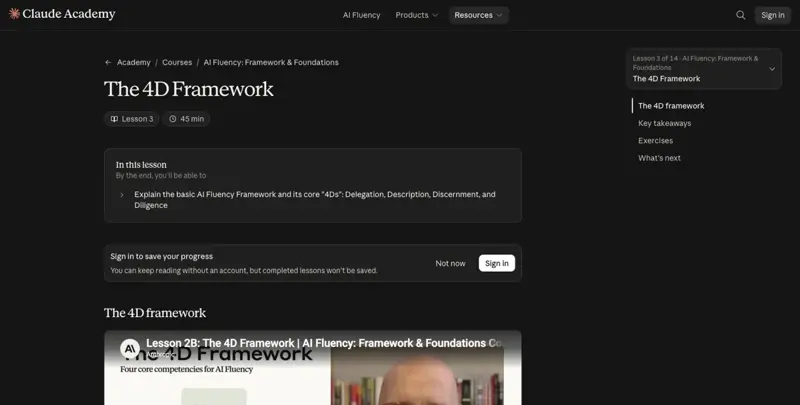
Worth knowing: the 4D framework wasn’t invented by Anthropic’s marketing team. It was developed by two academics — Rick Dakan at Ringling College of Art and Design and Joseph Feller at University College Cork — through research on how AI tools were changing creative and business work. Anthropic licensed and commercialized it under a Creative Commons license, then built its entire employee-onboarding program and now this public academy around it.
What’s Actually Inside (The Course Catalog, With Real Numbers)
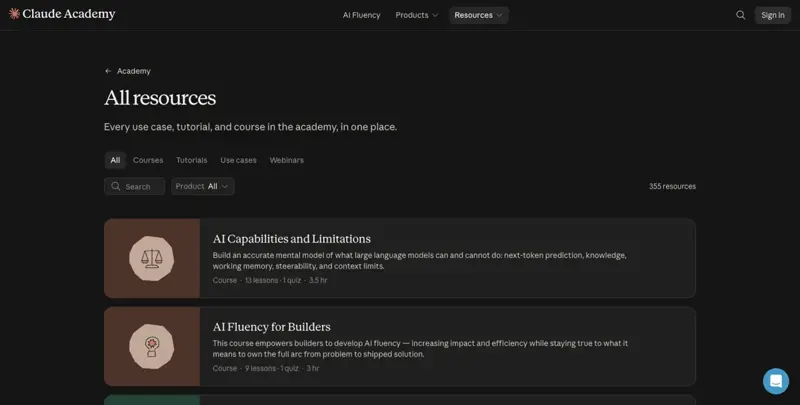
This is the part most coverage of the launch skips, because most of it was written before anyone actually opened the courses. Here’s the real catalog, pulled directly from the site, organized by which Claude product each track teaches:
| Course | Product Track | Lessons / Quizzes | Duration |
|---|---|---|---|
| Claude 101 | Claude.ai | 13 lessons, 1 quiz | 2.5 hr |
| Claude Code 101 | Claude Code | 12 lessons, 1 quiz | 1 hr |
| Claude Code in Action | Claude Code | 9 lessons, 1 quiz | 1 hr |
| Introduction to Agent Skills | Claude Code | 6 lessons | 1 hr |
| Introduction to Subagents | Claude Code | 4 lessons | 45 min |
| Introduction to Claude Cowork | Cowork | 14 lessons, 1 quiz | 2.5 hr |
| Claude Platform 101 | Platform | 13 lessons, 1 quiz | 1.5 hr |
| Building with the Claude API | Platform | 67 lessons, 8 quizzes | 9 hr |
| Introduction to Model Context Protocol | Platform | 10 lessons, 1 quiz | 1 hr |
| MCP: Advanced Topics | Platform | 11 lessons, 1 quiz | 1.5 hr |
| Claude with Amazon Bedrock | Platform (cloud) | 65 lessons, 8 quizzes | 8 hr |
| Claude with Google Vertex AI | Platform (cloud) | 66 lessons, 9 quizzes | 8.5 hr |
| AI Fluency: Framework & Foundations | Fluency | 14 lessons, 1 quiz | 4 hr |
| AI Capabilities and Limitations | Fluency | 13 lessons, 1 quiz | 3.5 hr |
| AI Fluency for Builders | Fluency | 9 lessons, 1 quiz | 3 hr |
| AI Fluency for Small Businesses | Fluency | 9 lessons, 1 quiz | 4 hr |
| AI Fluency for Nonprofits | Fluency | 9 lessons, 1 quiz | 4 hr |
| AI Fluency for Students | Fluency | 5 lessons, 1 quiz | 3 hr |
| AI Fluency for Educators | Fluency | 4 lessons, 1 quiz | 1.5 hr |
| AI Fluency for pK–12 Educators | Fluency | 10 lessons, 1 quiz | 3 hr |
| Teaching AI Fluency | Fluency | 7 lessons, 1 quiz | 4.5 hr |
One honest gap: a Claude Tag course (for teaching Claude to work inside your team’s Slack channels) is listed as a product category on the site, but its lesson count and hours weren’t published in the catalog at the time of writing — worth checking back on if you use Tag.
Notice the range here. “Claude Code 101” is a 1-hour on-ramp for someone who’s never opened a terminal. “Building with the Claude API” is a genuine 9-hour, 67-lesson technical course that would cost real money as a bootcamp elsewhere. That range — true beginner to production developer, inside one free hub — is the actual pitch, more than the 4D framework branding.
The Walkthrough: Getting From Zero to Your First Badge
Here’s exactly what happens if you go try it right now.
Step 1 — Go to academy.claude.com. No login wall. The homepage sorts everything into tracks by Claude surface (Claude.ai, Cowork, Code, Platform) plus the standalone AI Fluency cluster. If you’ve never touched an AI tool, the “Claude 101” card is the obvious first click.
Step 2 — Pick a track based on your actual work, not your job title. This matters more than it sounds. A marketing manager who mostly writes and organizes should start with “Claude 101” (2.5 hours, chat and documents) rather than “AI Fluency for Small Businesses,” which assumes you’re already running the operational side of a company. The site’s course descriptions are specific enough that you can tell the difference in one sentence.
Step 3 — Work through a course. Each one is a mix of short video, text explanation, and hands-on exercises inside the interface — not just a wall of reading. “AI Fluency: Framework & Foundations,” the flagship course, is 14 lessons and one quiz over roughly 4 hours, and it’s the one every other Fluency course assumes you’ve already done.
Step 4 — Take the quiz, get the badge. Passing the quiz at the end of a course unlocks a completion badge, visible on your account if you signed in. Expected result: a badge icon on your Claude Academy profile page, shareable but not independently verifiable — more on why that distinction matters in a second.
Step 5 (optional) — Install the Claude Academy Skill. This is the one genuinely clever feature buried in the launch. It’s a Claude “Skill” you can install that watches how you actually use Claude — what kinds of tasks, what kinds of mistakes, what you seem to be reaching for — and recommends specific Academy courses based on that pattern, instead of making you guess which of 289 resources is relevant to you.
A Worked Example: The Small-Business Owner Path
Say you run a five-person landscaping company and you’ve used ChatGPT a handful of times to write a Facebook post, but that’s it. Here’s what the realistic path through Claude Academy looks like:
- Start with Claude 101 (2.5 hr) — covers the first-conversation basics, effective prompts, and Claude’s “Projects” and “Artifacts” features, which is where most beginners get lost.
- Move to AI Fluency: Framework & Foundations (4 hr) — this is where the 4D framework actually clicks, because by now you have real Claude conversations to compare it against.
- Finish with AI Fluency for Small Businesses (4 hr) — the course built specifically for your situation: quoting jobs, scheduling, customer emails, and the operational tasks a five-person company actually has.
Total time: 10.5 hours, spread over however many sessions you want, entirely free, ending with three completion badges and — more usefully — three hours of hands-on practice inside the actual tool you’ll keep using.
Claude Academy vs. OpenAI Academy vs. Google’s Paid Courses
The honest comparison, because “which free AI course should I actually use” is the real question behind most of this:
| Feature | Claude Academy | OpenAI Academy | Google AI Essentials (Coursera) |
|---|---|---|---|
| Cost | Free, no account needed to browse | Free; ChatGPT account needed to save progress/certificate | Paid — $49/month Coursera subscription after 7-day trial |
| Named framework | 4D AI Fluency (Delegation, Description, Discernment, Diligence) | None — practical skill-building (context, review, delegation) | Structured 5-module curriculum, no named framework |
| Course scale | 289+ resources across 5 product tracks + Fluency cluster | Small core catalog: AI Foundations, Applied AI Foundations, Agents and Workflows (60–90 min each), plus livestreams | 5 courses (~10 hrs) in the Essentials specialization; 8-course Professional Certificate available |
| Credential | Free completion badge (non-proctored) | Free course-completion certificate (non-proctored) | Paid Google certificate on completion |
| Technical depth | Full range: consumer chat through API, MCP, and cloud deployment (Bedrock, Vertex AI) | Consumer/workplace-focused; limited public technical/API content | Consumer productivity-focused, not developer-oriented |
The pattern that falls out of this table: Claude Academy is the only one of the three that seriously covers both ends — a total beginner track and genuine production-developer content (the API course alone is longer than most paid bootcamp modules) — inside a single free hub. OpenAI’s academy is leaner and more workflow-focused, without a named pedagogical framework behind it. Google’s option is explicitly a paid product, positioning it closer to a professional certificate than free public education.
None of that makes Claude Academy “the best” in some abstract sense — it makes it the best free, comprehensive, tool-fluency option, which is a narrower and more useful claim.
Free Badges vs. the Paid Claude Certification (Don’t Confuse These)
This is the single most misunderstood part of the launch, and it’s worth being precise about it.
Academy completion badges are free and non-proctored. You watch the lessons, pass the in-course quiz, and you get a badge on your Claude Academy profile. There’s no standardized passing threshold beyond the quiz, and — this is the part people miss — it does not connect to Credly, the digital-badging platform employers actually check. It confirms you finished a course. That’s genuinely useful for your own learning. It is not a credential in the resume sense.
The Claude Certification Program is a completely separate, paid thing:
| Exam | Level | Price | Questions | Time |
|---|---|---|---|---|
| Claude Certified Associate – Foundations | Entry | $99 | 60 | 120 min |
| Claude Certified Developer – Foundations | Developer | $125 | 53 | 120 min |
| Claude Certified Architect – Foundations | Architect | $125 | 60 | 120 min |
| Claude Certified Architect – Professional | Senior architect | $175 | 63 | 120 min |
All four are proctored, scenario-based exams delivered through Pearson VUE (the same testing company behind many professional certifications), require a scaled score of 720 out of 1,000 to pass, and stay valid for 12 months. Passing one issues a genuine, verifiable Credly digital badge you can put on LinkedIn or a resume.
The catch most people don’t find out until they try to register: these exams are gated to people at organizations enrolled in the Claude Partner Network. A personal email signup gets rejected. If your company is a higher-tier partner, the exam fee can be discounted or waived entirely — Global Premier partners paid nothing through August 31, 2026, per Anthropic’s partner terms.
So the honest summary: Claude Academy teaches you the tool for free, and does it well. Claude Certification proves it to an employer, costs money, and requires your employer to be enrolled in a specific partner program. Don’t do a course expecting the second thing and get the first.
What This Means for You
If you’ve never touched an AI tool: Start with Claude 101, then AI Fluency: Framework & Foundations. Skip everything with “API,” “MCP,” or “Platform” in the title — that’s developer territory. Total time to a real working foundation: about 6.5 hours.
If you’re a small-business owner: Do the same two courses, then AI Fluency for Small Businesses (4 hr). The course is built around quoting, scheduling, and customer communication — the actual operational load of running something small — rather than generic “productivity tips.”
If you’re a teacher: AI Fluency for Educators (1.5 hr) is a fast on-ramp; AI Fluency for pK-12 Educators (3 hr) goes deeper into classroom-specific scenarios. Both are shorter than most district-mandated PD modules and arguably more useful.
If you’re a nonprofit staffer: AI Fluency for Nonprofits (4 hr) exists specifically because grant writing, donor communication, and program reporting are repetitive enough to benefit heavily from a tool-fluency course — and it’s free, which matters when your organization’s software budget is already thin.
If you’re a developer evaluating Claude for your team: Building with the Claude API (9 hr, 67 lessons) is a legitimately serious technical course, not a marketing overview. Pair it with Introduction to Model Context Protocol (1 hr) if you’re building anything that needs Claude to talk to your other tools.
If you already use Claude daily and feel like you’re “doing it wrong”: Skip straight to AI Fluency: Framework & Foundations. The Discernment and Diligence pieces — actually evaluating outputs and taking responsibility for what you ship — are the parts experienced users skip, not beginners.
If you manage a team and are deciding between this and paid corporate AI training: Claude Academy is an excellent first layer — free, well-structured, tool-specific. It is not a substitute for role-specific training on how your team actually uses AI in your industry’s workflows. Use it as the foundation, then build the job-specific layer on top.
Edge Cases and Troubleshooting
The course teaches a feature that’s already been replaced. One tester on X caught exactly this: a course still walking through a “Use style” preset that Anthropic has since folded into Skills — meaning the interface in front of you no longer matches the lesson. This is the real cost of a hub this large launching this fast: content freshness lags the product. If a screenshot doesn’t match what you see, assume the product changed, not that you’re doing something wrong.
Your badge doesn’t show up on LinkedIn the way a “certification” would. Because it isn’t one — see the badge-vs-certification section above. If you need something LinkedIn-verifiable, that’s the paid Certification path, and even then only if your employer is in the Partner Network.
You want the Certification exam but got rejected at registration. This almost always means you tried to register with a personal email instead of one tied to a Claude Partner Network organization. Check with whoever manages your company’s Anthropic relationship before assuming the program isn’t available to you.
A course feels “too basic” or “too advanced” for where you actually are. The track names (101, Fundamentals, Advanced Topics) are a reasonable guide but not precise. If a course opens and the first two lessons are review, skip to the quiz — passing it still earns the badge.
You installed the Claude Academy Skill and its recommendations feel off. It’s inferring your needs from usage patterns, which means it needs a real sample of how you actually work with Claude before its suggestions get sharp. Give it a week of normal use before judging it.
You’re not sure whether a course is current enough to trust for a fast-moving feature (like MCP or Agent Skills). The Platform-track courses on newer capabilities are the ones most likely to lag — check the course’s last-updated indicator if the site shows one, and cross-reference against Anthropic’s own changelog for anything you’re about to rely on in production.
You want to learn AI for your specific job, not just the Claude interface. This is the honest limit of the whole hub, covered next.
What Claude Academy Can’t Do
It teaches you the tool, not your job. Every course here is organized around a Claude product surface or a general fluency skill. None of them is “AI for medical billing,” “AI for real estate,” or “AI for accounting.” You’ll leave knowing how to prompt, delegate, and evaluate — genuinely valuable — but you’ll still have to figure out how that applies to your specific profession’s workflows, terminology, and compliance requirements on your own.
The free badges carry no employer-recognized weight. If you need a credential that shows up as verified on a resume or LinkedIn, the free Academy path doesn’t provide it — only the paid, partner-gated Certification does.
Content can lag the product. Anthropic ships fast. A hub this size, covering this many product surfaces, will always have some lessons trailing the current interface, as the “Use style” example above shows.
It’s a solo-learning platform, not a coaching relationship. There’s no instructor, no cohort, no feedback on your actual work product — just self-paced lessons and a quiz. If you learn better with accountability or live discussion, this won’t provide it.
It doesn’t cover competing tools. Naturally, everything here is Claude-specific. If your organization also uses ChatGPT, Gemini, or another assistant, you’ll need separate training for those, and the general fluency concepts (Delegation, Description, Discernment, Diligence) will transfer better than the product-specific mechanics will.
Why the Timing Matters
This launch didn’t happen in a vacuum. Every major AI lab is now racing to own the “learn how to use AI” moment, not just the “use our AI” moment — because the labs have figured out that the biggest barrier to adoption isn’t the model, it’s the person staring at a blank chat box not knowing what to type. OpenAI relaunched its own academy earlier in 2026 with a leaner, workflow-focused catalog. Google folded its AI training into a paid Coursera specialization, betting that professional certification demand justifies a subscription price. Anthropic’s bet with Claude Academy is the opposite: go wide, go free, go deep enough that a beginner and a production engineer can both find their level inside the same hub.
That bet shows up in the numbers. Going from roughly 13 courses in March to 289+ resources in August isn’t incremental growth — it’s Anthropic deciding that education is now a core product surface, not a side project. Worth noticing, too, that the free-and-open strategy mirrors how Anthropic has approached documentation generally: extensive, technical, and available without a sales conversation. For a company competing against OpenAI’s much larger consumer brand recognition, “we’ll teach you better, for free” is a coherent way to win people over one course completion at a time.
Frequently Asked Questions
Is Claude Academy actually free? Yes. Browsing every course requires no account and no payment. Signing in with a free Claude account lets you track progress and collect badges, but the sign-in itself costs nothing.
Do I need a Claude subscription to use Claude Academy? No. The courses teach you Claude’s free tier as well as paid features, and you can complete most lessons using a free Claude.ai account.
How is this different from the “Anthropic Academy” I might remember from earlier this year? Anthropic Academy launched in March 2026 on a third-party platform (Skilljar) with about 13 courses. Claude Academy is the same idea rebuilt natively on academy.claude.com with 289+ resources across five product tracks — a significant expansion, not just a rename.
Does finishing Claude Academy courses count toward Claude Certification? Not officially in a credit-transfer sense, but the content overlaps heavily — especially AI Fluency: Framework & Foundations — so working through the free courses first is a reasonable, free way to prepare for the paid exams.
Can my whole team use this for onboarding? Yes, and that’s clearly one of Anthropic’s intended uses. There’s no team-license requirement for the free courses — anyone can access them individually. Coordinating who’s done what across a team is on you, since there’s no admin dashboard for the free tier.
Is the “4D Framework” just marketing, or is there real substance behind it? There’s real academic substance — it originated with researchers at Ringling College of Art and Design and University College Cork, not Anthropic’s marketing department. Anthropic’s own internal research (its “AI Fluency Index”) has also found a real limitation worth knowing: measuring 4D behaviors across real Claude conversations, output-focused use (getting a finished document or app) correlates with less critical scrutiny of the AI’s work than thought-partner-style use does — a caution Anthropic itself has published, not hidden.
Will Claude Academy teach me things that stop being true as Claude updates? Some of it, yes — this is a documented real limitation, not a hypothetical one. Anthropic has said publicly that specific “fluency behaviors” it used to teach (like always spelling out your intended audience) have become less necessary as the models improved, which is why the framework has started shifting toward teaching durable mindsets (“verify in proportion to the stakes”) rather than fixed rules.
Should I do Claude Academy or a profession-specific AI course first? If you’ve never used an AI tool at all, start with Claude Academy’s foundational courses — you need the tool-fluency layer before profession-specific prompts make sense. If you already know how to hold a basic conversation with Claude, skip straight to the profession-specific training; you don’t need 10 more hours of general fluency to get value from job-specific workflows.
Is there a mobile version? The courses are accessible from a browser on mobile, though the experience is built primarily for desktop, especially the longer technical tracks like the API course.
What happens to my progress and badges if I stop using Claude for a while? Your account retains completed badges and quiz history. There’s no expiration on the free completion badges, unlike the paid Certification exams, which are valid for 12 months and require retaking.
Are the quizzes hard enough that I could actually fail? They’re comprehension checks, not gatekeeping exams — closer to the low-stakes quiz at the end of a corporate training video than a proctored test. The goal is confirming you absorbed the lesson, not filtering out learners, and most quizzes allow retakes with no penalty or waiting period.
Does Anthropic use my course activity for anything besides recommendations? The only stated use is powering the optional Claude Academy Skill’s course recommendations, based on your actual usage patterns in Claude. Anthropic hasn’t published a separate data-retention policy specific to Academy course activity beyond its general privacy policy, so if that matters to you, read the current privacy terms before signing in with an account you use for sensitive work.
The Bottom Line
Claude Academy is a genuinely useful, genuinely free expansion of what was already a decent training hub — 289+ resources, a real academic framework underneath the branding, and course depth that runs all the way from “I’ve never opened an AI chat” to “I’m shipping a production integration with the Claude API.” The launch numbers back up that it landed: a single announcement post pulling 8 million views isn’t hype, it’s a real signal that a lot of people have been waiting for exactly this.
But it teaches you Claude. It doesn’t teach you your job. The framework — Delegation, Description, Discernment, Diligence — is a genuinely solid mental model for working with any AI tool, and it’s worth the few hours it takes to internalize it. Once you have it, though, the highest-leverage next step is applying it to the actual, specific, repetitive work you do every day — which is exactly the gap a profession-specific course is built to close. If Claude Academy is where you learn to use the tool, FindSkill’s course library is where you learn to use it for your actual job — start with AI Fundamentals if you’re brand new, or jump straight to a course built around your profession.
Sources
- Anthropic — Claude Academy official announcement
- Claude Academy — course catalog
- Claude Academy — AI Fluency: Framework & Foundations
- Claude Academy — The 4D Framework
- Anthropic — The AI Fluency Framework (PDF)
- Anthropic — AI Fluency Index research report
- Gigazine — Claude Academy tutorial launch coverage (Japan)
- OpenAI — OpenAI Academy courses
- OpenAI Academy — course catalog
- Coursera — Google AI Essentials
- Credly — Claude Certified Architect Foundations badge
- flashgenius.net — Claude Certifications: The Complete 2026 Guide
- Ringling College Libguides — AI Fluency Framework origins