An AI notetaker startup called Jump just raised $80 million and told investors it now serves roughly 27,000 financial advisors — adding about 2,000 a month — at firms managing an estimated $12 trillion in assets. Its closest rival, Zocks, raised $45 million on the back of 5,000 advisory firms and 8x year-over-year revenue growth. This category didn’t exist in a meaningful way three years ago. Now it’s one of the fastest-adopted pieces of software in the advisory industry, and the SEC has named AI oversight a formal examination priority for fiscal year 2026.
If you’re an advisor who’s already using one of these tools — or thinking about it — this is the piece that actually answers the question everyone’s dancing around: not “should I use AI to take notes,” but “where, specifically, is the compliance line, and what happens if I cross it without realizing.” The short version: the tool isn’t the risk. Treating its output as a finished record without a human checkpoint is.
What just changed
The AI meeting-note category for financial advisors has gone from a niche convenience to near-default infrastructure in about two years. Kitces’ fall-2024 Advisor Productivity research found roughly 30% of advisors were using some form of AI meeting-notes tool, split between general-purpose products (Zoom’s built-in AI Companion, Fireflies, Fathom) and advisor-specific tools (Jump, Zocks, Finmate AI). By its 2025 Advisor Technology research, Kitces reported that number had risen further, with growth continuing into 2026. Interestingly, “pure solo” advisors adopted these tools at roughly one-third higher rates than small 2-3 person teams — and advisors delivering the most comprehensive financial plans used AI meeting notes at nearly four times the rate of those doing narrower, targeted plans. This isn’t a tool for cutting corners; it’s disproportionately used by advisors doing more thorough work.
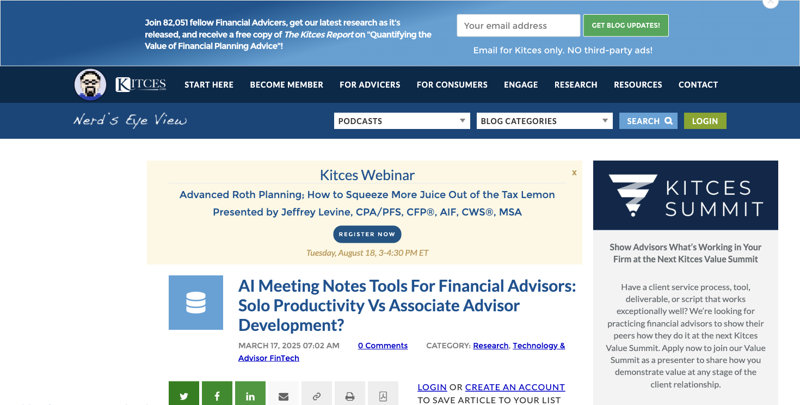
At the same time, the category is consolidating and the pricing is compressing fast. Standalone advisor-specific notetakers originally charged $120+/month; now Altruist’s built-in “Hazel” AI notetaker and Wealthbox’s integrated version are selling around $50, pushing Jump and Zocks to introduce cheaper “basic” tiers and pack more into premium plans to justify the price gap. Salesforce has entered the space directly too, launching its own “Meeting Concierge” and “Agentic Advisor” tools to defend its CRM position against AI notetakers that were starting to absorb CRM-style functions (task assignment, client documentation) themselves. The practical result for you as an advisor: more tools, falling prices, and features that increasingly blur the line between “just a notetaker” and “a system that touches your compliance record” — which is exactly why the SEC is paying attention now.
What the SEC actually flagged for FY 2026: The Division of Examinations released its fiscal-year 2026 priorities on November 17, 2025, explicitly expanding its focus on AI use in registrant operations. For AI and automated tools, examiners are checking whether: AI-related representations to clients are accurate, firm operations and controls match what’s disclosed to investors, automated advice or recommendations remain consistent with each client’s actual profile and strategy, and firms have real procedures to supervise AI technologies — including for back-office and operational uses like meeting documentation, not just for client-facing recommendation engines.
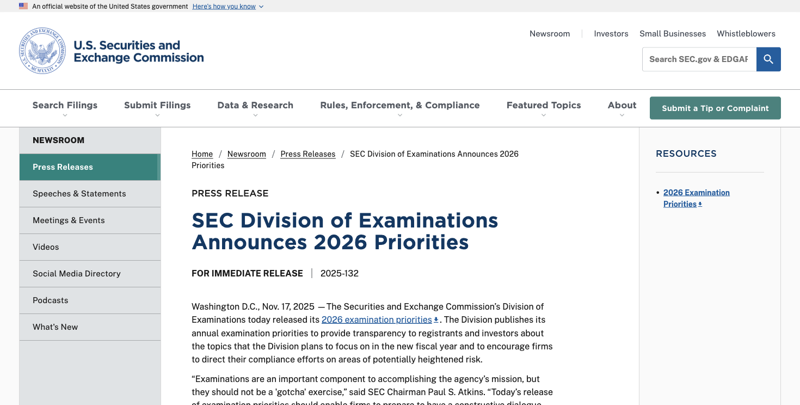
The SEC’s own framing matters here too. SEC Chairman Paul S. Atkins said in the release that “examinations are an important component of accomplishing the agency’s mission, but they should not be a ‘gotcha’ exercise” — the priorities are published specifically so firms know where to focus before an exam happens, not to trap firms that are making a good-faith effort. That’s useful context: this isn’t the SEC hunting for AI notetaker violations specifically. It’s the SEC telling every RIA, in advance, that “we used AI for this” is no longer a novel enough answer to skip the same documentation and supervision standards that already applied to every other tool touching client records.
What AI notetakers can — and legally cannot — do for you
This is the single most important distinction in this entire piece, and it’s the one vendor marketing pages consistently blur: there’s a hard difference between AI capturing what happened in a meeting, and AI (or you, relying on AI) determining what should happen as a result.
| An AI notetaker can do this | Only you (the adviser) can do this | |
|---|---|---|
| Transcription | Capture what was said, near-verbatim | — |
| Documentation | Draft a summary, task list, or CRM entry | Confirm the summary accurately states what happened and what was actually recommended |
| Suitability | Surface relevant facts mentioned in the meeting | Determine that a recommendation is in this specific client’s best interest given their objectives, constraints, and full circumstances |
| Follow-up | Draft a client-facing recap or follow-up email | Approve that recap before it’s sent |
| Compliance | Log that a meeting occurred and store the record | Decide whether that record satisfies Rule 204-2’s retention requirements for this specific client interaction |
Kitces’ own compliance research illustrates the risk with a scenario worth sitting with: a client discusses not selling concentrated employer stock because of the capital-gains hit. If distorted audio or misattributed speech causes the notetaker to log “sell” instead, and a team member forwards the AI-generated task list without reviewing it against what was actually said, the result is an unintended, irreversible trade with a real tax consequence. That’s not a hypothetical edge case — it’s the exact failure mode that a human-review checkpoint exists to catch, and it’s why “the transcript was accurate” doesn’t automatically mean “the summary and task list are safe to act on.”
The documented accuracy numbers back this up. An Oasis Group test of six advisor-specific AI notetakers — Jump, Zocks, Finmate, Zeplyn, Greminders, and Mili — found most tools transcribed a scripted test meeting at 100% word-level accuracy. But key-data capture (the specific numbers, dates, and facts that matter) landed at 85-96%, and action-item accuracy — correctly identifying what needs to happen next — came in at just 62-87%. The gap between “the words were captured correctly” and “the follow-up tasks were correct” is exactly where a firm gets into trouble if nobody’s checking.
The workflow: where the human-review line actually goes
Based on the SEC’s stated exam focus and Kitces’ compliance guidance, here’s the practical, five-step control structure that keeps an AI notetaker from becoming a liability.
Step 1: Get consent before you record — in writing where required
At least 10 US states require all-party consent to record a call or meeting, not just one-party notice. Before your AI notetaker joins a client call, get explicit permission — ideally documented, not just verbal — and offer a no-recording alternative for any client who prefers it. This isn’t optional legal housekeeping; it’s the first thing that goes wrong if a recording is ever challenged.
Step 2: Choose an approved tool with a real data-processing agreement
Vendor claims about SOC 2 compliance, configurable retention, or “compliance-ready” templates are a starting point, not proof of compliance. The SEC’s stated concern isn’t whether you use software — it’s whether your firm can demonstrate a functioning control environment: an approved tool, a clearly defined use case, accurate client-facing descriptions of what the tool does, secure handling of client data, and evidence the review process actually happened, every time, not just on paper.
Step 3: Let AI draft — but nothing goes to the CRM or the client unreviewed
Kitces’ expert guidance is direct: advisers remain liable for errors in AI output whether the mistake originated with the software or with how it was used, and the practical fix is reviewing every AI-generated note after the meeting and before it’s saved to the CRM. The reviewer’s job is specifically to catch: misattributed statements (who actually said what), omissions, and missed non-verbal context the audio-only tool couldn’t capture — sarcasm, hesitation, a client who agreed reluctantly rather than enthusiastically.
Step 4: Treat “record vs. draft” as a firm-level policy decision, not a per-advisor judgment call
Not every AI-generated artifact is automatically a required record under Rule 204-2 — but if it’s used as, contains, or evidences advisory advice, a recommendation, an investment decision, or client instructions, it likely falls inside the rule’s retention and production framework. The practical conclusion from SEC recordkeeping guidance: decide this in written firm policy ahead of time (which AI outputs count as records, which are working drafts), then retain the final approved version plus enough supporting material to substantiate what was actually communicated and decided — generally for at least five years, with the first two in an easily accessible place at the firm.
Step 5: Build a control design that makes “no unreviewed action” structurally true, not just a stated rule
The strongest version of this isn’t a memo telling advisors to be careful — it’s a workflow where no automatic trade, account change, recommendation, client instruction, task assignment with real consequences, or client-facing email can fire directly off an AI-generated note without a human approval step in between. Firms should also periodically sample past AI-generated notes for exactly the failure modes above: transcription defects, wrong-speaker attribution, omitted recommendations, inappropriate task assignments, and gaps in the archive — not waiting for an exam to be the first time anyone checks.
A worked example: from meeting to compliant record
Here’s how the five steps play out with a real (composited, de-identified) scenario, the kind of meeting that happens at advisory firms every week.
The meeting: An advisor, “Maria,” has a 45-minute video call with a client, “the Hendersons,” to discuss year-end tax planning. The client holds a large concentrated position in employer stock. Partway through, the husband says: “I don’t think we should sell any of this before year-end — the capital gains hit would be brutal with our income this year. Let’s revisit in January once we’re in a lower bracket.” His wife adds, “Yeah, let’s just hold and see where things are in Q1.”
Step 1 (consent): Before the call, Maria’s calendar invite included a line disclosed at scheduling: “This meeting may be recorded and AI-assisted notes generated for our records; let us know if you’d prefer we don’t record.” Neither Henderson objected. That’s documented consent, not an assumption.
Step 2 (tool): Maria’s firm uses an approved AI notetaker with a signed data-processing agreement, configured by the firm’s compliance administrator with a fixed note-structure template — not Maria’s personal ChatGPT account.
Step 3 (draft, don’t auto-act): The notetaker transcribes the call and drafts a summary. Because the husband’s sentence had some audio overlap with his wife’s, the AI-generated summary reads: “Client discussed selling employer stock position before year-end; interested in revisiting allocation in Q1.” That’s backwards — it dropped the “don’t” and flattened “hold and see” into “revisiting allocation,” which reads more actionable than what was actually said. This is the exact accuracy-gap pattern the Oasis Group testing found (interpretation and attribution errors, not raw transcription errors).
Step 4 (human review before it becomes a record): Maria reviews the draft that evening, per her firm’s policy, before anything is saved to the CRM. She catches the flipped meaning immediately because she remembers the call — the fix takes 30 seconds: she corrects the summary to “Clients explicitly do NOT want to sell employer stock before year-end due to capital-gains impact; revisit allocation discussion in Q1 once in a lower bracket.” She saves her corrected version, not the AI’s original draft, as the record of the meeting.
Step 5 (control design): Because Maria’s firm requires this review step for every AI-assisted note before CRM entry — not just as guidance but as a workflow gate her system enforces — there was never a window where the flipped summary could have auto-generated a “sell” task for an associate to execute, or gone out in a client-facing recap confirming the wrong decision. The firm’s periodic sampling of past notes (part of its written AI-oversight policy) would also catch this pattern if it started happening often with this specific vendor, prompting a conversation with the tool provider about audio quality or a firm-wide reminder to speak more clearly in overlapping conversations.
What this demonstrates: every single number in the accuracy research above — 100% transcription accuracy, 85-96% key-data capture, only 62-87% action-item accuracy — is compatible with exactly this kind of error. The words in the transcript may have all been captured correctly; the meaning the summary drew from them was inverted. That’s not a failure of the technology working as advertised. It’s exactly why “review before it becomes a record” isn’t a compliance nicety — it’s the single step standing between a technically-accurate transcript and a genuinely wrong action.
Choosing a tool: what actually matters for compliance (not just features)
The category has split into three distinct types of product, and the differences matter more for your compliance posture than the marketing pages suggest.
| Advisor-specific standalone (Jump, Zocks, Finmate) | CRM-integrated (Wealthbox AI, Salesforce Agentic Advisor) | General-purpose (Zoom AI Companion, Fireflies) | |
|---|---|---|---|
| Typical monthly cost | $50-120+ per advisor | Often bundled into existing CRM subscription | $10-30, or free/included with your video platform |
| Built for advisor compliance workflows | Yes — configurable note templates, some offer compliance-admin review controls | Partial — depends on the CRM vendor’s finance-specific configuration | No — general business meeting notes, not built for RIA recordkeeping |
| Data flows directly into CRM/task system | Yes, by design | Yes, natively (it is the CRM) | No — usually requires manual export or a separate integration |
| Firm-level oversight/admin controls | Increasingly common as the category matures | Depends on your CRM’s admin tooling | Usually minimal or none |
| Where the compliance burden sits | Partly reduced by vendor tooling, but firm review still required | Similarly reduced, plus fewer integration gaps | Almost entirely on your firm to build the review layer |
| Best fit | Solo advisors and small teams wanting a dedicated, configurable tool | Firms already standardized on that CRM, wanting one less vendor | Firms testing the category cheaply before committing, or advisors whose firm hasn’t approved a dedicated tool yet |
None of these three categories is inherently more or less compliant — Rule 204-2 doesn’t care which product you use. But the amount of work your firm has to do itself to build the review layer varies a lot. A general-purpose tool with no advisor-specific configuration puts nearly the entire compliance burden on your firm’s own process; an advisor-specific tool with built-in compliance-admin controls does more of that work for you, but “the vendor has compliance features” is never a substitute for actually using them and reviewing what comes out.
What this means for you
If you’re a solo advisor just adopting an AI notetaker for the first time: Start with Step 1 (consent) and Step 3 (review before CRM) — those two alone catch most of the real risk, and they take minutes per meeting, not hours.
If you’re already using Jump, Zocks, or a similar tool and haven’t formalized a review process: You likely have the accuracy risk already (recall: 62-87% action-item accuracy industry-wide) without the documented control that would defend you in an exam. Write the one-page policy this week — which outputs count as records, who reviews, when.
If you’re a compliance officer at a multi-advisor RIA: The SEC’s language — “procedures to monitor and supervise AI technologies, including for back-office functions” — means your existing electronic-communications supervision program needs an explicit AI-tool addendum, not a separate new program. Extend what you already have; don’t rebuild from scratch.
If your firm is choosing between a standalone notetaker (Jump, Zocks) and a CRM-integrated one (Wealthbox AI, Salesforce’s new tools): Integration reduces one failure mode (data getting lost between systems) but doesn’t reduce the core one (unreviewed output reaching a client or the record). Pick on workflow fit and price, not on the assumption that integration equals compliance.
If you manage ultra-high-net-worth or highly complex client relationships: Be more conservative than the baseline here. The Kitces “sell vs. don’t sell” concentrated-stock scenario is exactly the kind of complex, consequential, easy-to-misattribute conversation where a review skip is costliest.
If you’re evaluating whether to let AI draft client-facing follow-up emails, not just internal notes: Treat this as the highest-scrutiny use case in the whole workflow — it’s the one output a client sees directly, and it’s the one most likely to become evidence in a dispute if it misstates what was discussed.
If you’re worried this sounds like it kills the time-savings that made you want the tool: It doesn’t, in practice. The review step is minutes per meeting, applied to a draft that already exists — a fundamentally faster starting point than writing notes from scratch, which is the entire reason 27,000+ advisors adopted Jump alone.
If your firm is small enough that you (the advisor) are also the compliance officer: Don’t let the dual role become an excuse to skip documenting the process. Write the one-page policy even if you’re the only one who’ll ever read it — the point isn’t bureaucracy for its own sake, it’s having something concrete to show an examiner that demonstrates you thought about this deliberately rather than adopting a tool and hoping for the best.
If you’re switching from one AI notetaker to another (say, a standalone tool to a CRM-integrated one): Treat the transition itself as a compliance event, not just a workflow change. Confirm what happens to historical notes stored in the old tool — whether they migrate, get exported, or need to be separately archived to satisfy your firm’s retention policy — before you cancel the old subscription.
If you’re an advisor at a firm where “everyone just uses their own tool, nobody coordinated”: This is the riskiest configuration in the whole piece, not because any individual advisor is being careless, but because a firm can’t demonstrate a functioning, consistent control environment — the exact thing the SEC’s 2026 priorities name as the actual focus — when five advisors are running five different unreviewed workflows. Push for a firm-wide approved-tool policy even if it means switching away from a tool you personally like.
Edge cases and troubleshooting
“My notetaker transcribed a client’s hesitant ‘I guess, sure’ as an enthusiastic agreement.” This is exactly the non-verbal-cue weak point the accuracy research flags — tone, hesitation, and sarcasm are documented soft spots even in otherwise-accurate transcripts. It’s the specific reason the human review step in Step 3 exists; don’t treat a technically-accurate transcript as automatically capturing the client’s actual intent.
“The AI assigned itself a follow-up task that doesn’t match what we agreed on in the meeting.” This is the 62-87% action-item accuracy gap showing up directly. Review every auto-generated task list before it’s actioned — this is specifically what the SEC’s “automated advice or recommendations remain consistent with investor profiles” language is checking for in an exam.
“A client asked whether the AI notetaker is ‘compliant’ — what do I actually tell them?” Be precise, not reassuring-sounding: the tool assists with documentation; your firm’s review process, not the software, is what makes the resulting record compliant. Vendor SOC 2 badges and “compliance-ready” marketing language are a starting point for your due diligence, not something you should repeat to a client as a guarantee.
“We use a general-purpose tool (Zoom AI Companion, Fireflies) instead of an advisor-specific one — does any of this still apply?” Yes, fully. Rule 204-2 is technology-neutral — it doesn’t care which vendor produced the record, only whether your firm’s process meets the retention and accuracy bar. General-purpose tools typically have less advisor-specific compliance tooling built in (no configurable retention templates, no CRM push), which if anything raises your firm’s burden to build the review layer yourself.
“Our notetaker offers a ’no-recording’ or ‘privacy mode’ option — should we default to that?” Offer it as a client choice per Step 1, but don’t default to it universally — you lose the documentation benefit that makes the tool worth using, and a client who’s comfortable being recorded gets a materially worse (from-memory) record if you default to no-recording for everyone.
“How long do we actually have to keep these AI-generated records?” SEC recordkeeping rules generally require books and records be preserved for at least five years from the end of the fiscal year in which the last entry was made, with the first two years in an easily accessible place at the firm’s office — apply that to whatever your firm’s written policy defines as the “record” version of an AI-assisted note, not necessarily every draft.
“Is there a real enforcement case involving one of these specific notetaker tools I should know about?” Not as of this writing — the SEC’s one AI-related investment-adviser enforcement action to date (Delphia and Global Predictions, March 2024, $400,000 combined penalties) was about “AI-washing” — firms falsely claiming AI capabilities they didn’t have — not about a notetaker causing a compliance failure. That’s a meaningfully different risk than what this piece covers, but it establishes the SEC will act on false AI-related claims, which is directly relevant if your firm’s marketing describes your AI notetaker’s compliance capabilities more confidently than they actually perform.
What this can’t do
It can’t make the suitability determination for you. No matter how good the transcript is, only the adviser can judge whether a recommendation fits a specific client’s objectives, constraints, and full financial picture. AI can surface facts mentioned in a meeting; it cannot exercise fiduciary judgment.
It can’t guarantee the resulting record satisfies Rule 204-2 on its own. A transcript or AI summary becomes a compliant record only through your firm’s review and retention process — the software producing the output isn’t what makes it compliant.
It can’t substitute for state recording-consent law. Consent requirements vary by state and sometimes by which parties are present; the tool doesn’t know or enforce this for you, and getting it wrong is a legal problem independent of anything to do with AI accuracy.
It can’t reliably catch tone, sarcasm, or reluctant agreement. This is a documented, consistent weak point across the accuracy research — treat anything emotionally or contextually ambiguous in a transcript as something to verify against your own memory of the meeting, not accept at face value.
It can’t replace your firm’s existing electronic-communications supervision — it needs to be added to it. Bolting an AI notetaker onto a firm with no formal review process doesn’t just fail to fix the documentation problem; it can create a false sense that documentation is now “handled,” which is arguably worse than having no tool and knowing you’re relying on memory.
FAQ
Are AI notetakers like Jump and Zocks actually compliant with SEC rules? The tools themselves aren’t “compliant” or “non-compliant” — compliance is a property of your firm’s process around the tool. A notetaker used inside a workflow where a qualified human reviews and approves the record before it’s relied upon or sent to a client can be part of a compliant process. The same tool used to auto-generate client emails or CRM entries with no review step is a real exam risk.
What’s the single highest-risk habit advisors have with these tools right now? Letting AI-generated task lists or follow-up items act automatically — pushed into a CRM, assigned to a team member, or emailed to a client — without a human confirming they match what was actually discussed. That’s the exact scenario in the Kitces concentrated-stock example, and it’s where the documented 62-87% action-item accuracy gap does real damage.
Do I need written client consent to record meetings with an AI notetaker? At least 10 US states require all-party consent for recording, and best practice regardless of state is proactive, ideally written, consent — plus offering a no-recording alternative for clients who prefer it.
How long do I need to keep AI-generated meeting notes? If the note is used as, contains, or evidences advice, a recommendation, or client instructions, treat it as falling under Rule 204-2 — generally five years of retention, with the first two years in an easily accessible firm location. Decide in written policy which AI outputs count as the “record” version versus a disposable working draft.
Has the SEC actually taken enforcement action against a firm over an AI notetaker specifically? Not as of this writing. Its one AI-related investment-adviser enforcement action (Delphia and Global Predictions, March 2024) was about firms falsely marketing their AI capabilities, not about a notetaker causing a documentation failure. That doesn’t mean the risk isn’t real — the SEC has explicitly named AI oversight and recordkeeping as a 2026 exam priority, meaning scrutiny is arriving before any single enforcement case defines the boundaries.
Should I pick a standalone AI notetaker (Jump, Zocks) or one built into my CRM (Wealthbox, Salesforce)? Both can work inside a compliant process; the choice is mostly about workflow fit and cost (standalone tools currently run $50-120+/month, with pricing compressing fast as CRM-integrated options undercut them). Integration reduces the risk of notes getting lost between systems but doesn’t replace the human-review step either option still requires.
Can I just tell clients “our AI notetaker is SOC 2 compliant” and leave it there? No — a vendor’s SOC 2 certification, configurable retention settings, or CRM integrations are relevant to your due diligence but don’t by themselves establish that your firm meets its fiduciary, privacy, and books-and-records obligations. The SEC’s enforcement history (the Delphia/Global Predictions case) shows it specifically scrutinizes overstated AI-capability claims.
What single change would most reduce our firm’s risk starting this week? Add one required step to your existing workflow: every AI-generated meeting note gets reviewed by the adviser (not just glanced at) before it’s saved to the CRM or used to generate a client-facing follow-up. It’s the one control that catches misattribution, omitted context, and the action-item accuracy gap all at once, and it costs minutes per meeting.
The bottom line
AI meeting-note tools genuinely save advisors time — Jump alone says it now serves 27,000+ advisors precisely because the time savings are real. But “the transcript was accurate” and “the resulting record and task list are safe to act on” are two different claims, and the gap between them (documented at up to 38 percentage points on action-item accuracy in independent testing) is exactly where the SEC’s 2026 exam priorities are looking. The fix isn’t avoiding these tools — it’s one disciplined habit: nothing generated by AI reaches a client, a CRM record, or an action item without a human confirming it matches what actually happened in the room.
If you want the full workflow for using AI on meeting documentation across any profession — not just the compliance-specific version here — FindSkill’s AI Meeting Notes course walks through the setup, review habits, and privacy settings in eight short lessons, with the first two free.
Sources
- SEC — Division of Examinations Announces 2026 Priorities (Nov 17, 2025)
- SEC — 2026 Examination Priorities (full report)
- SEC — Advisers Act Rule 204-2 (“Books and Records Rule”)
- SEC — SEC Charges Two Investment Advisers with Making False AI Claims (March 18, 2024)
- SEC — Risk Alert: Electronic Messaging
- Kitces — Best AI Notetakers For Financial Advisor Meetings: Adoption, Satisfaction & Productivity
- Kitces — The Risks Of AI Meeting Notetakers: Evaluating Accuracy
- Kitces — The Latest In Financial #AdvisorTech (March 2026)
- WealthTech Today — AI Notetakers & Agentic OS for Financial Advisors: The 2026 Strategic Buyer’s Guide
- Harvard Law School Forum on Corporate Governance — 2026 SEC Division of Examinations Priorities
- WealthManagement.com — SEC Sets 2026 Exam Focus on AI Rules and Compliance
