You know the feeling: you’re three videos deep, something glossy autoplays, you feel the little hit of interest — and then you clock the seven-fingered hand or the sign with melted gibberish text, and the whole thing curdles. That’s “AI slop,” and in the summer of 2026 there’s so much of it that the platforms themselves are finally moving. This is the plain-English guide to what changed, how to spot the fakes, and — if you make things — how not to become slop yourself.
What “AI slop” actually means
AI slop is low-effort, high-volume content generated by AI and pumped into feeds to farm engagement or ad money. Not “someone used AI to help” — that’s just a tool. Slop is the factory version: the same template churned out a thousand times, the fake animal rescues, the synthetic history “facts,” the uncanny kids’ cartoons, the AI-narrated listicles nobody wrote and nobody checked.
The term has become a cultural weapon. One analysis of millions of comments found “AI slop” exploding as an insult from 2023 to 2026, overtaking older jabs — to the point where people now hurl it at human work too, out of sheer distrust. That’s the real story: slop didn’t just clutter feeds, it made everyone suspicious of everything.
What the platforms just did
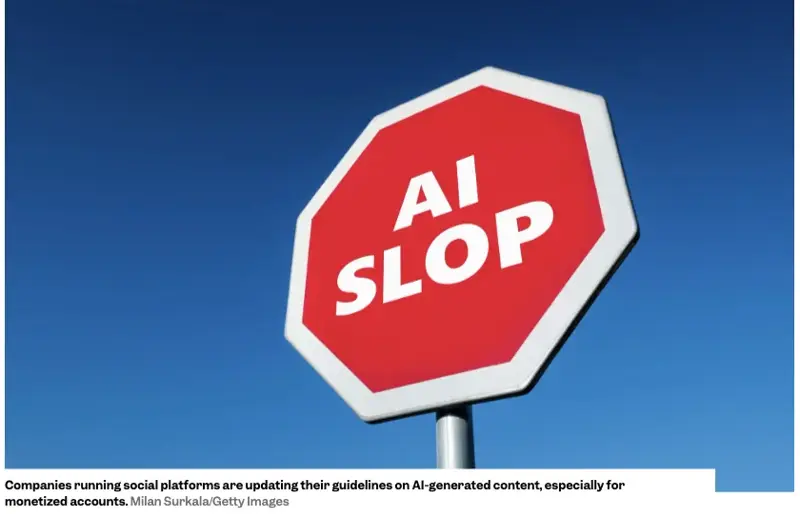
For the first time, the big platforms are treating slop as a problem to manage, not a growth metric. Here’s what actually shipped in 2026:
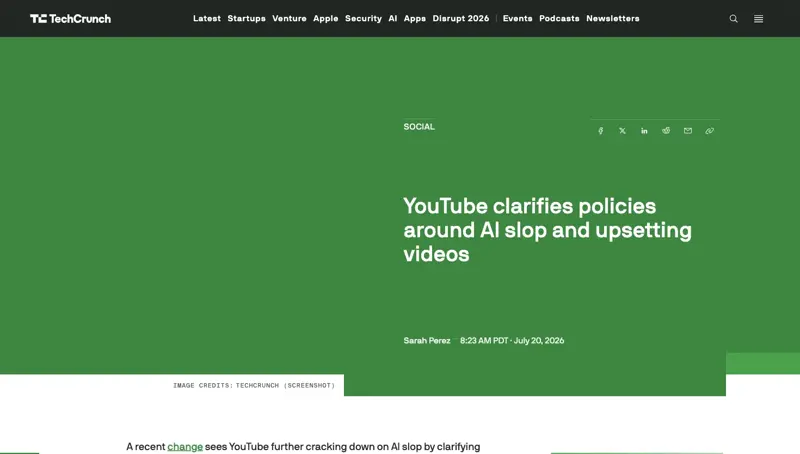
- YouTube clarified its Partner Program rules on July 16, folding “generic, repetitive, or template-based content,” distress-bait, and AI personas dishing advice on sensitive topics (health, finance, law) into its “inauthentic content” category — the stuff it won’t pay out for. Channels built on the worst of it can be booted from monetization.
- TikTok now labels AI content at massive scale — over 1.3 billion videos — reads C2PA “Content Credentials,” is testing invisible watermarks that survive re-uploads, and added a “Manage Topics” slider letting you dial how much AI-generated content shows up in your For You feed.
- Pinterest lets you tell it to show fewer AI-generated Pins in categories where slop runs thick, like beauty and art.
- Substack rolled out Pangram-powered detection that scans posts and comments and shows a human / AI-assisted / AI-generated breakdown, plus a space for writers to disclose how they used AI.
The honest read: these are real, and they’re partial. People report seeing fewer extreme “factory” channels — and still drowning in residual slop. The volume is winning faster than the rules.
How to spot it: the 2026 tells
The frontier generators got good, so single-frame “look at the hands” advice is weaker than it was. The reliable tells now are about consistency over time and physics. Here’s what to actually look for.
The mental shortcut: pause, zoom the text, watch the hands move, check the shadows. Three seconds of that catches most of it.
And the crucial caveat — provenance beats vibes. Google’s SynthID watermark has now been applied to over 100 billion images and videos, and platforms increasingly read C2PA credentials. When a label or credential is there, trust it more than your gut. When it’s absent, that’s not proof the content is real — it just means you’re back to the physics tells.
What this means for you
If you just want your feed back: use the new controls. TikTok’s “Manage Topics” AI slider and Pinterest’s “see fewer” setting are buried but real. Two minutes in settings measurably cuts the slop.
If you share news with family: the political and “did you hear that X died” slop is engineered to be shared before it’s checked. Build one habit — pause on anything glossy and emotional, check the source — and you’ll stop being the relay. Our AI Literacy for Seniors course is built exactly for helping the people most targeted by this.
If you’re a parent: kids’ content is one of the worst-hit categories — synthetic cartoons and “educational” videos with confidently wrong facts. Turn on the AI feed controls on their accounts, and teach the “melted text = fake” tell; kids catch it fast once they know to look.
If you make content: the platforms are now paying less for template slop and building detection against it — so the incentive has flipped. Use AI to help (draft, edit, research), but the thing you publish needs a human point of view, a real check, and something only you could have made. That’s the line between “AI-assisted” and “AI slop,” and in 2026 it’s also the line between monetized and demonetized.
What this can’t fix
- Detection isn’t proof. A single “AI detector” score — on text especially — is a guess, not a verdict. They flag suspicion; provenance and source-checking decide the hard cases. Don’t accuse a human writer based on one tool’s percentage.
- The tells are a moving target. Every generation of models fixes last year’s giveaways. Hands and faces are already much better than they were. Treat any single tell as a hint, not a courtroom verdict.
- Absence of a watermark means nothing. Slop makers strip metadata; plenty of real content never had credentials. “No SynthID” ≠ “real.”
- Platform rules have big gaps. The crackdowns target monetization and labeling, not existence. Slop that isn’t chasing ad money — political, spammy, or just noise — largely sails through.
- You can’t out-scan the volume. No amount of personal vigilance fixes a feed algorithm optimized for engagement. The controls help; the underlying incentive is the real fight.
The bottom line
AI slop is the pollution of the attention economy, and 2026 is the year the platforms admitted it and started — partially — to clean up. You don’t need to become a forensic analyst. Learn a few durable tells, trust provenance over vibes, flip on the feed controls the platforms just gave you, and if you create, stay on the human side of the line. The slop is loud, but it’s beatable.
Want to actually understand how this stuff is made — and use AI well instead of adding to the noise? Our AI Fundamentals course is the plain-English starting point, and Content Creation with AI teaches the human-in-the-loop way to make things worth watching. First two lessons free. For more on the trust question, see can you trust AI and do AI detectors actually work.
Sources
- TechCrunch — YouTube clarifies policies around AI slop and upsetting videos (Jul 20, 2026)
- Business Insider — the social platforms cracking down on AI slop (Jul 22, 2026)
- TikTok Newsroom — new ways to label and manage AI-generated content
- Google — SynthID and Content Credentials for identifying AI content
- CNET — Pinterest lets you see fewer AI images in your feed
- C2PA — Content Credentials: verifying media provenance
