A holiday party inquiry rarely arrives as a form. It arrives as a thread: a date that might be the 12th or the 19th, a headcount that is “around 40, could be 48,” a guest with a nut allergy mentioned in the middle of a sentence, and a budget in a different message from the menu. Someone then has to turn that thread into one page that the kitchen, the bar and the floor can run from. That page is the Banquet Event Order, or BEO.
This guide shows how to get a first draft of that page from an AI chat and, more importantly, how to check it. I ran the prompt below twice on October 22, 2026, in Grok’s web chat (Fast mode), on two invented email threads: a tidy one and a deliberately messy one. The model took 11 and 10 seconds. Checking its work takes longer, and that’s the part this guide is about. The AI did several things well. It also missed one thing that would have cost a venue real money, and one that could have hurt a guest if nobody had caught it. Both are below.
I’m not a restaurant operator, and I didn’t test this in a live kitchen. The client, the venue and the prices in the examples are invented. The research behind it is real: Toast’s guide to BEOs, an April 2026 piece from a hospitality-software founder on reply speed, the FDA’s allergen rules, the PCI Security Standards Council’s rule on card numbers in chat, Anthropic’s data settings, and what operators say on X and Reddit. Where the evidence is thin, I say so.
TL;DR. Paste the email thread and the prompt below into an AI chat. It will give you a draft BEO that separates what the client confirmed from what is still open, and a list of questions to send back. Then a person has to do three things the AI can’t own: check every line against the thread, check the arithmetic and the client’s budget, and have the chef confirm every allergy line. Never paste card numbers into the chat.
What a Banquet Event Order is, and what it isn’t
Toast defines a BEO as “a detailed, centralized document that outlines every aspect of the event—such as timing, menu items, guest count, staffing needs, and logistical considerations.” It’s the page your team works from, and a reference point for the client and any outside vendors. Toast’s guide lists eight key components:
| Section | What goes in | Why the team needs it |
|---|---|---|
| Event date and time | The date and start time, at the top | They set when setup begins and when each service rolls out |
| Event location | Address, room or hall name, access instructions | The team knows where to set up and how to get in |
| Client information | Name, phone, email, other decision-makers | Everyone knows who to call about a change |
| Detailed catering menu | Courses, dietary notes, beverage selections, portion sizes | The kitchen knows what to prepare and when |
| Event timeline | When each course, toast or speech happens | Service and kitchen stay in step |
| Staffing requirements | Number and roles of staff, shift times | Staff know their duties |
| Logistics and transportation | Vehicles, set-up timelines, parking, loading access | Nothing is blocked on the day |
| Budget and costs | Food, beverage, staffing, rentals, service fees | Both sides can track costs and avoid surprise charges |
The “why” column paraphrases Toast’s descriptions of each section. Toast also makes software for catering and events, so treat its guide as a vendor’s explanation of a standard document. Its own examples of what goes wrong without one are small: “forgetting a guest’s dietary restriction or misestimating the amount of food.”
A BEO is not a proposal or a contract
The research pass I ran through Perplexity’s Deep research made a point worth repeating: a BEO answers “exactly what must the team execute?” A proposal answers “what could we provide, and at what estimated price?” A contract answers “what have the parties agreed, and on what terms?” Toast’s own announcement of its catering product lists BEOs separately from digital contracts, quotes and estimates.
That’s a working distinction, not a legal one. A signed BEO might carry contract terms, and a BEO might simply carry out a separate agreement. Don’t rely on the title of a document. If a dispute ever turns on what a BEO means, that needs the actual documents and a lawyer who knows your state.
Why the holiday rush makes this the bottleneck
The holiday rush shows up on the search side: in the keyword data we use, US searches for “restaurant holiday party” were about 30 a month in summer and about 1,300 last November. The harder question is whether replying fast actually wins bookings, and here the honest answer is that I found no independent study that measures it.
What exists is opinion from people who sell to this market:
- Chris Kostoulas, founder of the hospitality-software company Reunion, wrote in Modern Restaurant Management in April 2026 that “most restaurants respond to inquiries within 24 to 72 hours.” He gave no sample or method. He recommends “a substantive response within two hours during business hours,” a real reply of about three sentences that confirms availability or asks a clarifying question, and says building a proposal from scratch takes one to three days.
- Tripleseat, which sells event software, wrote in December 2025 that “Speed matters” and that the restaurant that responds quickly and professionally often wins the booking. It gave no figures.
- A Perplexity Deep research pass found no independent study that estimates how much faster inquiry replies raise booking conversion at US restaurants. It found a 2011 Harvard Business Review article on the short life of online sales leads, but not enough in the record to apply to restaurant events.
So treat “reply fast” as common sense backed by vendors, not as a proven number. A caterer and restaurant owner on X put the limit well, according to our Grok search: “AI makes it 10x faster. it still can’t build the whole quote and the experience the way the client needs it….that takes a person. too much money on the line to trust that to anyone but me or my best people.” That’s one operator’s post, but it describes exactly where the AI draft ends and your judgment begins.
The workflow, step by step
Step 1: Copy the thread, and keep payment details out
Copy the emails into one block, oldest first. Before you paste anything into a chat, take out card numbers, security codes and bank details. The PCI Security Standards Council’s FAQ on the point is short. Asked whether unencrypted card numbers can be sent over email, instant messaging, SMS or chat, it answers “No,” and says PCI DSS Requirement 4.2.2 prohibits sending unprotected primary account numbers over end-user messaging technologies, “whether sent internally or over public networks.” The FAQ names chat among the end-user messaging technologies it covers, and I’d treat a chat with an AI assistant the same way.
You’ll add the billing contact back in yourself after the draft is written.
What you should see: a plain-text thread with names and dates, and nothing a stranger could charge.
Step 2: Paste it with this prompt
Open a new conversation in whichever assistant you use. I ran it only in Grok; I haven’t tested it elsewhere. The prompt is plain text, so it should work in other chat assistants, but check the result as hard in any of them.
You are the private-events coordinator for a restaurant. Turn the email thread below into a Banquet Event Order (BEO) that the kitchen and floor team can run from.

Rules:
- Use only facts that are in the thread or in the "House terms" below.
- If something is missing or unclear, write NOT CONFIRMED and add it to a list called "Questions to ask the client".
- Never guess a number, a time or an ingredient.
- Sections, in this order: Event summary; Contacts; Schedule; Headcount; Menu; Dietary and allergy notes; Beverage; Room and equipment; Pricing (show the arithmetic line by line); Payment terms; Questions to ask the client.
- In "Dietary and allergy notes", write each person's need exactly as the client wrote it, mark each one "CHEF TO CONFIRM", and never write that a dish is safe.
- Keep the whole BEO to one page of plain text.

House terms: [paste your room capacity, minimums, per-person prices, service charge, tax and deposit rules here]

EMAIL THREAD:
[paste the thread here]
Three choices in that prompt matter. “Use only facts that are in the thread” stops the model from filling gaps with plausible details. “NOT CONFIRMED” makes the gaps visible. And “never write that a dish is safe” keeps the AI out of the one judgment it can’t make.
The “House terms” line is where your numbers go. In my runs I gave it: a private room that holds up to 50 seated guests; a Friday food-and-beverage minimum of $2,500; a $72-per-person plated three-course dinner; a $28-per-person two-hour open bar; a 22% service charge on food and beverage; 8.25% sales tax on food, beverage and the service charge; a 25% deposit; and a free screen and projector. These are invented house terms. Use your own, and check how your state taxes service charges: the tax rule in my terms is an assumption I made, not advice.
What you should see: a one-page BEO with the sections in your order, a few NOT CONFIRMED markers, and a list of questions at the bottom.
Step 3: Read it against the thread, line by line
This is the step people skip. Put the thread beside the BEO and tick every line. Check names, the date, the headcount and every time. The model is allowed to leave things out, and leaving something out is the failure you won’t see unless you look.
What you should see: every fact on the BEO traced to a message, and anything you can’t trace crossed out.
Step 4: Redo the arithmetic, then compare with the client’s budget
The model did the multiplication correctly in Run 1. Do it yourself anyway, once, with a calculator, because the totals go on a document that your team and your client rely on. Then do the step the AI didn’t: divide the total by the headcount and compare it with what the client said they could spend.
What you should see: the same total you got from the model, and one more number the model didn’t give you.
Step 5: Send the questions back
The “Questions to ask the client” list is the most useful part of the answer. Edit it, and send it as your own email, in your own words. We come back to why below.
What you should see: a short list of specific questions, each of which closes one NOT CONFIRMED.
Step 6: Have the chef sign the allergy lines
Before the BEO goes to the kitchen, the chef or person in charge reads each allergy line and writes what they will actually do about it. Only then does “CHEF TO CONFIRM” become a real confirmation.
What you should see: a named person’s confirmation next to each allergy line.
Run 1: a tidy thread
The first thread was a company dinner. The client first said “around 40, could be 48,” Dec 12 or Dec 19, “Two vegetarians, one celiac, and Priya has a tree nut allergy,” and a budget of “about $85 a head.” The restaurant replied with the room, the per-person prices and the deposit. The client then locked Dec 12, gave a final count of 44, chose a menu, asked for a toast around 7:30, and gave a billing contact.
When we ran it in Grok’s web chat (Fast mode) on October 22, 2026, the model took 11 seconds and gave this (shortened, with the invented names as they appeared):
Event summary
Whitfield Logistics team holiday dinner. Friday, December 12, The Cellar (private room). Final headcount 44. 6:30 start. Plated three-course dinner. Two-hour open bar followed by cash bar. Setup crew arrives 6:00 pm for decor. Toast requested around 7:30 pm.

Schedule
Setup crew arrives: 6:00 pm (decor).
Event start: 6:30 pm.
Toast: around 7:30 pm — NOT CONFIRMED (exact time and duration).
Open bar window and cash-bar start: NOT CONFIRMED.

Dietary and allergy notes
Two vegetarians — CHEF TO CONFIRM.
One celiac — CHEF TO CONFIRM.
Priya has a tree nut allergy — CHEF TO CONFIRM.
(Each need written exactly as client stated. Alternatives for these guests: NOT CONFIRMED. No dish is marked safe.)

Pricing (estimated, based on 44 guests)
Food: 44 × $72 = $3,168
Beverage (open bar): 44 × $28 = $1,232
Food & beverage subtotal: $3,168 + $1,232 = $4,400
(Friday F&B minimum $2,500 — met.)
Service charge (22% of food & beverage): 0.22 × $4,400 = $968
Taxable amount: $4,400 + $968 = $5,368
Sales tax (8.25%): 0.0825 × $5,368 = $442.86
Estimated total: $5,368 + $442.86 = $5,810.86
Deposit (25% of estimated total): 0.25 × $5,810.86 = $1,452.72
I checked the arithmetic: $4,400 × 0.22 is $968.00, $5,368 × 0.0825 is $442.86, the total is $5,810.86, and a quarter of it is $1,452.715, which rounds to the $1,452.72 shown. The model also marked all three dietary needs for the chef, left the guest choice between short rib and salmon open, and ended with seven questions for the client.
What it missed in Run 1
The answer didn’t mention the budget. The client wrote “Budget is about $85 a head.” The estimated total of $5,810.86 across 44 guests is $132.06 a head. Food alone at $72 fits under $85, but the bar, the service charge and the tax push the total about $47 above what they said they’d spend. A coordinator who sends the BEO as it stands is sending a bill that is much bigger than the number the client had in mind, and finding out at the deposit.
The model had no reason to flag it: I told it to build a BEO from the thread, and it did. A BEO is an operations document, and a budget mismatch is a sales problem. That is why step 4 exists.
It also didn’t note that the Dec 12 versus Dec 19 question had been settled, which is harmless.
Run 2: a messy thread
For the second run I wrote a thread with traps in it. The headcount moves: “Count was 44 but Raj in sales just told me it’s more like 47-ish.” Priya “can’t eat nuts.” “I think one person is vegan?” The CFO is Jain, “so no onion or garlic for him.” The budget is “$85 a head all in, tip and tax included.” Then the client asks to extend the bar to three hours when the house terms only list a two-hour rate, adds their own cake from a local bakery at 8:15, and says the menu is “whatever you think is best.”
The model took 10 seconds and did what the prompt asked. A shortened version of its answer:
Headcount
Client stated original count 44, then "more like 47-ish." Exact number: NOT CONFIRMED (room capacity 50 seated).

Dietary and allergy notes
"Priya can't eat nuts." CHEF TO CONFIRM
"I think one person is vegan?" CHEF TO CONFIRM
"our CFO is Jain so no onion or garlic for him." CHEF TO CONFIRM

Beverage
Open bar requested for three hours. House two-hour open bar rate is $28 per person. Three-hour open bar rate: NOT CONFIRMED.

Pricing
Food: $72 per person × headcount = NOT CONFIRMED
[...every line NOT CONFIRMED...]
Client budget stated as "$85 a head all in, tip and tax included."
That is the behaviour you want. It didn’t pick a headcount, invent a three-hour price or decide what “can’t eat nuts” means. It quoted the dietary lines in the client’s own words, and left the pricing blank rather than guessing. Its eight questions covered the headcount, the times, the three-hour bar rate, the menu, the vegan guest, AV, cake service and billing.
What Run 2 still left to a person
The questions didn’t ask what “can’t eat nuts” means. It could be peanuts, tree nuts or both, and for a kitchen those are different problems. The FDA’s list of major allergens treats peanuts and tree nuts as separate categories. The list also didn’t ask whether the Jain request covers other ingredients, or whether a cake from outside the building is allowed, or whether there is a cake-cutting fee (my house terms didn’t say). The AI follows your rules; it doesn’t add the questions your rules didn’t think of.
Here’s a short summary of both runs:
| Situation | What the AI did | What a person still has to do |
|---|---|---|
| Clean thread, all prices given | Built every section; arithmetic correct | Compare the total per head with the client’s budget |
| Conflicting headcount | Kept both numbers, marked NOT CONFIRMED | Get a guaranteed count and a deadline |
| A price the house terms lack | Left it NOT CONFIRMED | Decide and quote the price |
| “Can’t eat nuts” | Quoted it, marked CHEF TO CONFIRM | Ask which nuts, and how severe |
| “I think one person is vegan?” | Quoted it, marked CHEF TO CONFIRM | Ask who, and what it means for them |
| Outside food (the cake) | Asked about cake service | Check your policy and any fee |
The allergy line is the one you never hand to the AI
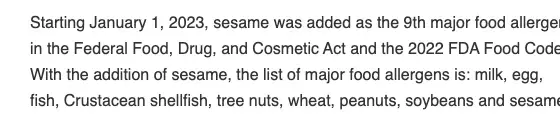
The FDA says that “Starting January 1, 2023, sesame was added as the 9th major food allergen.” The nine are “milk, egg, fish, Crustacean shellfish, tree nuts, wheat, peanuts, soybeans and sesame.” A BEO that says “nut allergy” has to be turned by a human into a statement about which of those nine, and what the kitchen will do.
A few more points from the FDA page and from the Perplexity research pass, with the caveat that the Food Code is a model code, not a federal law for restaurants:
- Whether a given provision applies to you depends on which code edition your state and local regulator adopted. Check yours.
- The FDA page says unpackaged foods served in a retail food establishment need written notification of major allergens as ingredients (Food Code section 3-602.12), and that employee food safety training “must include food allergy awareness of the 9 major food allergens.”
- Written notification of ingredients isn’t proof that your kitchen can prevent cross-contact. That’s a separate question for the chef.
- Don’t let a word on a form stand in for an assurance. Perplexity’s research brief put it as a rule for event control: do not convert “vegan,” “gluten-free,” or a blank dietary field into an assurance that a meal is safe for a particular allergy.
The prompt’s “CHEF TO CONFIRM” marker exists for this reason. Treat the AI’s output as the checklist the chef starts from.
What to keep out of the chat
Card numbers. Covered above. If a client pasted a card number into an email, delete it from the thread before it goes into any assistant.
More than you need. The AI doesn’t need the client’s home address or phone number to build a BEO. Paste the contact details in yourself afterwards. HoneyBook’s own guide for venues notes that “Some clients may prefer not to share their data with public AI models,” and suggests telling clients when and how you use AI.
Chats you haven’t thought about. Check the data settings of the assistant you use. Anthropic’s privacy centre page (dated March 16, 2026) says chats from Free, Pro and Max accounts may be used for model improvement if you allow it through the “Model Improvement” setting, and that Incognito chats are not used, “even if you have enabled Model Improvement.” I read only Anthropic’s page; each assistant has its own rules, so look up the one you use before pasting a client’s details.
Don’t let the AI write to your client
The BEO draft is for your team. The email to the client is different, and the community evidence is blunt. In a Reddit thread titled “Vendor PSA: Please Stop Using ChatGPT to Respond to Us” (October 2025, as found by our Grok search), a client described obviously AI-written replies from a caterer: bold text, emojis, em-dashes and generic questions. Our Grok search’s summary of the thread also mentions a vendor who turned up and said “You didn’t tell me it was a wedding!!” after emails handled by AI. That’s a thread on a wedding forum, not a survey, but it describes what a client sees.
So send the questions in your own words, and make them specific to the event. Kostoulas’s follow-up rhythm is a decent frame: a short check-in the day after you send the proposal, one piece of value three days later (a photo of a similar event, a suggested floor plan, an alternate date), a final check-in a week later, and then stop. He says venues that follow up this way report “a significant portion” of bookings coming from the second or third follow-up. He gives no percentage, and neither does the operator I quoted, who says quiet clients “got busy and forgot they ever asked. A lot of those turn into bookings with one follow up.”
What the software you already pay for does
If you already use event software, check whether it does this step for you before you build a workflow around a chat window. HoneyBook’s guide, dated October 9, 2026, says its platform “now has built-in floor plan and BEO generation.” HoneyBook is a software vendor, so that’s a product claim, not an independent test. Our Grok search also turned up AI features in other event tools, such as Tripleseat and Perfect Venue, from the vendors’ own pages. I didn’t open those pages, so I won’t describe them. Look at yours, and ask what happens to your clients’ data when you use them.
The case for the chat-window method is that it needs no software change and it makes you read the thread closely. The case against is that it depends on you doing every check in the workflow above, every time.
What this means for you
Six situations, with a recommendation and a first action for each.
If you run an independent restaurant with a private room. You’re the person who currently types this up on a Sunday night. First action: paste your last real event thread into an AI chat, with your real house terms, and compare the draft with what you actually wrote. Check which sections you needed that the AI left out.
If you’re a sales or events manager at a venue. A budget gap like Run 1’s is a sales problem as much as an operations one. First action: add one line to your prompt that asks for the total per guest, then compare it with the client’s stated budget before the BEO leaves your desk.
If you cater. Your BEO has more moving parts: Toast’s component list includes staffing and logistics and transportation. First action: add those sections to the prompt’s order and mark each NOT CONFIRMED until the client answers.
If you’re a chef or kitchen manager. You’re the last check. First action: ask your sales team to put the allergy lines first on the BEO, and write your own confirmation under each one, not a blanket “noted.”
If you already use Tripleseat, HoneyBook, Perfect Venue or similar. Look in your own tool for its drafting feature first. First action: find out whether your tool’s AI sees your clients’ data, and where it goes, before you paste anything into a separate chat.
If you’ve never used AI at work. Start with the Questions section, not the whole BEO. First action: paste one inquiry and ask only “What’s missing from this request that a kitchen would need to know?”
Edge cases and troubleshooting
The model wrote that a dish is safe. Delete the line. The prompt forbids it, so if it appears, the model didn’t follow the prompt. Replace it with the allergen and the chef’s name.
The model left a section out. Run the prompt again with “You left out the Room and equipment section. Add it, and change nothing else.” Then compare the two versions, because changing one part can change another.
Two dates in the thread. Run 1 had Dec 12 and Dec 19 and the client later chose one. If the thread never settles, write the open date as NOT CONFIRMED and put the date question first in your list.
The headcount keeps changing. The Perplexity research pass suggested a BEO record an expected count, a guaranteed count and a guarantee deadline. That’s its recommendation, not a verified industry standard, but it’s a sensible one: ask the client for a date after which the number can’t drop.
The total is far from the client’s budget. Don’t hide it in the BEO. Send the client a short note that gives the per-head total, and ask what they’d like to change: the bar, the menu or the headcount.
The AI’s tax is wrong for your state. I gave it a tax rule and it applied it. If you don’t give it one, don’t let it choose. Put your actual rule in the house terms.
The output is two pages. The prompt asks for one. Tell it to shorten and keep every NOT CONFIRMED. A page the line cook won’t read is not a BEO.
The thread contains something private. Start over with a clean paste, and check that assistant’s data settings for what happens to chats.
What this can’t do
- It can’t build the quote. The operator’s line applies: the whole quote, and the experience the client needs, “takes a person.”
- It can’t confirm an allergy accommodation. Only your kitchen can, and the FDA’s page says employee food safety training must include allergy awareness.
- It isn’t your contract. A BEO may or may not carry contract terms, depending on how you and the client treat it. Ask a lawyer before you rely on one.
- It doesn’t know your house. It knows only the terms you paste in. A missing cake-cutting fee or outside-food policy stays missing.
- It can’t tell you whether replying faster would have won the booking. Nobody has independent evidence on that, as far as I could find.
FAQ
What does BEO stand for? Banquet Event Order. It’s the document that tells your team what an event needs: the timing, menu, headcount, staffing and logistics.
Is a BEO a contract? Not necessarily. A BEO says what the team will carry out. A contract says what the parties agreed. A signed BEO might carry contract terms, so ask a lawyer how yours works.
What goes on a BEO? Toast lists eight components: event date and time, location, client information, the catering menu, a timeline, staffing, logistics and transportation, and budget and costs. Perplexity’s research brief also suggests adding dietary and allergen requirements and a guaranteed headcount with a deadline, which it calls a recommendation, not a standard.
Can ChatGPT, Claude or Gemini write a BEO? I tested the prompt only in Grok, so I can’t say how the others compare. Any chat assistant can draft one from a thread, but you have to check it against the thread.
Is it safe to paste a client’s email into an AI chat? Remove card numbers first: PCI DSS prohibits sending unprotected card numbers over chat. Then check the assistant’s data settings. Anthropic’s page says consumer chats may be used for model improvement if you allow it, and that Incognito chats aren’t. Other assistants have their own settings.
Can AI handle allergies on a BEO? It can copy and flag them. It can’t confirm an accommodation. In my runs it quoted each need in the client’s words and marked it for the chef.
How do I stop the AI inventing details? Tell it to use only the facts in the thread and your house terms, and to write NOT CONFIRMED for anything else. Then read the output against the thread. In both of my runs it followed that rule.
Does replying faster win more private events? Vendors say so, but I found no independent study that measures it for restaurants. Kostoulas recommends a substantive reply within two hours in business hours, and he describes it as his recommendation.
Should I use AI to write the email to the client? Use it to find the questions. Write the email yourself. In one Reddit thread, a client complained about AI-sounding replies from a caterer.
What if my event software already has AI? Use that first if it keeps client data where you want it. HoneyBook, for example, said on October 9, 2026 that its platform has built-in BEO generation.
The bottom line
An AI chat can turn a messy event thread into a clean first draft of a BEO in seconds, and in my two runs it was good at the part that matters most: separating what the client confirmed from what’s still open. It followed my rules in both runs, did the arithmetic correctly in Run 1, and refused to guess. It didn’t flag that the client’s budget was about $47 a head below the total, and it didn’t ask what “can’t eat nuts” meant.
So the working rule is simple. Let the AI draft and list the questions. You check every line against the thread, do the maths, compare the total with the budget, write to the client yourself, and have the chef confirm every allergy line before the page goes out.
If you want to learn how venues use AI across catering, guest experience and operations, AI for Event Venues & Hospitality (first 2 lessons free) covers it, and our free Event Run-of-Show Creator skill is for the minute-by-minute schedule of an event.
Sources
- Toast, “What Is A BEO In Catering And How Will It Boost Business?” (June 9, 2025)
- Modern Restaurant Management, “Why Most Restaurants Leave Private Event Revenue on the Table” (April 24, 2026)
- Tripleseat, “5 Expert-Backed Ways Restaurants Can Boost Event Bookings in 2026” (December 4, 2025)
- HoneyBook, “How to use AI for event planners and venues to work smarter” (October 9, 2026)
- FDA, “Addition to the 2022 Food Code: Sesame Added as a Major Food Allergen”
- PCI Security Standards Council, FAQ 1085: “Can unencrypted PANs be sent over e-mail, instant messaging, SMS, or chat?” (August 2025)
- Anthropic Privacy Center, “Is my data used for model training?” (March 16, 2026)