

Two days ago, ChatGPT quietly picked up a skill it never had before: it can actually book you a table. Not recommend one. Not describe one. Book it — pull real available times from OpenTable, Resy, or Yelp, and hand you a confirmed reservation, without you ever opening those apps yourself.
It’s a small feature on paper. It’s a genuinely different kind of thing underneath — the first time most people will feel ChatGPT complete a real-world action for them instead of just answering a question. Here’s exactly how it works, how to use it tonight, and the honest limits nobody’s telling you about yet.
What just changed
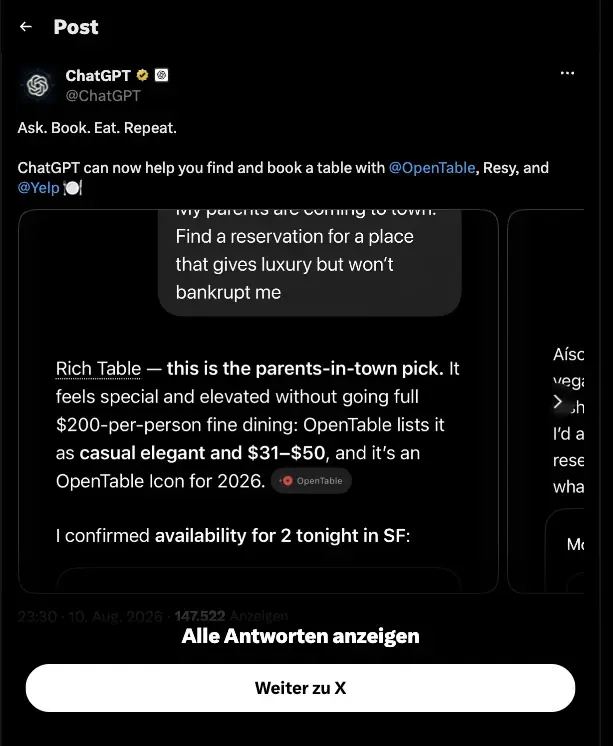
On August 10, 2026, OpenAI turned on restaurant reservation search and booking inside ChatGPT, through three partners: OpenTable, Resy, and Yelp. OpenAI’s own release notes describe it plainly: “ChatGPT can now help you find available restaurant reservations with OpenTable, Resy, and Yelp. Ask in the chat and include where and when you’d like to eat, your party size, and any preferences, such as cuisine, budget, dietary needs, or atmosphere. You’ll see available reservation times directly in the response. You can also ask follow-up questions to narrow your options or check a specific restaurant. When you find a time that works, select it to book it.”
That’s the whole feature in one paragraph, and it undersells how different this feels in practice. Until now, ChatGPT could tell you about restaurants — reviews, vibes, price ranges — but the second you wanted to actually sit down somewhere, you were on your own: open OpenTable, open Resy, open Yelp, or call. This closes that gap for the first time, inside a single conversation.
The coverage differs by partner, and it matters for whether this works for you tonight:
- OpenTable — available globally
- Resy — United States only
- Yelp — United States and Canada, and the only one of the three that also supports joining a waitlist, not just booking a confirmed slot
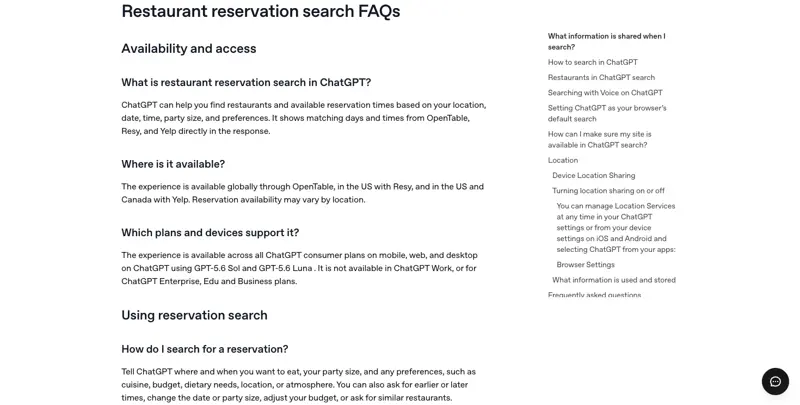
It’s rolling out across all ChatGPT plans — Free included — on mobile, web, and desktop, running on the GPT-5.6 Sol and GPT-5.6 Luna models. The one exclusion: ChatGPT Work does not include restaurant reservation search at all, and it’s unavailable on Enterprise, Edu, and Business plans. If you’re using ChatGPT through your employer, this feature may simply not exist for you — that’s worth knowing before you assume it’s broken.
Why this is a bigger deal than “one new feature”
Restaurant booking by itself is a nice convenience. What makes it worth understanding properly is what it represents: the first time an AI assistant most people already use daily has closed the full loop from “tell me what you want” to “here’s your confirmed reservation,” without a human doing the last click through a separate app.
One sharp read on this, from a product analyst on X, put the underlying shift bluntly: “this will definitely make these apps more useful while simultaneously making their brands less important. Resy can still own the restaurant relationships and all the infrastructure underneath while OpenAI owns my intent. Why would I need to open up Resy?” That’s the pattern to watch — not just for restaurants, but for the rideshare, travel, and shopping apps likely to get the same treatment next. Restaurant booking is the low-stakes test case: worst case, you cancel a table. That’s exactly why OpenAI, Google, and Microsoft all picked it as the place to prove agentic booking works before trying it on anything with real money attached.

Here’s the detail most coverage missed: ChatGPT wasn’t first. Microsoft’s Copilot Actions feature, with OpenTable as a launch partner, went live in Copilot Labs around June 2025 — over a year earlier — letting users type prompts like “make a dinner reservation for two at an Italian restaurant on OpenTable.com.” Google’s AI Mode agentic restaurant booking followed in August 2025, initially restricted to Google AI Ultra subscribers in the US, then expanded globally (UK, India, Australia, Canada, Hong Kong, New Zealand, Singapore) on April 10, 2026, with the subscription requirement dropped. ChatGPT is the third major assistant to ship this, arriving over a year after Microsoft and roughly a year after Google — but with by far the largest existing user base to hand it to at once.
How the booking flow actually works
You don’t need a special mode, a plugin toggle, or a settings change. You just talk to ChatGPT the way you’d talk to a friend who knows every restaurant in town and has all three booking apps open.
Step 1: Tell ChatGPT what you want, in plain language
Include four things and you’ll get the best results: where, when, party size, and any preferences — cuisine, budget, dietary needs, or atmosphere. You don’t need to format this as a command. A real example that worked, pulled from an early user’s post: “sushi in Beverly Hills tomorrow at 7-8pm for a party of 4.” ChatGPT checks availability across Resy, OpenTable, and Yelp simultaneously and responds with real matching times.
Expected result: ChatGPT replies with a short list of restaurants matching your criteria, each with a name, a quick description, and — where a reservation partner is connected — actual bookable time slots pulled live from the provider. This isn’t a static recommendation; it’s checking real-time availability the moment you ask.
Step 2: Narrow it down with follow-up questions
This is where it starts to feel less like a search engine and more like a conversation. You can ask for earlier or later times, change the date or party size, adjust your budget, or ask ChatGPT to suggest something similar to what it already showed you. You can also ask about one specific restaurant directly — “is [restaurant name] available Friday at 8?” — and ChatGPT will check that one specifically rather than making you scroll a list.
Expected result: ChatGPT refines its suggestions based on your follow-up without making you restate everything from scratch — it remembers the party size and preferences from your original message.
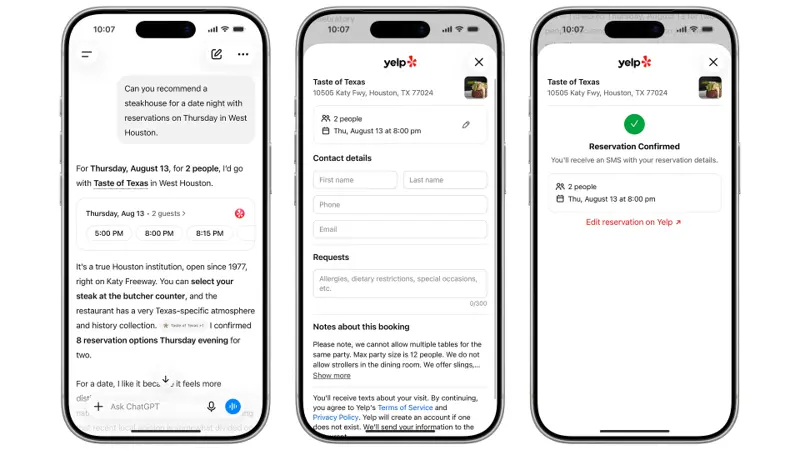
Step 3: Select a time and complete the reservation
When you see a time that works, select it. Depending on the provider, one of two things happens next:
- For OpenTable and Yelp reservations that don’t require a credit card, the booking can complete right inside the chat.
- If an OpenTable or Yelp reservation requires a credit card to hold the table, ChatGPT redirects you to OpenTable’s site to finish that step — this is stated explicitly in OpenAI’s own help documentation, not a bug.
- Resy uses its own account sign-in, so ChatGPT doesn’t prefill your details there the way it can for the other two partners.
Expected result: once you confirm, you get a confirmation email directly from OpenTable, Resy, or Yelp — not from OpenAI. That confirmation email is your source of truth from that point forward.
The worked example, start to finish
Here’s a complete run-through with real inputs, so you know exactly what to expect before you try it yourself.
You type: “My parents are coming to town. Find a reservation for a place that gives luxury but won’t bankrupt me — for 2 tonight in San Francisco.”
ChatGPT responds with a specific pick — in one real example, “Rich Table,” described as “the parents-in-town pick,” noting it’s listed on OpenTable as casual elegant, $31–$50 per person, and flagged as an OpenTable Icon restaurant for 2026 — then confirms live availability for 2 tonight in SF, showing the actual open time slots pulled from OpenTable at that moment.
You select a time. ChatGPT surfaces the reservation form inline — party size, date, and time already filled in from what you told it.
You confirm. A confirmation email arrives from the provider (OpenTable, Resy, or Yelp — whichever handled that particular restaurant) within moments, and that email is now your only way to view, change, or cancel that booking.
That’s the entire loop — from “I need somewhere to eat tonight” to a real, confirmed table — without opening a second app.
What data ChatGPT actually shares with the restaurant platform
This is the part most coverage skipped, and it’s worth knowing before you use the feature. To speed up your booking, ChatGPT asks for permission to share your name and email with the reservation partner. Once you allow it, ChatGPT fills in any visible, empty name and email fields in the reservation form for you. You’ll always see this permission prompt first, and you get three choices: allow once, always allow, or decline and type your own details manually. You can review and change this anytime under Settings → Data Controls → information shared with the apps. Resy is the one exception — it uses its own account sign-in system, so ChatGPT doesn’t prefill anything there regardless of your permission setting.
ChatGPT vs. Google vs. Microsoft vs. just using the app
You have four real options for booking a table today, and they’re genuinely different in how “agentic” they are. Here’s how they actually compare, based on documented behavior — not marketing claims.
| Microsoft Copilot | Google AI Mode (“Reserve with Google”) | ChatGPT | Just open OpenTable/Resy/Yelp | |
|---|---|---|---|---|
| First launched | ~June 2025 (Copilot Actions, Labs) | August 2025 (US, Google AI Ultra only at first) | August 10, 2026 | — (always available) |
| Booking partners | OpenTable | OpenTable, Resy, Tock, SevenRooms, TheFork, plus local partners (varies by region) | OpenTable, Resy, Yelp | Whichever app you’re in |
| Countries covered | Not broadly disclosed beyond initial rollout | US, UK, India, Australia, Canada, Hong Kong, New Zealand, Singapore | OpenTable global; Resy US; Yelp US + Canada | Depends on the app |
| Cancel/modify in-chat? | No — managed on OpenTable | No — final step often still routes through the partner panel | No — managed on the partner platform | N/A, you’re already there |
| Waitlist support | Not documented | Not documented | Yes, via Yelp only | Yes, natively |
| Cost | Free (part of Copilot) | Free since April 2026 (subscription requirement dropped) | Free on every ChatGPT plan except Work | Free |
| Best for | Quick one-off asks inside Windows/Edge workflows | Users already living in Google Search / AI Mode | People who already do most of their planning inside ChatGPT conversations | Anyone who wants full control, saved preferences, and loyalty points |
A genuinely important nuance: Google’s implementation, according to independent analysis, “isn’t fully agentic yet” in the strictest sense — the final booking step still often routes through a partner panel on OpenTable or SevenRooms rather than Google submitting it end-to-end, though some 2026 reporting describes a more automated variant that “handles the full transaction loop.” ChatGPT presents its version as completing the booking natively inside the chat once you select a time slot — but like both competitors, none of the three let you cancel or modify from inside the chat. That limitation is universal across all three assistants right now, not a ChatGPT-specific gap.
If you already have OpenTable’s app installed, know your favorite restaurants by name, and rack up loyalty points through direct bookings, opening the app directly is still faster for that narrow case. Where ChatGPT wins is the exact opposite scenario: you don’t know where you want to eat yet, you’re mid-conversation about something else (“what should I do tonight in SF”), or you want one place to compare cuisine, budget, and vibe before committing — without juggling three separate apps to check availability across all of them.
Why restaurants, and why now: the bigger agentic-commerce picture
Restaurant booking didn’t arrive in isolation — it’s the latest, and so far the most successful, entry in a much bumpier 2026 story about AI assistants trying to do things on your behalf, not just talk about them.
Rewind to September 29, 2025: OpenAI launched Instant Checkout, built on the Agentic Commerce Protocol it co-developed with Stripe, letting you buy real products (starting with Etsy) without leaving ChatGPT. It sounded like the same idea as restaurant booking — complete a real transaction inside the chat. It didn’t work the way OpenAI hoped. On March 24, 2026, OpenAI discontinued Instant Checkout as a native in-chat purchase flow. The numbers explain why: according to Forrester analyst Emily Pfeiffer, fewer than 30 of Shopify’s more than one million eligible merchants ever went live with it. Walmart — one of the biggest names OpenAI signed up — found conversion rates roughly three times lower for products bought directly inside ChatGPT compared to products that simply redirected shoppers to walmart.com to finish checkout there. Forrester’s May 2026 report on the wind-down put it starkly: only about 8% of consumers who were even aware the feature existed had ever used it to buy something. OpenAI’s own explanation to reporters was that “Instant Checkout is moving to Apps, where purchases can happen more seamlessly” — a quiet admission that the fully-native version wasn’t working.
That’s the context that makes restaurant reservations worth paying attention to: it’s OpenAI trying agentic action again, on a category built to succeed where checkout struggled. A Checkout.com study published in June 2026 found the exact trust gap that explains the difference — 65% of US consumers said they’d trust AI to compare prices for them, but only 14% said they’d trust it to place an order autonomously, a 51-point gap between “help me decide” and “act for me without asking again.” Nuvei’s own analysis of the Instant Checkout wind-down landed on a similar number: only 10% of people had ever used an AI agent to make a purchase, and 61% said outright they wouldn’t be comfortable doing so.
Restaurant booking sidesteps that exact fear. Nobody’s handing over a stored credit card and trusting the AI to spend money unsupervised — for OpenTable and Yelp bookings that need a card, ChatGPT redirects you out to finish that step yourself, and Resy requires its own separate account login. What you’re trusting the AI with is time and effort, not money, and the worst-case failure is “I need to cancel a table” rather than “I got charged for something I didn’t want.” That’s a genuinely lower-stakes place to prove the underlying pattern works, which is exactly why Microsoft, Google, and now OpenAI all picked restaurant booking — not shopping — as the category where agentic action has actually stuck.
It’s also worth knowing that reservations run on completely different technical rails than Instant Checkout did. Public developer documentation describes the booking flow as running through a “restaurant reservation conversion spec” built on OpenAI’s Apps SDK — itself built on the Model Context Protocol (MCP) — where restaurant partners implement a standardized widget and a restaurant_reservation tool that ChatGPT invokes directly from a “Reserve” button. That’s architecturally distinct from the Agentic Commerce Protocol that powered (and ultimately didn’t save) Instant Checkout: industry analysis has summed up the difference as reservations “move a booking record” while ACP “moves money” — different rails, different risk, different outcome so far.
None of this means AI-driven commerce is failing broadly — quite the opposite. Despite the Instant Checkout retreat, Adobe Analytics, drawing on more than a trillion site visits, found AI-referred traffic to US retail sites grew 393% year-over-year in Q1 2026, and — in a reversal from a year earlier, when AI traffic converted 38% worse than organic search — by March 2026, AI-referred traffic was converting 42% better than organic search traffic, with visitors spending 48% longer per session and viewing 13% more pages. Shopify’s own Q1 2026 telemetry (self-reported, not independently audited) showed AI-referred traffic to its merchants up roughly 8x year-over-year, with AI-referred orders up nearly 13x. Read together, the honest picture is: people increasingly research and get referred by AI, and they increasingly trust AI to act on low-stakes, reversible tasks like a dinner reservation — but full autonomous purchasing, where real money moves without a human double-checking, is still the part nobody’s fully cracked yet.
What this means for you
If you’re planning a last-minute dinner — this is the single most useful case for the feature right now. Skip the tab-juggling between three booking apps; just describe what you want in one message and let ChatGPT check all three simultaneously.
If you’re hosting out-of-town guests — the “parents in town” example above is genuinely representative. Describe the occasion and budget in plain language (“nice but not $200-a-head fancy”) and let ChatGPT translate that into an actual filtered search, the way a local friend would.
If you’re planning a trip — this pairs naturally with ChatGPT’s existing trip-planning conversations. You can go from “what should I do in this city” straight into “OK, book me dinner near there Thursday” in the same thread, without restarting your research in a different app. If you haven’t set up a dedicated Project for trip planning yet, that’s worth doing alongside this — see our guide on ChatGPT Projects.
If you’re privacy-conscious about sharing your name and email — you’re not stuck with the default. Decline the permission prompt and type your details manually inside the booking form instead, or review/revoke what’s already been shared under Settings → Data Controls at any time.
If you use ChatGPT through work (Team, Enterprise, Edu, Business, or ChatGPT Work) — this feature currently doesn’t exist for you at all. Don’t assume it’s broken if you can’t find it; check which plan you’re actually on first.
If you have dietary restrictions, need specific seating, or are booking for a large group — the feature supports describing these needs in your request, but as of this week there’s essentially no public track record yet of how reliably that information survives into the actual reservation. Mention it in your ChatGPT request, but double-check the reservation details (and consider calling ahead for anything genuinely critical, like a severe allergy) until the feature has a longer track record.
If you’re deciding between ChatGPT, Google AI Mode, and Microsoft Copilot for this — pick based on where you already spend your time, not which one is “better.” All three do the same core job with roughly the same limitation (none let you cancel in-chat). The real differentiator today is coverage: Google currently reaches more countries, ChatGPT’s OpenTable leg reaches more countries than its Resy/Yelp legs, and Copilot is the narrowest of the three.
Edge cases and troubleshooting
“I don’t see the Reserve button for a restaurant I know takes reservations.” The Reserve button only appears when ChatGPT can match that specific restaurant to a listing from one of the three supported partners. Some restaurants — especially independent spots not on OpenTable, Resy, or Yelp — simply won’t have it, even if they take reservations through some other system entirely.
“ChatGPT isn’t showing any availability.” Coverage and availability both vary by location and partner — try asking for a different date or a wider time range before assuming there’s nothing open. If nothing turns up, ChatGPT may point you toward the restaurant or the reservation partner directly to check other options manually.
“I’m on the Free plan — does this actually work for me, or is it a paid-only feature in disguise?” It’s genuinely available on every consumer ChatGPT plan, Free included, per OpenAI’s own documentation. The only people excluded are ChatGPT Work, Enterprise, Edu, and Business users.
“I tried to cancel or change my reservation and ChatGPT couldn’t do it.” That’s expected, not broken — this is a hard, documented limitation across all three partners. After you place a reservation, ChatGPT does not save it or track it going forward. Use the confirmation email from OpenTable, Resy, or Yelp to cancel or make changes directly with that provider.
“My booking needed a credit card and ChatGPT redirected me out of the chat.” This is the expected flow for OpenTable and Yelp reservations that require a card to hold the table — you’ll be sent to OpenTable’s site to finish that specific step, then the booking completes there.
“I asked for a dietary accommodation or specific seating and I’m not sure it actually reached the restaurant.” As of this week, there’s no public track record of how reliably special-request text carries through to the venue — the feature only launched days ago. Treat anything genuinely important (a severe allergy, an anniversary surprise, a wheelchair-accessible table) as worth a follow-up call to the restaurant directly rather than trusting the chat request alone.
“I want to book for a big group — 8 or more people.” Party size is explicitly supported as an input, but large-group booking accuracy hasn’t been publicly stress-tested yet at the time of writing. For anything above a standard 2–6 top, consider confirming directly with the restaurant once ChatGPT surfaces availability, especially for split-table situations.
“Is it actually faster than just opening the OpenTable app?” If you already know exactly where you want to eat and have the app installed, probably not — direct app use still wins for that specific case, and you’d keep any loyalty points tied to booking directly. Where ChatGPT clearly wins is when you’re comparing options across all three platforms at once, or when the booking is a side-quest inside a longer conversation you’re already having (trip planning, “what should I do tonight”).
What this can’t do
It can’t cancel or modify a reservation once it’s made. This is the single most important limitation to understand before you rely on it — ChatGPT does not save your reservation after booking. You manage every change through the confirmation email and the original provider, not through the chat.
It doesn’t tell you what happens if a restaurant fails to confirm. None of OpenAI’s, Yelp’s, or Resy’s public documentation addresses the request-only or failed-confirmation path — every official source describes only the successful-booking flow. If you’re using a request-based reservation (rather than an instantly-confirmed slot), be aware that the “what if it gets rejected” experience isn’t documented anywhere yet.
It doesn’t work with voice mode yet. Reservation search specifically is not currently supported in ChatGPT’s voice chats, even though voice chats with general search are rolling out. If you’re mid-voice-conversation and want to book a table, you’ll need to switch to text for that part.
It won’t reliably handle payment-required, non-card bookings the same way across all three partners. Resy’s separate account sign-in means ChatGPT can’t prefill your details there the way it can for OpenTable and Yelp — you’ll need an existing (or newly created) Resy account regardless of what you tell ChatGPT.
It isn’t a replacement for calling ahead on anything high-stakes. For a serious food allergy, a surprise proposal, or a reservation that absolutely cannot fall through, the sensible move is still a direct call or a manual booking you can personally verify — not because the feature is unreliable, but because it’s genuinely new enough that nobody has a multi-month track record with it yet.
FAQ
Can ChatGPT actually book a restaurant, or does it just recommend one? As of August 10, 2026, it can complete the actual booking — not just recommend a place. It pulls live availability from OpenTable, Resy, or Yelp and can confirm the reservation inside the conversation (with a redirect to finish card-required OpenTable/Yelp bookings, or Resy’s own sign-in for that partner).
Is this free, or do I need ChatGPT Plus? It’s free on every ChatGPT consumer plan — Free, Plus, Pro, and Team all have it. The only exclusions are ChatGPT Work, Enterprise, Edu, and Business.
Which countries does this work in? It depends on the partner. OpenTable reservations are available globally. Resy is US-only. Yelp covers the US and Canada (and is the only one of the three that also supports joining a waitlist).
Does ChatGPT use OpenTable specifically, or all three equally? All three — OpenTable, Resy, and Yelp — are checked when you ask, and ChatGPT surfaces whichever has matching availability for the restaurant and time you’re after.
Can I cancel a reservation I made through ChatGPT? No, not through ChatGPT. You’ll need to use the confirmation email you received directly from OpenTable, Resy, or Yelp — ChatGPT doesn’t retain or track your booking after it’s placed.
Does ChatGPT share my personal information with the restaurant? It can share your name and email if you approve a permission prompt, to speed up filling the booking form — but you can decline and enter your details manually instead, and you can review or revoke this sharing anytime in Settings → Data Controls.
Was ChatGPT the first AI assistant to do this? No. Microsoft’s Copilot Actions launched OpenTable booking around June 2025, and Google’s AI Mode followed in August 2025 — both over a year before ChatGPT’s August 2026 rollout. ChatGPT arrives third, with the largest existing user base of the three.
Can I join a restaurant waitlist through ChatGPT, not just book ahead? Yes, but only through Yelp — OpenTable and Resy bookings through ChatGPT are reservation-only, no waitlist option documented for those two.
Does this work with ChatGPT’s voice mode? Not yet. Restaurant reservation search specifically isn’t supported in voice chats as of this week, even as general voice search continues rolling out.
What happens if I don’t have an account with OpenTable, Resy, or Yelp already? For OpenTable and Yelp, ChatGPT can prefill your name and email if you allow it, which functions similarly to a guest checkout. Resy requires signing into (or creating) a Resy account separately, since ChatGPT can’t prefill through Resy’s own login system.
Is this the same technology as “Buy it in ChatGPT” / Instant Checkout? No, and that’s worth knowing. Instant Checkout ran on the Agentic Commerce Protocol (built with Stripe) and was discontinued as a native in-chat flow in March 2026 after weak merchant adoption. Restaurant reservations run on a separate system — an MCP-based Apps SDK widget — and involve booking a table, not moving money through ChatGPT itself.
Will ChatGPT eventually book flights, hotels, or rideshares the same way? OpenAI hasn’t announced that specifically, but restaurant booking is widely read as the low-stakes proof case for exactly this kind of action-taking. Given that Microsoft and Google both already show early signs of expanding their own agentic booking beyond restaurants, it’s a reasonable category to watch — though nothing beyond dining reservations is confirmed for ChatGPT as of this writing.
The bottom line
Restaurant reservations inside ChatGPT is a small feature that’s easy to undersell — it’s “book a table,” not “launch a rocket.” But it’s the first time most people will feel ChatGPT complete a real, external, physical-world action for them end to end, and the honest limitations (no in-chat cancellation, no voice support yet, one undocumented edge case around failed confirmations) are worth knowing going in rather than discovering mid-booking. If you eat out even occasionally, it’s worth trying the next time you’re deciding where to go — describe what you want the way you’d describe it to a friend, and see what comes back.
Want to get more out of ChatGPT beyond one-off feature tricks — how to actually prompt it well, and how it stacks up against the other major AI tools? Our Prompt Engineering and ChatGPT vs. Claude courses cover the rest, and a free account opens the first two lessons.
Sources
- OpenAI — ChatGPT Release Notes (Aug 10, 2026 entry: restaurant reservations)
- OpenAI — ChatGPT Search Help Center (restaurant reservation FAQs, data sharing, cancellation policy)
- Yelp — Yelp Brings Reservations and Waitlist to ChatGPT (Aug 10, 2026)
- Resy / American Express Newsroom — Resy launches reservations in ChatGPT
- Android Authority — ChatGPT can now help secure your spot at a restaurant
- 9to5Mac — ChatGPT users can now book tables and join restaurant waitlists through Yelp
- PYMNTS — Yelp lets users book tables from within ChatGPT
- Semrush — Google AI Mode’s agentic restaurant booking expansion
- Mashable SEA — ChatGPT will let you book a table mid-chat
- Releasebot — ChatGPT updates by OpenAI, August 2026
- Adobe Analytics via industry reporting — AI-referral retail traffic +393% YoY, Q1 2026
- developers.openai.com — Apps SDK / MCP-based reservation widget documentation