Your doctor’s portal has your lab results. Your iPhone has your steps, your sleep, your resting heart rate. And as of July 23, ChatGPT wants all of it in one place — so it can explain what your bloodwork means and spot patterns across the whole picture.
That’s a genuinely useful idea. It’s also your medical history handed to a chatbot. So before you tap “connect,” it’s worth knowing exactly what ChatGPT can see, what happens to that data, and the handful of things you should never trust it with.
Quick promise up front: this isn’t a hype piece and it isn’t a scare piece. It’s the calm version — what’s real, what’s yours, and where the line is.
What ChatGPT Health actually is
On July 23, 2026, OpenAI switched on “Health in ChatGPT” for every US adult (18 and over) on the web and the iPhone app. Free, Go, Plus, and Pro plans are all included. It’s not a separate download. It’s a new Health tab inside the ChatGPT you might already use.
Once you turn it on, you can connect three kinds of data:
- Apple Health (through HealthKit) — steps, sleep, workouts, heart rate, the stuff your watch and phone already track
- Your actual medical records from supported US health systems, plus One Medical and Function Health — visit notes, lab results, medications, immunizations
- Anything you upload yourself — a PDF of your bloodwork, a photo of a prescription label
Then you can ask real questions. “What changed in my cholesterol since last year?” “Summarize what happened at my last appointment.” “What should I ask my doctor about this result?” ChatGPT answers using your own numbers instead of generic web advice. OpenAI says the newest model behind it was tuned to handle health questions more carefully.
That’s the pitch. Now the part that matters more.
What actually happens to your data
Here’s the honest privacy read, straight from OpenAI’s Health Privacy Notice.
What OpenAI says it does NOT do: It doesn’t use your connected records, your Apple Health data, or any conversation that touches them to train its models — and that holds no matter what your other training settings say. It doesn’t use that data to target ads. Health chats get an extra layer of encryption on top of ChatGPT’s normal encryption, and they’re “isolated” from your regular chats, so your health questions don’t bleed into the rest of ChatGPT.
What you control: You choose what to connect and what to upload. Nothing syncs unless you say so. And if you disconnect an account, OpenAI says the synced source data leaves its systems within 30 days. One catch worth knowing: your past chat history stays until you delete those conversations yourself.
So far, so reassuring. But there’s a gap most people won’t think about.
The HIPAA gap nobody mentions
When your doctor’s office handles your records, it’s bound by HIPAA — the federal law that gives you the right to your records, limits who they’re shared with, and forces breach notifications. Most people assume health data automatically means HIPAA-protected.
It doesn’t. Not here. HIPAA only covers “covered entities” — doctors, hospitals, insurers — and the vendors they sign formal agreements with. A chatbot you decide to use on your own isn’t any of those. The moment your lab results move from your hospital’s portal into ChatGPT, they stop being HIPAA records and become data governed by OpenAI’s privacy policy and general consumer law instead.
That’s not a scandal. It’s how US health-privacy law has always worked — consumer apps live outside HIPAA. But it does mean the protections here are OpenAI’s promises, not your legal rights. And regulators are paying attention: a group of state attorneys general subpoenaed OpenAI back in June 2026 for documents on how it handles consumer and health data.
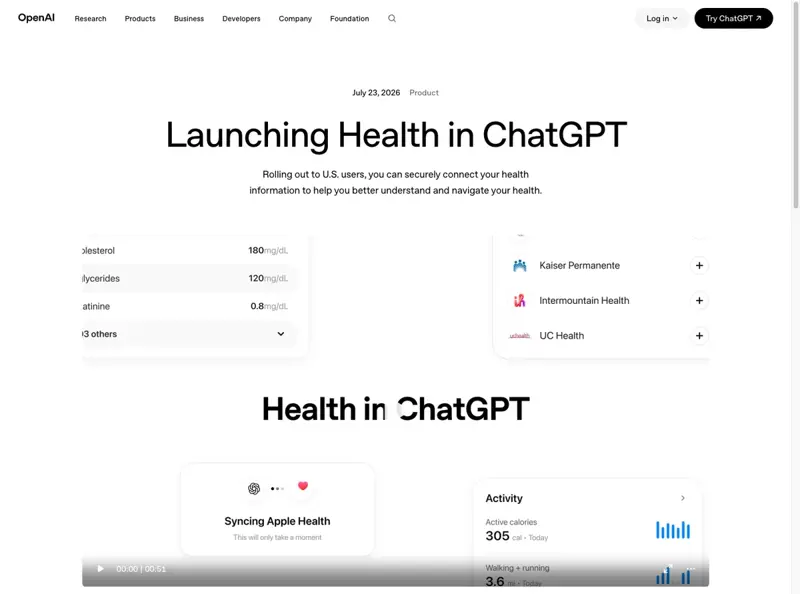
OpenAI’s own Health page lays out the pitch: connect Apple Health and your records, ask about labs and appointments. The privacy promises are real — but they’re policy, not law. Source: OpenAI.
What this means for you
If you’re managing a chronic condition: This is probably the strongest use. Diabetes, thyroid, blood pressure — anything where you track numbers over time. Having ChatGPT line up two years of labs and say “your A1C has crept up since spring” can genuinely help you walk into an appointment prepared. Just bring the summary to your doctor. Don’t let it replace the visit.
If you barely use ChatGPT and this feels like a lot: Then skip it, or start tiny. You don’t have to connect your whole medical history to try it. Upload one lab PDF, ask it to explain the terms in plain English, and see if the answer’s actually useful before you hand over anything more.
If you’re privacy-cautious: Connect nothing permanent. Use the upload option for a single document, get your answer, then delete the chat. You still get the benefit — plain-English explanations — without a standing live link to your hospital records. And keep that 30-day deletion rule in your back pocket if you ever connect and change your mind.
If you’re helping an aging parent: This can be a real help for untangling a messy medical picture — meds from three different doctors, results scattered across portals. But it’s their data and their consent. Set it up with them, not for them, and keep the “we’ll ask the doctor” habit front and center.
What it can’t do — and when to just call a doctor
Read this part twice. ChatGPT Health is not medical advice, and it is not a diagnosis. It’s an explainer and an organizer. Here’s where it falls down — and these aren’t hunches, they’re from peer-reviewed studies of ChatGPT on real medical tasks.
- It’s confidently wrong more often than you’d expect. On US medical licensing exam questions, ChatGPT scores around 60% — barely passing. On a UK neurology specialty exam, its diagnosis accuracy was 63%, and its ability to interpret findings dropped to 50–58%. Reading coronary angiograms against real cardiologists, one study clocked it at 71.6% sensitivity and 57.2% specificity. Those are coin-flip-ish numbers for anything that matters.
- It gets worse on the hard stuff. Accuracy falls on specialty questions — pediatrics, gynecology, cases with more than one condition tangled together. In a cancer tumor-board test, its subtype “diagnosis” was often simply wrong even when it was handed the full case.
- It confabulates. Researchers use that word on purpose. ChatGPT will state something false in exactly the same confident tone it uses for something true. There’s no wobble in its voice to warn you — one BMJ commentary compared it to a memory disorder. If you want a deeper look at why AI sounds so sure of itself, we wrote a whole piece on whether you can trust AI.
- It can’t actually see you. It does better when a human hands it complete records, but it can’t examine you, order a test, or sense that something’s off. Anything urgent, anything involving images like scans or X-rays, anything where you’d want a second human opinion — that’s out of scope.
And there’s a fresh reminder of the stakes. In late July 2026, a Florida man sued OpenAI, alleging ChatGPT told him his symptoms were “not something dangerous” and to take it easy — shortly before a near-fatal pulmonary embolism. It’s an allegation, and the courts will sort out what happened. But the lesson stands on its own. When in doubt, call a human. New or severe symptoms, chest pain, anything that scares you — that’s an ER or a doctor, not a chat window.
Simplest rule I can give you: use it to understand what already happened, never to decide what to do next.
The bottom line
ChatGPT Health is a real convenience wrapped around a real risk. The convenience is genuine — plain-English explanations of confusing results, one home for a scattered medical history, sharper questions for your next appointment. The risk isn’t that OpenAI is going to sell your bloodwork; by its own policy, it won’t train on it or advertise against it. The risk is quieter than that. It’s that a confident, sometimes-wrong chatbot starts to feel like a doctor — and that your records now live under a privacy policy instead of a privacy law.
So connect deliberately, or don’t connect at all. Use it to prepare for care, not to replace it. And if you want to get sharper at spotting when any AI is bluffing you — in health or anywhere else — that’s exactly the muscle our Become AI Fluent course is built to train.
Sources:
- Launching Health in ChatGPT — OpenAI
- Health in ChatGPT — OpenAI Help Center
- Health Privacy Notice — OpenAI
- Is Giving ChatGPT Health Your Medical Records a Good Idea? — TIME
- ChatGPT Health Goes Nationwide: Your Medical Records and HIPAA — Tech Times
- OpenAI rolls out Health in ChatGPT — Fierce Healthcare
- ChatGPT wants access to your health records — The Register
- Evaluating the limits of AI in medical specialisation: ChatGPT on the UK Neurology exam — BMJ Neurology Open
- ChatGPT in medical licensing examination: diagnostic accuracy — BMJ Health & Care Informatics
- Florida man sues OpenAI over dangerous medical advice — CBS News
