

On April 21, Google dropped two autonomous research agents on the same day. Deep Research runs in five to ten minutes. Deep Research Max reads 900,000 tokens before it even starts writing — a single run can take a full hour.
And here’s the detail every market researcher should care about: both can plug straight into FactSet, S&P Global, PitchBook, and Morningstar. That hasn’t been possible from a general-purpose LLM before.
So the question isn’t which one is “better.” It’s which one fits each phase of the work you actually do — the competitive scan, the briefing pack, the overnight industry report that has to land in someone’s inbox by Monday morning.
Let’s get into it.
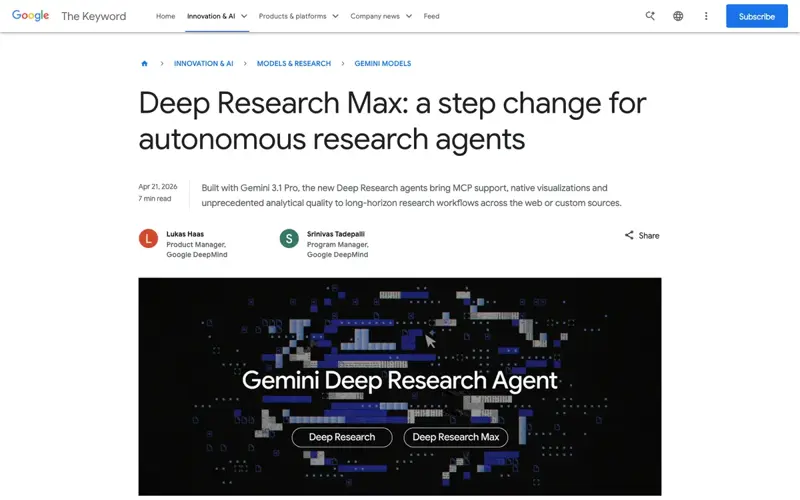
Google’s official launch post, April 21, 2026. Source: The Keyword blog.
What Actually Shipped
Both agents run on Gemini 3.1 Pro. Both support Model Context Protocol (MCP) — the thing that lets the agent query private databases instead of just the open web. Both render charts and infographics inline. Both let you preview and edit the research plan before the agent runs.
The difference is how deep they go and how long they take.
| Spec | Deep Research | Deep Research Max |
|---|---|---|
| Web searches per run | ~80 | ~160 |
| Input tokens | ~250k | ~900k |
| Latency | 5-10 min | Up to 60 min |
| Mode | Interactive / synchronous | Asynchronous / batch |
| DeepSearchQA benchmark | — | 93.3% |
| BrowseComp benchmark | 61.9% | 85.9% |
| Typical cost per run | ~$1.22 | ~$3-$7 |
Those benchmark numbers matter. BrowseComp specifically measures how well an agent finds hard-to-locate facts across the open web — the thing most research agents still fall apart on. Google’s own standard Deep Research went from 59.2% in December to 61.9% in this update. Max jumped to 85.9%. For comparison, GPT-5.4 Thinking xhigh sits at 58.9% on the same benchmark. Anthropic’s Opus 4.6 Max is at 45.1%.
That’s not a catch-up release. That’s a 27-point lead on a task McKinsey pays associates serious money to do well.
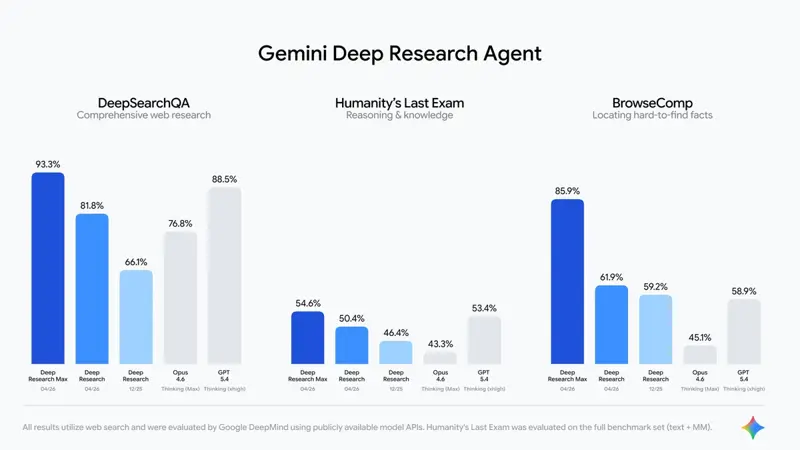
Google DeepMind’s own benchmark chart comparing Deep Research Max against standard Deep Research, Claude Opus 4.6, and GPT-5.4 across DeepSearchQA, Humanity’s Last Exam, and BrowseComp. Source: Google Blog.
One honest caveat before you get excited: these are vendor-reported numbers evaluated by Google DeepMind on public APIs. Independent evaluations are still pending. Treat them as a strong prior, not proof.
What Is Deep Research Max, Actually?
If you haven’t touched it yet, here’s the plain version. You type a research question — “map the competitive landscape for refrigerated B2B meal kits in the UK, including private equity activity 2024-2026” — and the agent plans a multi-step investigation. It searches the open web. It pulls data from any proprietary source you’ve connected via MCP. It writes a cited report with embedded charts.
Max is the “kick it off before bed, read the finished report over coffee” mode. Google literally pitches it that way in the launch blog. One early tester generated a 19-page company research document on his first run. Nothing magical — just the same infrastructure that already powers Gemini App, NotebookLM, and Google Finance, now exposed via the API.
The catch: you pay per token. One X user connected an API key, ran a single Deep Research Max session, and got billed ₹1,679 — about $18 for one report. His one-word verdict: “never use it again.” We’ll come back to cost.
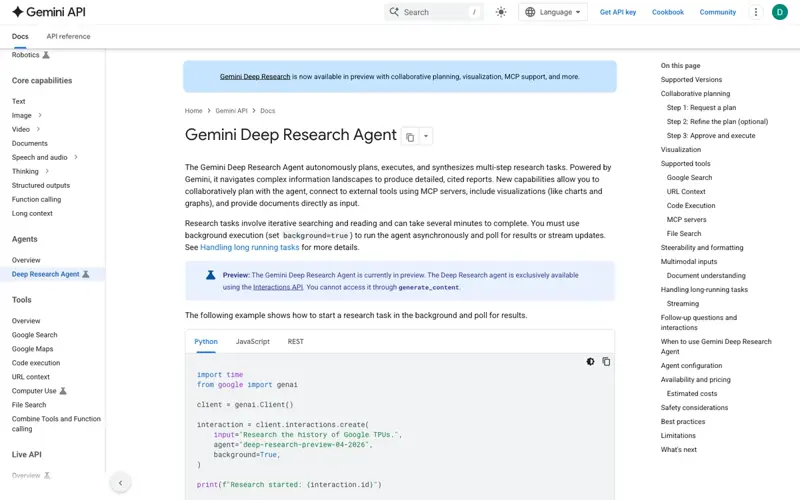
The Deep Research Agent page in Google’s Gemini API docs. Note the Preview banner — Deep Research is exclusively accessible via the Interactions API, not generate_content. Source: ai.google.dev.
When Deep Research (Not Max) Is the Right Pick
You’re running a live competitive scan during a client call. You need an answer in under ten minutes. The research question is narrow — “what’s Kantar’s latest coverage of the Gen Z luxury beauty segment?” rather than “build me a full category overview.”
Standard Deep Research handles this. 80 searches, 250k input tokens, a few minutes of wait time, about $1.22 per run. The output is cited, structured, and usually enough to fact-check a hunch or build a slide in real time.
Interactive research — where you iterate, ask a follow-up, then pivot — is also the right fit. Max’s 60-minute horizon kills that rhythm. You’d wait an hour to find out you asked the wrong question.
Use Deep Research when:
- You need a fast, cited brief during active work
- The question is scoped to one angle, one market, one player
- You want to iterate with follow-ups and see intermediate reasoning
- The stakes are exploratory — informing a meeting, not signing off a deliverable
When Deep Research Max Earns the Wait
You’re prepping a competitive landscape deck for a strategy engagement. The client wants private equity activity, market sizing, three-year trend analysis, regulatory context, and a 20-company landscape grid. Normally an associate spends a day and a half assembling this. You have four hours before the kickoff call.
This is the Max job. You draft the prompt, spend ten minutes reviewing and editing the research plan it proposes, hit go, and walk into your meeting. By the time you’re back, a 30-page cited report is waiting with embedded charts.
Or the other use case: the overnight batch. You set Max running on three different category briefs at 6pm Friday. By Monday morning, three fully-researched briefing packs are in your inbox. The bottleneck stops being analyst-hours and becomes review time.
Use Deep Research Max when:
- The deliverable is long-form — a full briefing pack, not a question
- You need breadth (100+ sources synthesized) not speed
- The work can run asynchronously — overnight, during a meeting, while you focus elsewhere
- Cost per run is justified because a human would take 8-16 hours on the same output
The MCP Piece Is the Real Story
Here’s what most of the launch coverage misunderstands. Benchmark numbers are open-web benchmarks. The product is not. What makes this a step change for market research specifically is Model Context Protocol support.
MCP lets the agent query proprietary data the open web doesn’t index. Google has named four financial data providers as MCP partners:
- FactSet — market data, consensus estimates, SEC filings
- S&P Global — indices, credit ratings, ESG analysis (via the Kensho AI Hub MCP server that originally launched for Claude in July 2025)
- PitchBook — private equity, venture capital, M&A database
- Morningstar — investment research on public markets
The hedge fund version of this is flashy: point the agent at your internal deal flow plus a PitchBook feed plus the open web, and get a synthesis across all three in one report.
The market research version is more boring and more valuable. Competitive landscapes that require both public data (press releases, SEC filings, industry news) and syndicated research (PitchBook firmographic data, S&P credit views) can run as a single prompt. The “scan for signals” phase of competitive intelligence — which used to need one analyst on open web and another logged into the data terminal — collapses into one pass.
One critical detail people keep missing: MCP is the integration layer, not a data license. You still need an active FactSet subscription to use the FactSet MCP server. The integration doesn’t unlock someone else’s paid data for free.
Where It Still Falls Short
Let’s be honest about what Deep Research and Max cannot do.
Primary research. These agents can’t run customer interviews, moderate focus groups, or replace an Ipsos panel. Any claim that AI “replaces market researchers” runs aground on this — the qualitative primary layer is still a human job.
Non-MCP paywalled data. Without an active MCP server plus a paid subscription, the agent can’t touch Bloomberg Terminal data, proprietary Nielsen panels, MSCI ESG feeds, or Euromonitor reports. Your access is exactly what your licenses already cover — no more.
Nuanced qualitative judgment. Forrester’s 2026 research on AI-augmented analysis frames it as “embedding insights into the flow of work” — not replacing the human interpretation layer. McKinsey’s State of Organizations 2026 is more pointed: BCG’s 2025 Global AI Study found only about 5% of organizations have realized substantial financial gains from AI. The bottleneck isn’t tool adoption. It’s workflow integration and judgment.
Reliability at the edges. A January 2026 arXiv paper titled “Why Your Deep Research Agent Fails? On Hallucination Evaluation of Deep Research Agents” evaluated six agents including Gemini, OpenAI, Perplexity, Qwen, and Grok. The finding: every single one fails to achieve robust reliability, with “multidimensional deficits” in retrieval quality and factual grounding. Gemini 3.1 Pro specifically scores highest on the FACTS benchmark (68.8) but also shows what researchers call the “Gemini paradox” — 88% hallucination rate on AA-Omniscience, a metric for confident-but-wrong assertions in long-horizon reasoning chains.
In plain terms: these agents sound authoritative even when they’re wrong. That’s the single most dangerous failure mode for a market research deliverable that ends up in front of a client.
The 60-minute timeout. Very broad queries can hit the wall and return partial reports. Scope your Max runs. “Everything about the global snack food market” will choke. “Private equity activity in UK refrigerated ready-meals, 2024-2026” will not.
Cost surprises. Web search results count as input tokens. Reasoning tokens (when enabled) bill as output. Max sessions can spike past the $3-$7 range Google quotes if your prompt pulls in huge source sets. Budget for it.
How It Stacks Up Against the Rest
As of late April 2026, here’s the competitive map.
| Tool | Strength | Cost / Access | When to reach for it |
|---|---|---|---|
| Gemini Deep Research Max | Highest benchmarks, async batch, MCP financial ecosystem | Gemini API paid tier; $3-$7+ per Max run | Long-form briefing packs, overnight research, enterprise data pipelines |
| Gemini Deep Research | Fast cited briefs with the same MCP access | Gemini API paid tier; ~$1.22 per run | Live research during meetings, iterative scoping |
| OpenAI ChatGPT Deep Research | Strongest narrative synthesis | 10 runs/month on Plus; limited API | When the deliverable is a long prose report, not a data brief |
| Perplexity Pro Deep Research | Fast, transparent inline citations | $2/$8 per million tokens; under 3 min | Fact-checking, cited quick-reference, interactive Q&A |
| Anthropic Claude Projects | Strong reasoning on structured data | Claude Pro/Teams; includes same MCP financial ecosystem (FactSet, S&P Capital IQ, Morningstar, Moody’s, PitchBook, LSEG announced April 2026) | Code-heavy research, structured document analysis |
| Kimi K2.6 (open swarm) | Competitive on BrowseComp (86.3%), no per-run licensing | Open weights, DIY hosting | Teams with engineering resources who want cost control |
Two points to flag from that table.
First, Anthropic shipped a nearly identical MCP financial ecosystem in April 2026. Google’s MCP partner list overlaps heavily with Claude’s. For firms that have standardized on Claude already, switching to Gemini just for the data access isn’t necessary. What Google wins on is the benchmark lead and the 160-search / 900k-token horizon.
Second, Perplexity still wins on latency and citation transparency for quick-reference work. If you’re fact-checking a claim in real time, Perplexity is still the right tool. Deep Research Max is overkill for questions that fit in a paragraph answer.
The Real Workflow: Use Both
The pros I’ve talked to over the last 24 hours aren’t picking one. They’re stacking them.
A typical consulting day might look like this:
- Morning — live research. Deep Research (not Max) during the client call to pull a cited brief on a specific competitor in under ten minutes.
- Midday — batch run. Kick off a Deep Research Max job on the full competitive landscape before lunch. Edit the research plan before it starts. Walk away.
- Afternoon — synthesis. While Max runs, you work on the deck outline. When it’s done, you pull key data points from the cited report and drop them into your slides.
- Evening — overnight jobs. Queue three Max runs for the three parallel category briefs you owe by Thursday. Review tomorrow morning.
The trap is using Max for everything. It’s expensive, and the 60-minute wait breaks any interactive rhythm. The other trap is using Deep Research for deliverables that need the 160-search depth. You’ll get a shallower report that a senior will flag on read.
Match the tool to the phase. That’s it.
What This Means for You
If you’re a market researcher at a consulting firm: Your associate-level competitive landscape work is the exact task Deep Research Max was built to compress. The real play isn’t replacing the associate — it’s having the associate run three parallel Max jobs on Friday afternoon and spend Monday reviewing and sharpening, not assembling. That’s a 3x throughput move.
If you’re a strategy consultant at a small firm or solo: This changes your unit economics. A single Max run at $3-$7 replaces several hours of your own time or an outsourced researcher. If you’re charging clients for landscape work, you’re now competing against peers who can ship a 30-page cited brief overnight. Either speed up, or specialize on the judgment layer the agent can’t touch.
If you lead an in-house corporate strategy team: Your Gemini Enterprise seat is the gate. Google has said Deep Research and Max will “soon” be available on Google Cloud for enterprises, but the exact licensing tier isn’t public yet. The API is available today on the paid tier. If you want secure enterprise access, start the procurement conversation this week — the tool is real, the access path is still settling.
If you work in research ops or data licensing: The MCP piece is the thing to watch. Every proprietary data provider in your stack is going to get asked “is there an MCP server?” in the next 90 days. Get ahead of it.
If you’ve never used AI for research: The low-risk way to start is Perplexity Pro for small cited searches, then Gemini Deep Research (not Max) for fuller briefs. Skip Max until you have a specific long-form deliverable where the hour of runtime is worth it. Don’t pay for the ceiling when the floor does the job.
Who Should Actually Use Deep Research Max
You should use Deep Research Max if you meet two of these three:
- You produce research deliverables longer than ten pages at least weekly
- You or your team pays for at least one of FactSet, S&P Global, PitchBook, or Morningstar
- Your research work runs on multi-day timelines where an overnight batch genuinely helps
If none of the three fit, standard Deep Research at $1.22 a run is the right starting point. If all three fit, you’re the exact target user Google built this for.
The Bottom Line
Deep Research Max is not a chatbot upgrade. It’s a research-grade agent aimed directly at the work market researchers, strategy consultants, and corporate strategy analysts do every day. The benchmark lead over GPT-5.4 and Claude is real. The MCP connections to FactSet, S&P Global, PitchBook, and Morningstar turn it from a web search tool into an enterprise research tool. The 60-minute async mode matches how overnight briefing packs already get generated in consulting firms.
But it’s not magic. The “Gemini paradox” — highest FACTS score and 88% hallucination rate on confident-but-wrong assertions — means every Max report still needs human review before it leaves your desk. The 60-minute horizon isn’t a feature if you haven’t scoped the question. The $18 real-world cost from one early user is a warning, not a fluke.
The right move for most market research teams: start with standard Deep Research on the Gemini API for a week. See if the output quality is enough for your typical brief. Only graduate to Max when you have a long-form deliverable where the hour is worth the cost. Pair it with Perplexity for quick fact-checks and Claude Projects for structured document analysis.
And for the love of research integrity, review the citations before you ship the slide.
Sources:
- Deep Research Max: a step change for autonomous research agents — Google Blog (Apr 21, 2026)
- Gemini Deep Research Agent — Google AI for Developers documentation
- Google’s new Deep Research and Deep Research Max agents can search the web and your private data — VentureBeat
- Google launches Deep Research and Deep Research Max agents to automate complex research — The Decoder
- Why Your Deep Research Agent Fails? On Hallucination Evaluation of Deep Research Agents — arXiv:2601.22984
- Google Launches Deep Research Agents For Enterprise Workflows — Dataconomy
- PitchBook Announces New Essential MCP Integration — Yahoo Finance
- Morningstar and PitchBook Bring Trusted Investing Intelligence to Apps — Morningstar Newsroom
- S&P Global and Anthropic Announce Integration of Trusted Financial Data — S&P Global Press