DeepSeek is one of the most downloaded free AI apps in the world. It’s also blocked on government devices in Italy, Australia, South Korea, and a big chunk of the US federal government. Both of those things are true at the same time — which is exactly why searching “is DeepSeek safe” turns into such a headache. You get security-vendor jargon on one side and “relax, it’s fine” threads on the other.
Here’s the calm version. Where your data actually goes, what’s proven versus what’s just an accusation, and the honest line on when DeepSeek is fine to use — and when you should keep it well away from your keyboard.
What DeepSeek is (and what just blew up again)
DeepSeek is a Chinese AI lab. Its chatbot went viral in January 2025 by matching the big US models at a fraction of the cost, and it shot to number one in the app stores almost overnight. It’s free to chat with, cheap to build on, and it releases open “weights” — the model files anyone can download and run themselves. That last part matters later.
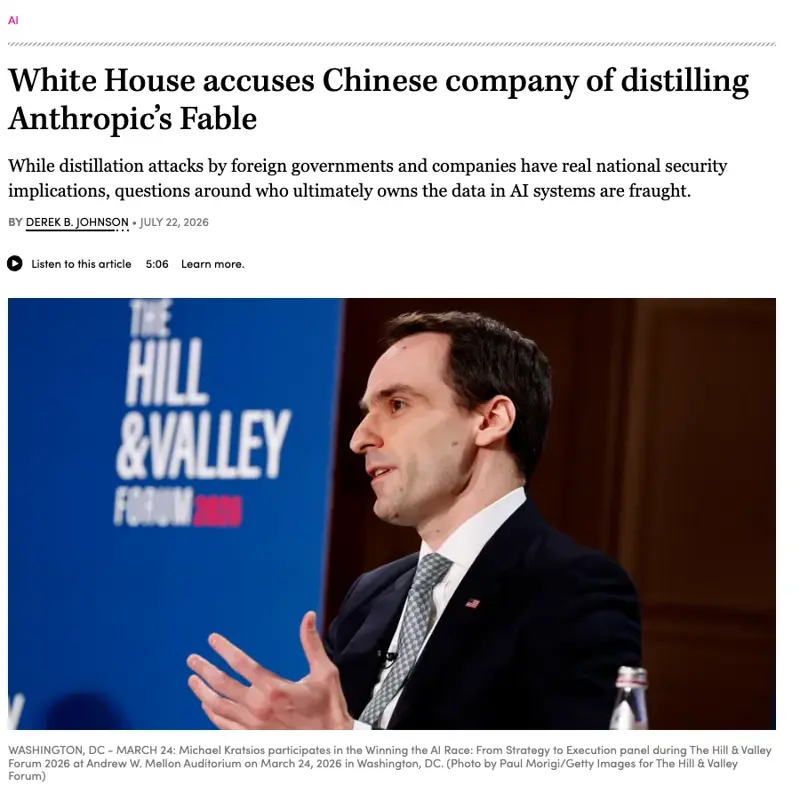
The reason it’s back in the headlines this month isn’t DeepSeek exactly. On July 22, 2026, a White House official accused a different Chinese lab — Moonshot, maker of the Kimi model — of secretly copying a US AI to build its latest system. No proof was released, and the accusation is disputed. But it dragged the whole question back into the open: can you trust where your AI came from, and is it safe to hand it your data? For most people, “a Chinese AI app” still means DeepSeek. So that’s the one we’ll actually answer.
Where your data goes (this part isn’t a rumor)
Start with the thing nobody disputes, because it’s written in DeepSeek’s own privacy policy: the company stores the information it collects on servers in China.
And it collects a lot. Your account details. Everything you type into the chat, plus any files or audio you send. Your IP address and device info. The policy even lists keystroke patterns — how you type, not just what.
Now layer on the legal part. Under China’s national-security and intelligence laws, the government can require Chinese companies to hand over data they hold. That’s not a conspiracy theory — it’s the specific, boring reason a dozen governments told their staff to delete the app. Your chat history sits somewhere you can’t reach, under rules you don’t control.
That’s the real risk with DeepSeek. Not that it’s secretly attacking your phone. That where your words end up is out of your hands.
What’s proven vs what’s just alleged
This is where most articles blur the line, so let’s not.
Documented — you can check these yourself:
- The bans are real. In 2025, Italy’s privacy regulator ordered a nationwide block and the app got pulled from stores there. South Korea paused downloads. Australia banned it on government devices. The US Navy, NASA, both houses of Congress, and roughly 16–17 US states restricted it too.
- The database leak was real. In January 2025, security firm Wiz found an exposed DeepSeek database — over a million log lines, including plain-text chat history and secret keys, sitting open on the internet. DeepSeek locked it down about 30 minutes after being told. Real, embarrassing, and since fixed.
- The app flaws were real. Researchers at NowSecure found the iOS app disabled a standard Apple security protection and used weak, outdated encryption. Also real, also mostly patched since.
Alleged — not proven:
- The “copying” accusation. The July 2026 White House claim that Moonshot distilled a US model to build Kimi K3 came with no public evidence, and researchers point out the timeline barely adds up. Anthropic put out an earlier report in February 2026 saying several Chinese labs — DeepSeek among them — pulled its model’s outputs through thousands of fake accounts. More concrete, but still contested, and China calls it groundless. Treat all of this as an accusation, not a verdict.
“But it says it’s Claude!” — what that actually means
You’ve probably seen the screenshots where a Chinese model, asked what it is, replies that it’s Claude, made by Anthropic. People wave those around as a smoking gun. It’s suggestive. It’s not proof.
Here’s why. The open web is now saturated with text like “I am Claude, an AI assistant made by Anthropic.” Any model trained on a big scrape of the internet can soak up those phrases and parrot them back — without ever having touched the original model. Google’s Gemini once insisted it was ChatGPT. Early open-source models did the same thing. Researchers do flag this pattern as worth investigating, but on its own, a model calling itself Claude tells you the training data was messy, not that anyone stole anything.
If you want the longer version of how to reason about confident-but-unverified AI claims like this one, we wrote a whole piece on it: Can You Trust AI?
So — is it safe to use?
Depends entirely on what you’re using it for. Same rule we’d give you for any tool.
The test is simple: would you be okay posting this on a public forum you can’t delete? If yes, DeepSeek is fine. If it makes you flinch, don’t type it in.
What this means for you
If you’re just curious: Go ahead and try it. Ask it to explain something, draft a poem, compare two ideas. Keep it to stuff you wouldn’t mind a stranger reading. The capability is genuinely good, and poking around costs you nothing but a little attention to what you paste.
If you’d enter personal or financial info: Don’t. Not your taxes, not your medical questions with real details, not your passwords or account numbers. Swap in a chatbot that stores data somewhere you’re comfortable with, or strip the personal bits out before you ask.
If you use AI at your job: Check your company’s policy first — a lot of employers have already banned DeepSeek outright, and using it with work data could put you offside. Never feed it client files, internal docs, or anything under an NDA.
If you’re a developer or tinkerer: The open weights are your escape hatch. Download the model and run it locally, or use it through a Western host, and the “data goes to China” problem basically disappears — because the pipe to their servers is gone. The model itself isn’t the threat. The app-and-API plumbing is.
What this post can’t tell you
Honesty cuts both ways, so here’s what I can’t promise you.
- Whether a future update changes the rules. Privacy policies get rewritten. What’s collected today might not be what’s collected next year. Re-check before you trust it with more.
- Whether it’s safe for your specific job. That’s a compliance call that depends on your industry and your data — above what any blog post can answer for you.
- Whether the copying accusation is true. It’s unresolved. Anyone telling you it’s definitely proven, or definitely fake, is guessing.
- What actually happens to data once it lands on those servers. Nobody outside the company can see that. “Stored in China under laws that can compel access” is the honest ceiling of what we know.
- This isn’t a full security audit. If you’re rolling DeepSeek out across a whole company, get a real review — not a 1,700-word explainer.
The bottom line
DeepSeek is a capable, genuinely impressive free AI. It is not secretly hacking your phone. But it stores what you type on servers in China, under laws that can force access — and that, not some movie-villain malware, is why so many governments said no.
So the honest answer is the useful one. Fine for casual, non-sensitive questions. Not for your personal, financial, or work data. If that line feels a little annoying, that is the answer — and knowing exactly where the line sits beats both the panic and the “relax, it’s nothing.”
The real skill here isn’t memorizing which app is banned this week. It’s being able to size up any AI tool — where the data goes, what’s proven, what’s hype — in about two minutes. That’s the whole point of our Become AI-Fluent course, and it outlasts any single headline.
Sources:
- DeepSeek Privacy Policy
- DeepSeek’s app sends US data to China — Wired
- Wiz Research: exposed DeepSeek database leak
- DeepSeek chat histories were publicly exposed — Ars Technica
- NowSecure: security and privacy flaws in the DeepSeek iOS app
- Italy’s Garante orders DeepSeek block
- US Congress bans DeepSeek — Axios
- South Korea pauses DeepSeek downloads — PBS
- Australia warns on DeepSeek — BBC
- DeepSeek and the China data question — IAPP
- Trump official accuses Moonshot AI, no evidence presented — SCMP
- White House accuses Chinese company of distilling Anthropic’s Fable — CyberScoop
