

Somewhere this week, a buyer typed “who’s the best real estate agent in [their city]” into ChatGPT — and got an answer that didn’t include you. Not because you’re bad at your job. Because AI search engines can’t see you, and by most current estimates, that’s true for roughly 9 out of 10 agents in the US right now.
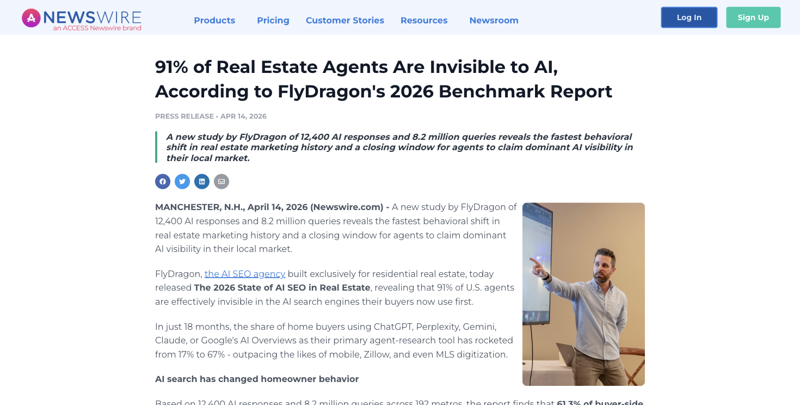
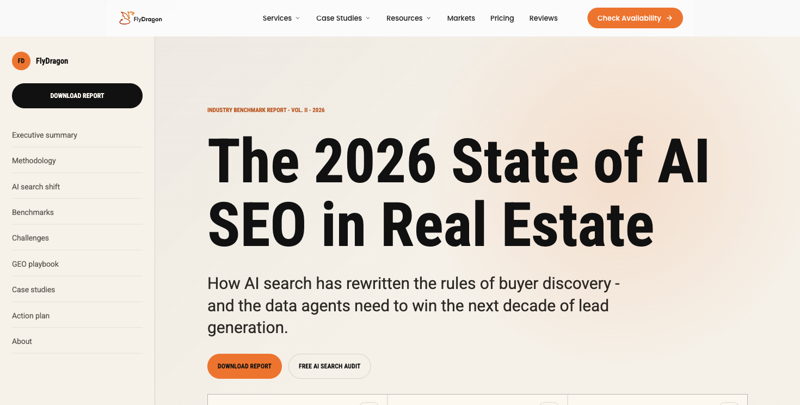
That’s the headline finding from FlyDragon’s 2026 State of AI SEO in Real Estate report: 91% of agents are effectively invisible in the AI search engines their buyers increasingly use first. In the space of 18 months, the share of home buyers using ChatGPT, Perplexity, Gemini, Claude, or Google’s AI Overviews as their primary agent-research tool has jumped from 17% to 67% — a faster behavioral shift than mobile search, Zillow adoption, or MLS digitization ever produced. This is the plain-language version of what changed, what the data actually supports (and doesn’t), and the concrete, do-it-yourself fix for a solo agent who isn’t going to hire an agency to solve this.
What Just Changed for Real Estate Agents
For close to two decades, “getting found” as an agent meant ranking on Zillow, showing up in Google’s local pack, or getting referred by a past client. That’s not gone, but it’s no longer the whole game. A growing share of buyers now start their agent search inside a chat window, not a search results page — and the AI doesn’t work the way Google’s blue links do.
When a buyer asks ChatGPT “who’s a good realtor in Austin,” the model isn’t running a live search and ranking paid listings. It’s synthesizing an answer from whatever it can find and trust about agents in that market — website content, Google Business Profile data, press mentions, structured data, review signals — and naming a small number of them, usually without you knowing you were even in the running. If your online presence doesn’t give the AI enough to work with, you don’t rank lower. You don’t exist in the answer at all.
FlyDragon’s report puts a number on how lopsided this has already become: analyzing roughly 12,400 AI-generated responses across 8.2 million buyer queries in 192 US metro markets, the study found only about 8.4% of agents appear in high-intent AI answers. The other 91%? Never cited, in any of the queries sampled. And it’s not evenly distributed — the top 1% of agents by AI-search presence capture 47% of total citation share, and in 71% of metros studied, no single agent breaks above a 15% citation share in their own market. This is a winner-take-most dynamic forming in real time, and most agents don’t know it’s happening.
An Important Honesty Check on the Data
Before going further, it’s worth being direct about something most coverage of this report skips: FlyDragon is a vendor selling an AI-visibility scorecard and optimization service. This is not an NAR study, an academic paper, or an independently audited benchmark. The 91% figure, the 17%-to-67% buyer-behavior shift, and the metro-level citation-share numbers all come from FlyDragon’s own proprietary measurement methodology. The company hasn’t published its raw query list, its full sampling frame, or independently reproducible attribution rules for how it decided an agent was “cited” versus not.
That doesn’t mean the numbers are wrong — multiple pieces of independent, corroborating evidence point the same direction (more on that below) — but it does mean you should treat “91%” as a vendor’s best estimate of a real and fast-moving trend, not a peer-reviewed fact. The trend is real. The precise percentage is closer to informed marketing research than settled science.
Here’s the corroborating evidence that matters more than the exact percentage:
- 5WPR and Haute Residence’s separate 2026 study found real estate has the lowest AI Overview trigger rate of any tracked industry — just 0.14% — even though 82% of agents say they now use AI daily in their work. That’s an independent confirmation of the same underlying gap: agents are adopting AI as a tool, but not showing up as a result.
- An independent analysis from Omni Eclipse, which examined 334 real ChatGPT answers across 197 property markets, found the model cites a median of just 6 agents per city — and 98% of what it cites traces back to the agent’s own website or Google Business Profile. Notably: Zillow was cited zero times in that sample. If that holds up at scale, it means the AI-search game and the portal-ranking game an agent has been playing for 15 years are almost entirely different games, with different inputs.
- Zillow’s own agent-discovery traffic share fell from 41.2% to 33.8% year-over-year — its first recorded decline since portal-share tracking began in 2024 — with the displaced share moving toward AI tools rather than competing portals. That’s a market-level signal independent of FlyDragon’s specific methodology.
The Walkthrough: A 20-Minute AI-Visibility Audit
You don’t need an agency retainer to start showing up. Here’s the self-test and fix, in order.
Step 1: Run the self-test
Open ChatGPT (or Perplexity, or Gemini) and ask it directly: “Who is a good real estate agent in [your city/neighborhood + your specialty, e.g., ‘first-time buyers in East Austin’]?” Try three or four phrasings a real buyer would actually use — not marketing language, buyer language. Note whether you appear, who does, and what those competitors have in common (chances are it’s a strong Google Business Profile, plain-language bio content, and specific neighborhood mentions).
Expected result: If you’re like roughly 9 in 10 agents, you won’t appear. That’s the baseline you’re fixing, not a verdict on your business.
Step 2: Rewrite your bio for how AI reads, not how humans skim
AI models pull from text that answers a question plainly. A bio full of taglines (“Your trusted partner in real estate excellence”) gives the model nothing concrete to cite. A bio that says “I specialize in first-time buyers in East Austin, closed 34 transactions in 2025, and average 11 days faster than the area’s median time-to-close” gives it specific, citable facts.
Rewrite checklist:
- Name your specialty in plain terms (first-time buyers, luxury condos, relocation, new construction)
- Name your specific geography — neighborhood-level, not just “the greater metro area”
- Include a real, current number (transactions closed, years of experience, average days-on-market for your listings) — never invent one
- Answer the implicit question “why this agent, for this kind of buyer” in the first two sentences
Step 3: Audit and complete your Google Business Profile
This is the single highest-leverage fix, based on the Omni Eclipse finding that 98% of AI citations trace to an agent’s own site or Google Business Profile. Log in and confirm:
- Your category is set precisely (Real Estate Agent, not just “Real Estate Agency” if you’re a solo agent)
- Your service area lists actual neighborhoods, not just the city name
- Your posts and Q&A section are active — these are a text source models can pull from directly
- Your review responses are substantive, not “Thanks!” — a response like “So glad we found the right first home for your family in Mueller” gives the AI another neighborhood + specialty signal to associate with your name
Step 4: Publish content that answers real buyer questions
You don’t need a blog empire. Three or four pages that directly answer questions buyers actually type — “what’s a typical closing timeline in [your city],” “how does [your neighborhood]’s school district affect resale value,” “what should a first-time buyer budget for closing costs here” — give AI models concrete, attributable material with your name attached. This is the same logic that made “featured snippet” optimization work for Google; it’s just aimed at a chat answer instead of a blue link now.
Step 5: Re-run the self-test in 30 days
AI-search citation isn’t instant — models re-crawl and re-weight sources on their own schedule, not yours. Set a calendar reminder to re-run Step 1’s exact queries a month out and track whether you’ve entered the answer set.
What This Means for You
If you’re a solo agent with no marketing budget: Steps 1–3 above cost nothing but time. Do those first, this week, before considering any paid AI-visibility service.
If you’re at a 5–10 agent brokerage: Standardize the bio-rewrite template (Step 2) across your team’s individual agent pages — a shared content gap (generic taglines, no neighborhood specificity) hurts every agent’s citation odds equally, so fixing it once, as a template, multiplies the fix.
If you’re a luxury specialist: The Haute Residence/5WPR finding that real estate has the lowest AI-Overview trigger rate of any industry cuts both ways for you — less competition to be cited if you get the fundamentals right, but also less existing search volume to capture at the high end. Prioritize Google Business Profile completeness and press mentions over volume content.
If you’re a new agent (under 2 years in the business): You don’t have a long track record to cite yet, and that’s fine — lean hard on specificity (a tight geographic niche, a specific buyer type) rather than trying to compete on years of experience you don’t have.
If you’re a team lead managing 10+ agents: Consider running the FlyDragon-style self-test as a team exercise once a quarter — not to chase the vendor’s specific score, but because the underlying practice (checking whether your team is actually citable) is worth doing regardless of which report first surfaced the problem.
If you already rank well on Zillow and Realtor.com: Don’t assume that protects you. The Omni Eclipse data suggests portal ranking and AI citation draw from almost entirely different signals — a strong Zillow profile with a weak personal website and thin Google Business Profile can still be functionally invisible to ChatGPT.
If you’re skeptical this matters yet in your specific market: That’s a reasonable position for now, especially in markets where AI-search buyer behavior hasn’t caught up to the national average. But the FlyDragon data on early movers is the more actionable number here: agents who started this work in early 2025 already hold 5.7x the citation share of agents who started twelve months later — despite the latecomers spending more on average. Waiting has a real, compounding cost.
Edge Cases and Troubleshooting
“I tried the self-test and a competitor with a worse reputation showed up instead of me.” This usually means their online content is simply more specific and complete, not that the AI is making a quality judgment. Compare their Google Business Profile and bio content directly against yours using Step 2’s checklist — the gap is almost always in specificity, not merit.
“My brokerage’s corporate website doesn’t let me customize my agent page.” Your personal Google Business Profile and any personal social presence (a LinkedIn “About” section, a personal Instagram bio) are independent of your brokerage’s site and are still worth optimizing on their own.
“I rank fine on ChatGPT but not on Perplexity (or vice versa).” Different AI search products weight sources differently — Perplexity leans more heavily on recent, crawlable web content; ChatGPT’s answers can draw more on aggregated training data plus live browsing depending on the mode. Optimize for Google Business Profile and your own site first — those feed most models — before chasing platform-specific tactics.
“A buyer told me they asked AI and it recommended three agents, including a competitor who retired last year.” AI models can surface stale information, especially names that were heavily cited in older training data. If this happens with your own listing or profile info, it’s worth actively publishing current content to overwrite outdated signals — silence lets old data persist.
“I don’t have 34 closed transactions or an impressive number to cite.” Cite what’s true and specific instead: “I’ve helped 6 families find homes in the Riverside school district this year” is more useful to an AI (and a buyer) than an inflated number. Specificity beats volume.
“Is there a way to see exactly why an AI cited or didn’t cite me?” Not directly — none of the major AI search products currently expose per-source attribution reasoning the way Google Search Console shows ranking factors. The self-test-and-iterate loop (Steps 1 and 5) is currently the best available feedback mechanism.
“My market is small/rural — does any of this apply?” Possibly less urgently. The FlyDragon and Omni Eclipse data both skew toward higher-query-volume metros. In a market where buyers still rely heavily on local word-of-mouth and drive-by signage, the AI-search shift may take longer to matter — but the free fixes (Steps 2–3) cost nothing to do regardless.
Comparison: AI-Search Citation vs. Traditional Portal Ranking
| Factor | Zillow/Realtor.com ranking | AI-search citation (ChatGPT, Perplexity, Gemini) |
|---|---|---|
| Primary input | Paid placement, listing activity, portal-specific profile | Website content, Google Business Profile, structured data, press mentions |
| Cost to improve | Often requires paid featured-agent placement | Free — content and profile completeness |
| Visibility into ranking factors | Portal dashboards show some metrics | No exposed attribution — self-test is the only feedback loop |
| Update cycle | Real-time / near-real-time | Model-dependent re-crawl cycle, days to weeks |
| Winner concentration | Moderately concentrated | Highly concentrated (top 1% hold 47% of citation share per FlyDragon) |
| Independent verification | Portal-reported traffic numbers | Mixed — FlyDragon vendor data, corroborated in part by Omni Eclipse and 5WPR/Haute Residence |
What This Can’t Fix
It doesn’t replace referrals or a real reputation. AI-search citation is a discovery channel, not a trust channel. A buyer who finds you via ChatGPT still evaluates you the way any buyer does — through reviews, past-client conversations, and your actual responsiveness. The fixes in this piece get you into the conversation; they don’t close the deal for you.
It doesn’t work if your fundamentals are actually weak. No amount of bio-rewriting fixes a genuinely thin transaction history or poor reviews — if anything, making yourself more citable just means more scrutiny finds the same gaps faster.
The specific numbers in this piece may shift. Because the underlying research (FlyDragon in particular) is vendor-published and not independently audited at the raw-data level, treat “91%” and “17% to 67%” as directional evidence of a real trend, not permanent facts. Re-verify with fresh self-tests rather than assuming last year’s numbers still describe this year’s landscape.
It doesn’t guarantee you’ll be named over a competitor with genuinely better content. This is optimization, not manipulation. If a competitor has more specific, more current, more complete online content than you, the fixes in this piece narrow that gap — they don’t guarantee you win every citation.
Frequently Asked Questions
Is the “91% of agents are invisible to AI” statistic accurate? It’s FlyDragon’s own proprietary measurement, not an independently audited figure — treat it as a strong directional signal (multiple other studies point the same way) rather than an exact, verified number.
Do I need to pay for an AI-visibility service to fix this? No. The core fixes — bio rewrite, Google Business Profile completeness, a few pages of genuinely useful local content — cost time, not money. Paid services mainly offer speed and measurement dashboards, not access to tactics you can’t do yourself.
How is this different from regular SEO? Traditional SEO optimizes for ranking in a list of links a human then clicks through. AI-search optimization aims to get your specific facts synthesized directly into a generated answer — the buyer may never click a link at all, so your content needs to be complete and self-contained rather than optimized to earn a click.
Does having a strong Zillow profile help my AI-search visibility? Indirectly at best. The Omni Eclipse data found Zillow cited zero times across a 334-answer sample — AI models appear to lean on an agent’s own website and Google Business Profile far more than third-party portals.
How often should I re-check whether I show up in AI search? Monthly is reasonable while this trend is moving fast; quarterly once you’ve established consistent citation, since re-crawl cycles for most models aren’t instant.
Will NAR or my MLS regulate this? NAR has issued statements supporting AI integrations like Zillow’s ChatGPT app, provided they comply with existing MLS rules and data-license agreements — but there’s no NAR-specific “AI visibility standard” for individual agents as of this writing.
Is this trend the same across every market? No — the FlyDragon and Omni Eclipse data both concentrate on higher-volume US metros. Rural and smaller markets may see slower AI-search adoption from buyers, which changes the urgency but not the direction of the fix.
What’s the single highest-impact thing I can do this week? Complete your Google Business Profile with neighborhood-specific service areas and a rewritten, fact-based bio (Steps 2–3 above) — that’s the pair of fixes the independent Omni Eclipse data most directly supports.
The Bottom Line
The exact percentage in “91% of agents are invisible to AI” deserves a healthy dose of skepticism — it’s a vendor’s measurement, not a peer-reviewed study. But the underlying trend it’s describing is corroborated by multiple independent sources, and it points in one clear direction: buyers are increasingly asking AI to recommend an agent before they ever open a portal, and most agents’ online presence isn’t built to be readable by the systems doing that recommending. The fix doesn’t require a marketing budget — it requires 20 minutes rewriting your bio and completing your Google Business Profile with the specific, factual detail an AI model can actually cite.
If you want the fuller picture — CMA workflows, listing descriptions, and the AI tools that actually save you time day to day, not just visibility — our AI for Real Estate Agents course covers the parts of this job AI can genuinely help with, this fix included.
Sources
- Newswire — 91% of Real Estate Agents Are Invisible to AI, According to FlyDragon’s 2026 Benchmark Report
- FlyDragon — The 2026 State of AI Search in Real Estate
- Yahoo Finance — 91% of Real Estate Agents Are Invisible to AI
- AccessNewswire — 1,500 Real Estate Agents Tested Their AI Search Visibility, Only 1 in 10 Showed Up at All
- PR Newswire — 5WPR and Haute Residence Find Real Estate Ranks Last Among All Industries in AI Search Visibility
- Morningstar/PR Newswire — 5WPR & Haute Residence AI Search Visibility Report
- Inman — The 30-day plan to get your real estate business discovered by AI
- Pinova — Real Estate Portals’ ChatGPT Apps in 2026
- ConnectEra — Real estate AI arbitrage 2026: 71% of metros have no agent above 15% citation share
- NAR — AI Becomes Early Step in Homebuying Journey
- NAR — Statement on Zillow’s App for ChatGPT
- Inman — Zillow Goes “AI Mode” With New Home Search Assistant