You typed “will AI replace paralegals” into Google at 11pm, probably after a long day of watching your firm’s attorneys paste discovery summaries into ChatGPT. Every result told you not to worry. Not one of them told you what to actually do. That gap is the whole problem — and it’s also your opening.
Here’s the short version: no, AI is not going to replace paralegals wholesale. But it is already replacing the tasks — first-draft research, document summaries, contract review passes — that used to fill a big chunk of the job. What’s left standing between a firm and a sanctions order is one thing: a human who checks the AI’s work before it goes out the door. Right now, almost nobody is teaching that skill. This post does.
What just changed (and why you’re searching this at 11pm)
Go search “will ai replace paralegals” right now. Every single organic result — Clio, EvenUp, MyCase, Blackstone, LeanLaw, a handful of legal-AI vendor blogs — says some version of “don’t worry, it’s transformation, not replacement.” Google’s own AI Overview does something more interesting: it actually names the real risk, under a section literally titled “What AI Cannot Replace.” It says AI “frequently makes errors, including ‘hallucinating’ false case law or incorrect citations, requiring strict human verification.” Then it stops. Nobody on that page tells you how to do the verification. That’s the gap this post fills.
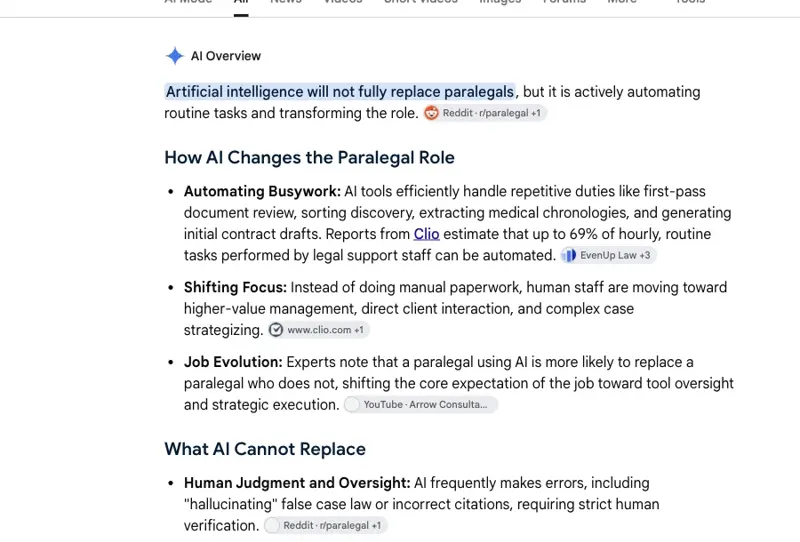
Source: Google Search, “will ai replace paralegals” (live SERP, August 2026)
The anxiety is real and it’s not irrational. The U.S. Bureau of Labor Statistics updated its 2024–2034 projections this year and paralegal employment is now expected to grow just 0.2% over the decade — about 600 net new jobs nationally, down from a 1.2% growth projection in the prior cycle. BLS says the reason in plain language: AI is making paralegals “more efficient at tasks such as conducting research and preparing documents, which may reduce demand for these workers.” Lawyers, in the same report, are projected to grow 4%. That’s not a rounding error. That’s AI displacement pressure landing specifically on the support role, while the licensed role holding ultimate responsibility keeps growing.
And the community conversation has shifted with it. On r/paralegal, a thread from earlier this year — “Is anyone really worried about AI taking their job?” — pulled in genuine anxiety in the replies. One litigation paralegal in personal injury described a new AI-powered medical-records portal that promises “actionable case notes, injury and work capacity assessments, interactive event timelines” for 20-40 cents a page, and asked point-blank: is there any part of this job that can’t be replicated? The most upvoted reply wasn’t reassurance fluff — it was specific: “talking to court coordinators — no AI can do that.” Another commenter, an attorney, put it more bluntly: any lawyer who thinks AI can replace a paralegal is “signing his own bankruptcy papers,” because paralegals do the human interaction, judgment calls, and firm-specific workflow knowledge that AI can’t touch. Both are right, and both are incomplete. The piece nobody’s naming out loud is the one skill that determines which of those two outcomes you get: whether you’re the person who reads the AI’s first draft, or the person who checks it.
A legal-AI blog put this reframe well back in June: “the paralegal who used to produce the first draft now checks the machine’s first draft, manages the process, and owns the quality bar. The job is now the check, not the read.” That’s the actual shift. Not gone — moved.
The urgency isn’t theoretical, either. A 2026 industry survey found legal AI adoption hit 91% of surveyed firms this year, and hallucination concern jumped 15 percentage points to become the second-biggest barrier to adoption — right as adoption itself went mainstream. 89% of respondents agreed human review is necessary. Far fewer said they actually have that review formally documented anywhere. That gap between “we know we should check” and “we actually check, on paper, every time” is exactly where sanctions happen. And it’s exactly where you become the person the firm can’t do without.
What “hallucination” actually means (in plain terms)
Quick definition, because you’ll see this word everywhere and it’s worth being precise about it once. When an AI model “hallucinates,” it means the AI generated something that sounds completely confident and completely plausible — a case name, a quote, a statute, a page number — that is either entirely made up or subtly wrong. It’s not the AI “lying.” It’s not a bug you can patch. Large language models predict what text is statistically likely to come next, and sometimes the most statistically likely-sounding case citation is one that has never existed in any court record. The AI has no internal sense of “I’m not sure about this one” — it delivers a fabricated case in exactly the same confident tone as a real one. That’s why you can’t skim for hallucinations. You have to actually check.
And the data on how often this happens is not comforting. A 2026 benchmarking study called “Who Checks the Citations?” tracked hallucination rates across eight generations of ChatGPT models, from late 2023 through late 2025, on 92 real legal drafting prompts. The finding that should worry every firm treating this as a solved problem: hallucination rates are “no longer consistently decreasing” as models get newer. Mid-2024’s GPT-4o hit a low of 1.23% hallucinated citations — genuinely good. But the newer GPT-5.1 model hallucinated at 6.57%, a statistically significant increase (p=0.001). Across the study’s full dataset of 4,499 citation instances, roughly 25% — 1,107 citations — contained some form of hallucination. The researchers found over 1,000 real court filings containing fabricated citations, and said the number is “growing year-over-year,” not shrinking. Earlier academic work found even starker numbers on specific, verifiable legal research questions: ChatGPT-4 hallucinated 58% of the time, and Llama 2 hit 88%.
Newer models are not quietly fixing this for you. Which means the checking has to be a human habit, not a feature you wait for a vendor to ship.
The walkthrough: how to actually verify an AI-drafted legal document
Here’s the five-step version, distilled from a mix of sources: the American Bar Association’s Formal Opinion 512 (the national baseline for AI use in legal practice, issued July 2024), the Alabama State Bar’s much more operational 2026 checklist, and a synthesis of practices legal-tech researchers have converged on after watching a few thousand sanctions cases pile up.
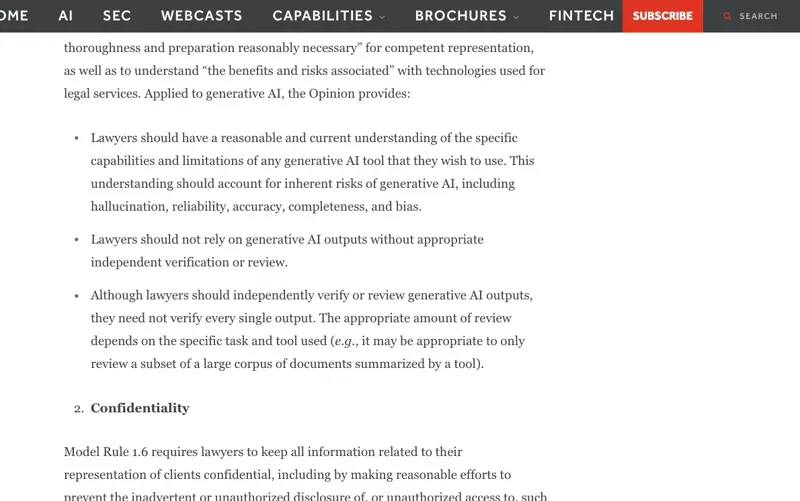
Source: Debevoise & Plimpton Data Blog — analysis of ABA Formal Opinion 512
Step 1: Read the actual source, not the AI’s summary of it. If the AI is summarizing a deposition, a contract, or a case, go read the underlying document yourself before you trust the summary. This sounds obvious. It’s the step everyone skips under deadline pressure, and it’s the step that catches drifted facts — a paraphrase that’s subtly wrong in a way that doesn’t jump out unless you’re looking at the source side by side.
Step 2: Confirm every case actually exists. Take the exact citation — “847 F.3d 233 (9th Cir. 2021),” whatever it is — and search it in Westlaw, Lexis, Google Scholar, or the free CourtListener database. Not the case name alone (AI can attach a real-sounding name to a fake citation, or vice versa). The citation string itself. If it doesn’t pull up, or it pulls up a completely different case at that reporter and page, you’ve found a fabricated case. This is the single most common hallucination pattern in every sanctions case on record, from the original 2023 Mata v. Avianca filing (six invented cases) through 2026’s Nebraska bar suspension (20 hallucinated cases out of 63 citations in one brief).
Step 3: Check the pin cite. A citation can point to a real case and still be wrong, because the specific page cited doesn’t actually contain the language being quoted. Pull up the actual page. Confirm the quoted text is there. This catches a subtler hallucination than a fully invented case — and it’s the one that’s easiest to miss because everything looks legitimate at first glance.
Step 4: Confirm the holding matches what’s actually claimed. This is the step most people skip even when they’ve confirmed a case is real. A real, correctly-cited case can still be hallucinated in the sense that matters most: the AI can attach a holding to it that the case never actually established, or even reverse what the court decided. You have to read the actual holding paragraph and ask: does this case stand for the proposition my draft says it does? Not “is this a real case about a related topic” — does it say this specific thing.
Step 5: Cross-check every factual claim against the source, then flag and document. For any factual summary — a timeline, a set of deposition quotes, a discovery response — ask the AI (or do it yourself) to quote-and-cite every claim back to a specific page in the source record. Then spot-check a sample against the actual document. When you find something wrong, don’t quietly fix it and move on. Flag it, note what you checked and what you found, and tell whoever’s supervising the matter. The Alabama State Bar’s 2026 checklist requires exactly this kind of documentation: which tool was used, on what date, for what task, what it produced, and what verification steps were taken before it went out.
A worked example: catching two planted errors in an AI-drafted motion
Say your supervising attorney asks Claude or ChatGPT to draft a short section of a motion to compel arbitration, and hands you the draft to review before it goes anywhere near a filing. Here’s what a plausible AI draft might contain — and how the five-step process catches it.
The draft says: “Courts have consistently required a case-by-case unconscionability analysis before enforcing an arbitration clause. See AT&T Mobility LLC v. Concepcion, 563 U.S. 333 (2011) (holding that state-law unconscionability review must be conducted individually for each arbitration agreement). See also Bramwell v. Sequoia Freight Systems, 847 F.3d 233 (9th Cir. 2021) (denying motion to compel where employer failed to provide adequate notice of the arbitration clause).”
Two sentences. Two citations. Both wrong, in two completely different ways.
Catching error #1 (Step 2 — does it exist?): You search “847 F.3d 233” in CourtListener. Nothing matches that case name at that citation. You try Westlaw by party name — no Bramwell v. Sequoia Freight Systems exists anywhere in the Ninth Circuit’s docket. It’s a fabricated case, invented whole-cloth, with a citation format realistic enough to pass a skim. This is the exact pattern from the Wyoming sanctions case earlier this year, where eight of nine cited cases in a filed brief turned out to be fake — and the supervising partner had signed the brief without reading it.
Catching error #2 (Step 4 — does the holding match?): Concepcion is a real, very well-known Supreme Court case — which is exactly why this error is more dangerous than the first one. It’s real enough to survive a database search. But you pull the actual opinion and read the holding, and it’s the opposite of what the draft claims. Concepcion actually held that the Federal Arbitration Act preempts state rules — like California’s old Discover Bank rule — that would require class-wide arbitration procedures as a condition of enforcing an arbitration agreement. It didn’t establish a case-by-case unconscionability requirement; it restricted states from imposing exactly that kind of condition on arbitration clauses. The AI took a real, famous case and reversed its actual thrust into something that sounds equally authoritative and is functionally backwards.
That second one is the pattern that should worry you more than the first. A completely fake case is (relatively) easy to catch once you know to search for it. A real, correctly-spelled, famous case cited for a holding it doesn’t actually support is much harder to catch on a skim — and it’s the kind of error that, filed and unchallenged, could shape how a court rules on the actual motion.
AI draft red flags: what to check and how
| Red flag | What it looks like | How to check it | Real example |
|---|---|---|---|
| Fabricated case | Realistic-sounding case name + citation that doesn’t exist anywhere | Search the exact citation string in CourtListener, Westlaw, or Lexis — not just the case name | 8 of 9 cited cases fake in a 2025 Wyoming federal filing; supervising partner signed it unread |
| Misquoted holding | A real, correctly-cited case attached to a proposition it doesn’t actually support | Read the holding paragraph yourself; don’t trust an AI’s characterization of what a case “held” | Draft claims Concepcion requires case-by-case review; the case actually restricts that requirement |
| Wrong pin cite | Real case, real quote — but the specific page cited doesn’t contain that language | Pull the actual page cited and confirm the quoted text is there, word for word | Common in long opinions where the AI approximates rather than locates the exact passage |
| Drifted fact / summary | A timeline, deposition summary, or factual claim that’s subtly wrong versus the source document | Ask for quote-and-cite-to-page on every factual claim, then spot-check against the source | Root cause behind most non-citation sanctions — factual misstatements, not just fake cases |
| Overconfident tone with no hedging | AI presents every claim with identical, confident certainty — no “I’m not fully certain” signal | Treat every unverified AI output the same way regardless of how confident it sounds | AI has no internal signal distinguishing a solid citation from a fabricated one — confidence is not evidence |
| “Verified” vendor tags that aren’t actually verified | Legal-AI tools show citation links that look authoritative but link to the wrong section or a tangential passage | Click through every citation link yourself; don’t trust a green checkmark you didn’t personally confirm | Even tools marketed as “hallucination-free” have been shown to fabricate content at meaningful rates in academic testing |
What this means for you
Litigation paralegals. You’re the highest-exposure role here — discovery summaries, deposition digests, and motion support are exactly where AI drafting is heaviest and where sanctions cases keep originating. First action: for the next AI-drafted document that crosses your desk, run all five verification steps and time yourself. Know your real baseline before you promise a turnaround time.
Corporate and transactional paralegals. Contract review and redlining is one of the fastest-growing AI use cases in-house, and the failure mode is different — it’s less “fake case law,” more “AI missed or misstated a clause that matters.” First action: build a standing checklist of the 8-10 clause types your firm cares about most (indemnification caps, termination triggers, assignment restrictions) and manually confirm each one against the AI’s summary before it goes to the attorney.
Solo-attorney-office paralegals. You likely don’t have a Westlaw or Lexis seat, which changes your verification toolkit. First action: bookmark CourtListener (free, covers federal courts and most state appellate courts) and Google Scholar’s case-law search — both let you confirm a citation exists without a paid subscription. It’s not as complete a database, but it catches the majority of fabricated-case errors, which is your highest-frequency risk.
New or entry-level paralegals. You’re joining the field exactly as this shift is happening, which is actually a real advantage — you don’t have old habits to unlearn. First action: ask your supervising attorney directly whether the firm has a written AI-use policy yet. If it doesn’t, offer to draft a one-page verification checklist modeled on the Alabama Bar’s format. Being the person who brought structure to a gap nobody else addressed is a genuinely strong first-year move.
Paralegal managers and supervising paralegals. You’re the one who has to operationalize this across a team, not just for yourself. First action: build a simple documentation template — tool used, date, task, output, verification steps taken, who reviewed it — and require it on every AI-assisted filing-adjacent document. This is close to word-for-word what the Alabama State Bar’s 2026 guidance recommends, and having it in place before an incident happens is the difference between “we have a process” and “we’re improvising after a court asks.”
Immigration paralegals. Heavy deadline pressure, heavy reliance on case-specific factual summaries (client declarations, country-condition evidence), and courts that have shown zero patience for AI errors in filings. First action: for any AI-drafted factual summary, require quote-and-page-cite for every single factual assertion before it goes into a filing — no exceptions for time pressure, because immigration filings often can’t be amended after the fact the way a civil brief sometimes can.
Freelance and contract paralegals. You often work across multiple firms with wildly different AI policies (or none at all), which means you can’t assume a shared standard. First action: bring your own verification checklist to every engagement and use it regardless of what the client firm does or doesn’t require — it protects your professional reputation independent of any one firm’s internal process.
Edge cases and troubleshooting
“My attorney just says paste it in, don’t worry about it.” This is a real, common friction point, and it’s not really your call to overrule. What you can do: document that you flagged a specific concern, in writing, even briefly — an email or a note in the file. If an attorney overrules a flagged issue and it later becomes a problem, having documented that you raised it protects you professionally, even though the ultimate filing decision and ethical responsibility sits with the attorney, not you.
The AI cites a real case, with the right name, but gets the court or the year wrong. This one’s sneaky because a name-only skim passes it clean. Always verify the full citation string — reporter volume, page, court, and year — not just that the case name sounds familiar.
You’re reviewing a 200-page AI-generated summary of a huge discovery production, and one fact out of hundreds is wrong. This is the needle-in-haystack problem, and full verification of every single claim in a massive document often isn’t realistic under real deadlines. ABA Formal Opinion 512 actually addresses this directly — it says lawyers need not verify literally every output, and that “the appropriate amount of review depends on the specific task.” The practical version: prioritize verification effort on the claims that carry the most legal weight (holdings, dates that trigger deadlines, dollar figures, admissions) rather than trying to check everything with equal intensity.
A legal-AI vendor tool shows a citation as “verified” with a checkmark, but when you click through, the link goes to the wrong page or a tangential passage. Vendor verification features are a genuine improvement over raw model output, but a checkmark from the tool is not the same as you personally confirming the source. Click through every linked citation yourself before you trust the tag.
The AI corrected an earlier error when asked, but the original (wrong) version had already gone out to opposing counsel or been filed. This happened in a real 2026 sanctions case — an attorney’s corrected motion still contained some of the original false citations even after she’d been alerted to a problem. The lesson: verification has to happen before something leaves the building, not as a reactive fix after someone else flags it.
Your firm’s turnaround expectations haven’t adjusted to account for verification time. This is one of the most common practical frictions right now — firms adopted AI expecting speed gains and haven’t budgeted the review time that has to come with it. Raise it explicitly with whoever assigns your work: verification is not optional overhead, it’s the part of the job that used to be baked into slower first-draft production.
You don’t have access to Westlaw or Lexis and can’t afford a seat. Free alternatives exist and cover a meaningful share of what you need: CourtListener for federal and many state appellate opinions, Google Scholar’s case law search, and most state court systems now post opinions directly on their own websites. Not comprehensive, but enough to catch the highest-frequency error (fabricated cases) without a paid subscription.
An attorney asks you to “just double-check the citations are real” but not the substance. Push back gently if you can — a citation that exists but is misquoted for its holding is arguably the more dangerous error of the two, since it survives a database check. If you only have time for one pass, prioritize existence-checking the citations you’re least familiar with and holding-checking the ones doing the most legal work in the argument.
What this can’t fix
Being honest about the limits matters more than pretending this skill solves everything.
Verification takes real time, and that time has to come from somewhere. Nobody’s figured out how to make thorough citation-checking instant. If your firm expects AI-era turnaround speed and full verification, one of those expectations is wrong, and it’s worth saying so out loud rather than quietly absorbing unpaid overtime to make both true.
The ethical duty to verify is not legally delegable to you, even when you’re the one doing the checking. A California appellate court ruled directly on this in mid-2026 — in a case where a paralegal had reviewed AI-generated citations, the court held explicitly that assigning citation-verification to a paralegal does not discharge the supervising attorney’s own personal ethical obligation to read and confirm every citation before filing. This matters practically: your verification work protects the client and strengthens the document, and it makes you far more valuable professionally, but it doesn’t function as a legal shield the way “I had it checked” might imply. The attorney still owns the final duty.
It doesn’t fix a firm culture that discourages raising problems. If flagging an AI error gets treated as “slowing things down” rather than “doing the job right,” no checklist changes that dynamic. That’s a management and culture problem, not a verification-technique problem.
It’s a discipline, not a guarantee. Even the best current AI models still hallucinate on a meaningful percentage of legal citations — the newest widely-used model in 2026 testing hallucinated at nearly 7%, and that’s the low end across the models tested. A five-step process dramatically reduces the odds something fabricated slips through. It doesn’t reduce them to zero, and treating any process as foolproof is itself a risk.
It doesn’t reverse the broader employment picture. BLS’s flat 0.2% growth projection for paralegals over the next decade reflects real structural pressure on the role, and no individual skill fully offsets a labor-market-wide trend. What this skill does is make you the paralegal a firm keeps when they’re cutting headcount elsewhere — not a guarantee that headcount reductions won’t happen at all.
Frequently asked questions
Is being a paralegal safe from AI? Not automatically, and not without adapting. The routine research and first-draft tasks that used to fill entry-level paralegal time are genuinely shrinking. But the verification, judgment, and client-facing work AI can’t do is growing in relative importance. Safety now depends on which half of the job you’re doing.
Is paralegal a dead-end job in 2026? No, but it’s changing shape. BLS still projects roughly 39,300 annual job openings for paralegals — driven mostly by turnover and people moving into other roles, not by net growth. The ceiling on pure headcount growth is real (just 0.2% over the decade), but that’s different from “no jobs.” It means competition for the roles that do exist is shifting toward people who can demonstrate the AI-verification skill, not just document production speed.
Are paralegals in demand in 2026? Yes, in the sense that turnover alone creates tens of thousands of annual openings, and firms are actively looking for paralegals who can supervise AI output rather than just produce documents manually. Demand for the old version of the role — pure drafting and research volume — is softer.
What percentage of the time does AI make up fake legal citations? It varies a lot by model and task, and it’s not improving in a straight line. A 2026 benchmarking study found rates ranging from 1.23% (the best-performing model tested) to 6.57% (a newer model that actually hallucinated more), with roughly 25% of all citations tested showing some form of hallucination across the full study. Earlier academic research on specific, hard legal research questions found rates as high as 58-88% depending on the model. There’s no single safe number — which is the whole argument for checking every citation rather than trusting a “usually fine” assumption.
Can I get fired for missing an AI hallucination? It depends heavily on your firm and the severity of the miss, but the more relevant framing is professional reputation, not just job security in the moment. Courts have increasingly named and shamed specific attorneys and firms in sanctions orders — this is public record, searchable, and follows people. Being the person known for catching these errors is a durable career asset in a way that’s hard to overstate.
Do I need Westlaw or Lexis to verify AI citations, or can I use free tools? Free tools cover a meaningful share of verification needs. CourtListener is a free, searchable database of federal opinions and many state appellate courts. Google Scholar’s case-law search is also free and covers a broad range. Neither is as complete as a paid Westlaw or Lexis subscription, but both catch the highest-frequency error — a fabricated case that simply doesn’t exist anywhere.
What’s the difference between an AI hallucination and a regular research mistake? A regular research mistake usually comes from a real source that was misread, outdated, or misapplied — the underlying case or statute exists, and a human made a judgment error about it. A hallucination is different in kind: the AI generated something — a case, a quote, a statute section — that doesn’t correspond to anything real at all, presented with the same confidence as accurate information. That’s why hallucinations require existence-checking, not just re-reading.
Should I tell my attorney I used AI to help draft something? Yes, and disclosure has actually helped attorneys in sanctions proceedings, not hurt them. Legal-tech researchers who’ve studied the sanctions pattern note that courts have consistently penalized attorneys more harshly for denying or being evasive about AI use than for the underlying citation error itself. Proactive disclosure, paired with documented verification, is the position that holds up.
What AI tools do law firms actually use, and do they still hallucinate? Thomson Reuters’ CoCounsel and Harvey are two of the most widely adopted legal-AI platforms in 2026, and both explicitly tell users, in their own official documentation, that verification remains the user’s responsibility. CoCounsel’s own head of litigation product wrote that “if you can’t verify it, you can’t sign it.” Harvey’s platform agreement states directly that its output “is AI-generated, and it may contain errors and misstatements or may be incomplete.” Even vendor tools marketed around trustworthy citations don’t claim to be hallucination-free — they claim to make verification faster, which is a meaningfully different promise.
Source: Thomson Reuters Institute — “If You Can’t Verify It, You Can’t Sign It” (May 5, 2026)
How long does verifying an AI draft actually take? It depends entirely on document length and citation density, and there’s no universal number worth quoting — anyone who gives you one is guessing. What’s more useful: time yourself on your next few AI-assisted documents specifically so you have your own real baseline. That number is what you should be using in conversations with attorneys about realistic turnaround times, not an industry average that doesn’t reflect your actual practice area or document types.
Bottom line
AI is not coming for the paralegal profession wholesale. It’s coming for the parts of the job that were always the least defensible against automation — fast first drafts, routine summaries, document review at volume. What’s left, and what’s actually growing in importance, is judgment: the ability to read an AI’s confident output with real skepticism, know exactly what to check and how, and catch the two-sentence error that would otherwise become a sanctions order with your firm’s name on it. That’s a teachable skill. It’s not mysterious, and it’s not about being a tech expert — it’s a five-step discipline you can start applying to the next AI-drafted document that lands on your desk today.
If you want to build this into a full working routine — not just this one post, but a structured walkthrough of using AI safely across the actual paralegal workflow, from intake to filing — the AI for Paralegals course covers it step by step, along with the broader first-day setup in our Claude for Legal paralegal guide.
Sources
- American Bar Association — Formal Opinion 512 (July 29, 2024)
- Alabama State Bar — Formal Opinion 2026-01 on Artificial Intelligence Use
- U.S. Bureau of Labor Statistics — Paralegals and Legal Assistants Occupational Outlook
- U.S. Bureau of Labor Statistics — Industry and Occupational Employment Projections Overview (2026)
- arXiv — “Who Checks the Citations? Benchmarking Legal AI Hallucination Rates” (2026)
- GC AI — AI Hallucination Legal Cases: A Sanctions Tracker (2026)
- Reuters — “Judge rules both sides in lawsuit misused AI, disqualifies lawyers” (June 9, 2026)
- Reuters — “California court sanctions attorney for delegating AI citation…” (Aug 20, 2026)
- Reuters — “Top Connecticut court warns lawyers on AI risks after fake citations” (Aug 3, 2026)
- Reuters — “US appeals court sanctions lawyers over AI hallucinations, lack of candor” (June 3, 2026)
- Thomson Reuters — “If You Can’t Verify It, You Can’t Sign It” (May 5, 2026)
- Harvey AI — Platform Agreement
- Damien Charlotin — AI Hallucination Cases Database
- Scientific American — “Why lawyers keep citing fake cases invented by AI”