Somewhere between the AI-scribe ads in your feed and the think-pieces about robots in healthcare, a lot of EMTs and paramedics are quietly asking the same question: is this coming for us? It’s a fair question — AI really is moving into EMS, and faster than most of the field realizes. It’s listening to 911 calls in some systems. It’s writing chart narratives in others.
So here’s the honest answer, with the receipts: no, AI is not replacing you — the numbers say the opposite — but it is about to change which parts of your shift are miserable. Let’s separate the two.
What the numbers actually say
Start with the least dramatic, most reliable source in this conversation: the Bureau of Labor Statistics. The BLS projects employment of EMTs and paramedics to grow 5% from 2024 to 2034 — faster than the average across all occupations — with roughly 19,000 openings a year. That projection already lives in a world where AI exists. The government’s official forecast for your job, in the middle of the biggest AI boom in history, is more medics, not fewer.
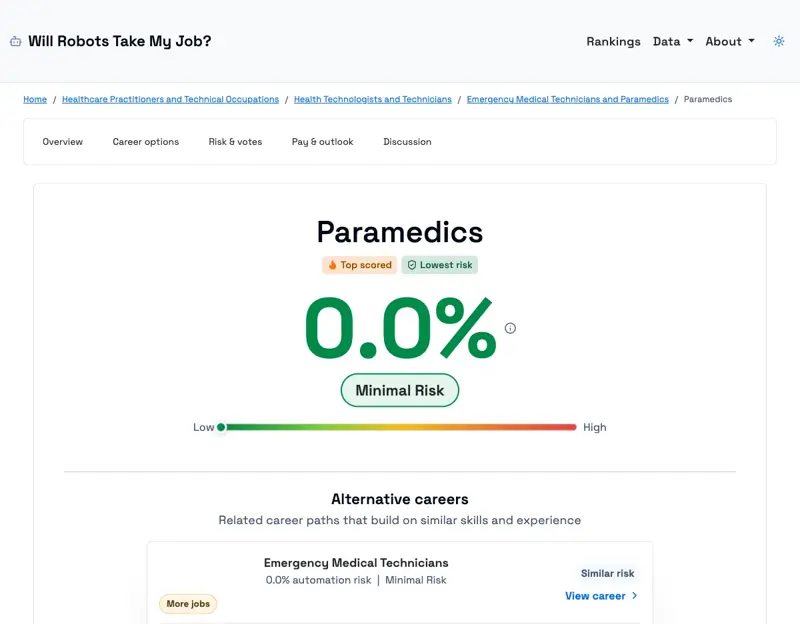
The academic automation research lands in the same place. The Oxford framework that scores occupations for automation risk puts paramedics near the bottom of the list — the popular tracker built on that data shows paramedics and EMTs at effectively 0% automation risk, the lowest tier it assigns. (Worth knowing: that’s a simplified model, not a prophecy. But the reasoning holds up — more on that below.)
Meanwhile, the actual crisis in EMS runs the other direction. The American Ambulance Association’s industry turnover study found 36% annual turnover for full-time EMTs and 27% for full-time paramedics, with more than a third of new hires gone inside their first year — and a 55% open-position rate for part-time paramedics. A national study of certified EMS clinicians published in 2025 found about half reporting burnout, with burned-out providers more than three times as likely to intend to leave the profession within a year.
Read those two paragraphs together and the real story appears. EMS doesn’t have a “too many medics, here comes AI” problem. It has a “can’t keep the medics it has” problem. Every serious AI deployment in EMS is aimed at that — keeping you, by making the job survivable.
Why the field part of the job doesn’t automate
The automation researchers’ reasoning matches what every working medic already knows. The hard part of EMS was never information processing. It’s:
- Hands. Extrication, airway management, lifting a 280-pound patient down three flights of stairs at 3am. There is no robot for this, and nothing in any lab is close.
- Scenes. A kitchen with a combative patient, a dark highway shoulder, a family screaming in two languages. AI models need structured inputs; a scene is the opposite of structured.
- Judgment under uncertainty. The patient who “looks wrong” before any number says so. Pattern recognition built from a thousand calls, applied in seconds, with incomplete information.
- The human moment. Talking a panicking patient down. Telling a family the truth gently. EMS leaders keep landing on this point — as one former chief put it this spring, the job is scene awareness, empathy, ethical decisions, and clinical reasoning, and no algorithm replaces that moment of patient care.
Notice what’s not on that list: writing the narrative afterward, predicting where to post the ambulance, and catching what a caller’s voice gives away. That’s where AI is actually showing up.
Where AI is already in EMS (and how well it really works)
Dispatch is the proven case. Copenhagen’s EMS ran a real randomized trial of a machine-learning system (Corti) that listens to 911 calls for signs of cardiac arrest. Published in JAMA Network Open: the model recognized out-of-hospital cardiac arrest with 85% sensitivity versus 77.5% for human dispatchers. The honest fine print: when dispatchers got the AI’s alerts, their overall recognition barely moved (93.1% vs 90.5% — not statistically significant). The machine heard more than the humans; getting humans to act on it is still being figured out. That’s the most realistic snapshot of AI in EMS you’ll find — genuinely better at one narrow task, and still dependent on the people.
Deployment prediction is promising. Systems that forecast call volume and pre-position units have published early wins — a South Korean network study saw patient transfer delays drop from 27.5% to 19.6%. US-scale peer-reviewed results are still thin, but every major ePCR and CAD vendor is building toward this.
Documentation is the gold rush. AI scribes that turn voice or structured data into chart narratives are the loudest product category in EMS right now. Real talk about the numbers: the “saves an hour a shift” line comes from vendor marketing and physician self-report surveys. The peer-reviewed studies in medicine show real but more modest gains — about 20% less time in the record in the closest controlled studies. For a medic drowning in late PCRs, 20% is still meaningful. Just know the difference between the brochure and the data.

The 3 things AI actually helps with on shift
Forget replacement. Here’s where a working EMT or paramedic can get real value today — all three within the two hard rules (next section).
1. Narrative practice, on your own time. Writing a tight, defensible PCR narrative is a skill nobody teaches well, and new providers struggle with it for months — vague descriptions, missing pertinent negatives, narratives that contradict the vitals tab. ChatGPT is a free, infinitely patient practice partner: feed it fictional scenarios (“write a D-CHART narrative for a made-up fall patient, then critique it like a QA reviewer”) and drill the structure until it’s automatic. We built a full walkthrough of this in our PCR narrative guide.
2. Protocol and pharmacology study, in plain English. “Explain why we give this med in this situation like I’m a new EMT, then quiz me with five NREMT-style scenario questions.” Educators are already building exactly this into training programs. The non-negotiable: AI gets medical specifics wrong, so every answer gets verified against your agency’s current protocol — the study aid is for understanding, never for a field decision.
3. The non-clinical writing. Shift-handoff summaries (de-identified), a QA self-checklist for your own charts, the email to your training officer, the resume when you’re ready for flight or fire. The boring paperwork around the job is the safest, most immediate win.
The two hard rules (this is the part that keeps your cert)
Rule one: no patient information goes into a public AI tool. Ever. Free ChatGPT is not HIPAA-compliant — OpenAI signs no business associate agreement for consumer accounts, which means pasting anything identifiable (names, dates, locations, ages over 89, even unusual call details that could identify someone) is a reportable breach waiting to happen. Practice on made-up patients in made-up towns on made-up dates. Period.
Rule two: check your agency’s AI policy before you touch any of this for real work. This one surprises people: some departments now have explicit policies, and at least a few treat AI-written narratives as a firing offense. Others restrict documentation to company devices where chatbots are blocked. If your agency runs an embedded AI feature inside the ePCR (some platforms auto-draft narratives from your entries), that’s a different animal — sanctioned, covered by agreements, and still 100% yours to proofread, because auto-generated narratives have shipped charts with the wrong working diagnosis.
What AI can’t fix in EMS
- It can’t make a field decision. Not triage, not treatment, not transport destination. Every system deployed today is decision support, with a human required — and the legal weight of the PCR stays on the human signing it.
- It can’t fix understaffing. A scribe shaves charting minutes; it doesn’t conjure a second medic at 4am. The workforce math needs pay and retention, not just software.
- It can’t carry your liability. “The AI wrote it” defends exactly nothing in a deposition or a billing audit.
- It can’t replace earned instinct. The model has read about a thousand chest-pain calls; you’ve run them. Those aren’t the same knowledge.
The bottom line
AI is not coming for the medic — the government’s own forecast has your field growing faster than average while half the industry burns out and walks. What AI is coming for is the paperwork, the dispatch guesswork, and the parts of the job that were never the reason you took it. The medics who’ll benefit most are the ones who learn the tools early and respect the two hard rules: nothing identifiable into public AI, and agency policy first.
If you want to build that skill properly — prompts, privacy, and the judgment about what to automate — our AI for Healthcare Workers course covers the safe-use foundation in about an hour, no tech background needed.
Sources
- EMTs and Paramedics — U.S. Bureau of Labor Statistics, Occupational Outlook Handbook
- Will AI Replace EMTs and Paramedics? Field Medicine in 2026 — Qualora
- Will Paramedics be replaced? — Will Robots Take My Job
- Effect of Machine Learning on Dispatcher Recognition of Out-of-Hospital Cardiac Arrest — Blomberg et al., JAMA Network Open (2021)
- Burnout among nationally certified EMS clinicians — Powell et al., JACEP Open (2025)
- EMS Industry Turnover Study — American Ambulance Association / Newton 360
- Charting the Future: How AI Is Rewriting the EMS Narrative — EMS1
- The 5 Stages of AI That Will Reshape EMS — EMS1 Leadership Institute
- Top EMS workforce challenges: burnout, retention and staffing gaps — EMS1 Trend Report
