

You’ve probably seen the guilt-trip version. Every question you ask ChatGPT supposedly drinks a whole 500 ml bottle of water. Then you scroll a little further and OpenAI’s CEO says an average query uses 0.32 ml — about a fifteenth of a teaspoon. Those two numbers are more than a thousand times apart, and both get shared with total confidence.
So which is it? Are you quietly draining a reservoir every time you ask for a recipe, or is it nothing at all?
Here’s the honest answer, and it’s more useful than either side wants to admit: a single prompt costs almost nothing — a few drops to a couple of teaspoons — but the giant data centers behind AI really are putting real strain on the water supply in specific places. Both things are true. Let me show you why the numbers look like they’re screaming at each other, and what’s actually worth caring about.
Why this is suddenly everywhere again
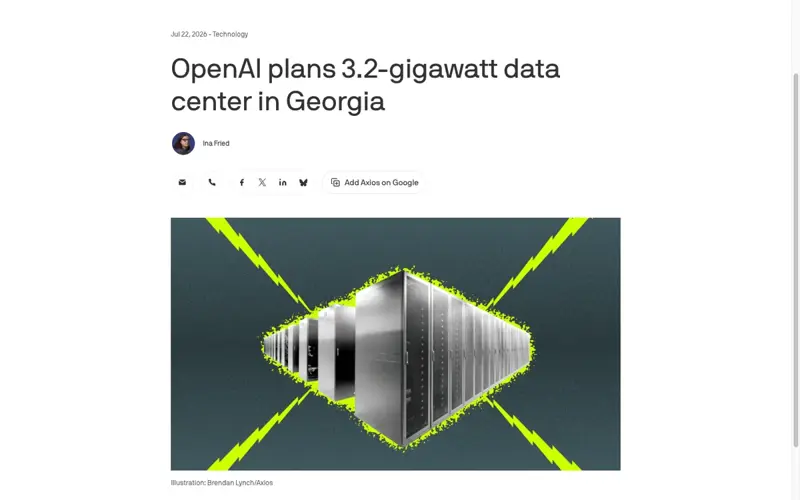
The topic itself is old. What’s new is the scale of what’s being built. This week OpenAI announced Project Camellia — a roughly $20 billion, 1,400-acre AI data center campus in Effingham County, Georgia, drawing 3.2 gigawatts of power in phases from 2028 to 2032.
And notice how they announced it. OpenAI went out of its way to say the site will use closed-loop cooling — water that recirculates “like a car radiator” instead of being drawn fresh and evaporated away — with ongoing water use “comparable to a similar-size office building,” plus an $80 million local pledge and a promise that “Georgia families will not subsidize this project.”
Companies don’t preemptively defend their water use unless “AI is draining our water” has become a real, mainstream worry. It has. That’s the backdrop for every viral bottle-of-water post in your feed.
Why one prompt gets answered “0.3 ml” and “500 ml”
Here’s the thing nobody explains: those numbers aren’t really fighting. They’re answering different questions and pretending to answer the same one.
When you ask “how much water does a ChatGPT prompt use,” you could mean any of these:
- Just cooling the chips. The data center’s servers get hot; water carries the heat away. Counting only that, OpenAI’s Sam Altman put an average query at ~0.32 ml (in his June 2025 essay “The Gentle Singularity”). Google reported its Gemini median prompt at about “five drops” — roughly 0.26 ml — in August 2025. Tiny. Both are on-site cooling only.
- Plus the water it took to make the electricity. Your prompt burned a little power, and power plants use water too. Add that in and Google’s own “five drops” climbs to about 2.7 ml. Independent researcher Shaolei Ren — the scientist whose lab actually started this whole debate — now estimates a modern prompt at roughly 15 ml all-in (about 5 ml on-site plus 10 ml for the grid), in a July 2026 update.
- A whole conversation on an old model. The famous “500 ml bottle” comes from Ren’s own 2023 UC Riverside paper, “Making AI Less Thirsty.” Read the actual paper and the claim was 500 ml per 10 to 50 replies on a GPT-3-era model — “depending on when and where.” That’s a full back-and-forth chat, in a hot region, on old tech. Ren himself now calls the 500 ml figure outdated for today’s systems.
So the range from 0.3 ml to 500 ml isn’t a lie on either end. It’s the difference between measuring one sip and measuring the whole meal — and then a lot of people quoting the biggest, oldest number as if it were one quick question today. The honest single-prompt figure right now is somewhere between a few drops and a couple of teaspoons. Call it 15 ml if you want one number to hold onto — and remember Ren says even that is “33 times lower than the bottle.”
How that stacks up against your normal day
A couple of teaspoons is hard to feel bad about once you see what everything else costs. Water is hiding in nearly everything you consume, in amounts that make an AI prompt look like a rounding error.
Put it this way: the water behind a single hamburger is enough for well over a hundred thousand ChatGPT prompts. One almond costs more water than a few hundred questions. This is why, back in February 2025, Altman got salty on X about people who “make up shit about our water usage while eating a hamburger.” It’s his framing, and he has a point — though, as we’ll get to, it’s not the whole point.
If you’d like the general skill of untangling numbers like these — where the same fact gets spun three different ways — we wrote a whole guide on it: Can You Trust AI? The water debate is a near-perfect case study in reading a statistic before you repeat it.
But here’s the part the cheerleaders skip
If the story ended at “your prompt is basically free,” that would be its own kind of dishonest. Because zoom out from the single query, and the aggregate is genuinely a real issue.
US data centers directly consumed about 17.4 billion gallons of water in 2023 — that’s the Lawrence Berkeley National Lab’s 2024 report to Congress, covering all data centers, not just AI. It’s on track to reach 38 to 73 billion gallons a year by 2028, with another ~211 billion gallons a year hiding in the electricity they use. And the problem isn’t the national average — it’s that this lands in specific towns. A single hyperscale campus can pull millions of gallons a day, peak-day demand can run 6 to 30 times the yearly average, and up to 85% of the water used for direct cooling evaporates and doesn’t come back to the local supply.
Here’s the twist that catches people off guard: the tech is getting more efficient per task, and total water use is going up anyway. Microsoft’s fleet hit 0.30 liters per kilowatt-hour in 2025, 39% better than 2021. Google improved too — and still went from 4.3 to 6.1 billion gallons a year between 2021 and 2024, because the sheer amount of computing grew faster than the efficiency gains. Researchers estimate the US needs $10 to $58 billion in new water infrastructure by 2030 just to keep up.
So both things hold at once. Your one prompt: a few drops. The buildout behind it: a real, concentrated, regional strain that deserves the attention it’s getting.
What this means for you
If you feel guilty every time you use ChatGPT: You can let that go. Skipping a query to “save water” saves you roughly a teaspoon — less than you spill making tea. Use AI for your work, your learning, your emails. The guilt is aimed at the wrong target.
If you’re the one being told to feel guilty: Now you’ve got the honest counter. It’s not “AI uses nothing” or “AI is destroying the planet.” It’s “one prompt is trivial, the data-center boom is a real local issue,” and you can say both without picking a tribe.
If you live near a proposed data center: This is where your attention actually matters — far more than your chatbot habits. The questions worth asking at the town meeting: Is it closed-loop or evaporative cooling? Where’s the water coming from, and who gets it in a drought? Who pays for the new infrastructure? That’s the leverage point, not your keyboard.
If you’re a heavy AI user or run a business on it: The efficiency varies a lot by model. A quick answer from a small model sips; a long reasoning session on a giant model gulps (up to ~150 ml). If you care, reach for the lighter model when you don’t need the heavy one — but honestly, that’s about cost and speed more than water.
If you’re explaining this to your kids or students: Great teachable moment. Same fact, three headlines, all technically “true.” The skill isn’t memorizing the number — it’s asking “counting what, exactly?” before believing any of them.
What this doesn’t fix (and the honest caveats)
Let me be straight about the limits of everything above.
- Skipping queries won’t move the needle. The real leverage is at the policy, utility, and data-center-siting level — how these campuses are cooled, where they’re built, and who pays. Your individual prompts are a teaspoon in an ocean. Feeling bad about them is misdirected energy.
- Nobody’s numbers are fully audited. OpenAI hasn’t published the methodology behind 0.32 ml. Independent estimates rely on assumptions about hardware and location. Treat every figure here — mine included — as a reasonable range, not gospel.
- Location changes everything. The same prompt in hydro-powered, cool Oregon and in coal-heavy, blazing Phoenix have very different footprints. A single global number always hides that.
- Electricity and water aren’t the same conversation. AI’s power demand is arguably the bigger story, and it’s related but distinct. Solving one doesn’t automatically solve the other.
- This isn’t a free pass for the industry. “Your prompt is tiny” and “the buildout needs real oversight” are both true. Don’t let anyone use the first to wave away the second.
The bottom line
If you remember one thing, make it this: a single AI prompt costs a few drops to a couple of teaspoons of water — not a bottle. The scary 500 ml figure is a whole old-model conversation in a hot climate, quoted out of context. You do not need to feel guilty about asking a chatbot a question.
But keep the other half too. The data centers behind AI are drinking real water in real towns, efficiency gains and all, and that’s worth watching — at the level of how they’re built and cooled, not whether you hit send.
The actual skill here isn’t the water number. It’s being able to catch a viral statistic, ask “counting what?”, and land on the honest version before you share it. That’s the whole idea behind our Become AI-Fluent course — and our guide to becoming genuinely AI-fluent carries that muscle way past this one debate.
Sources:
- The Gentle Singularity (0.32 ml figure) — Sam Altman, June 2025
- Making AI Less Thirsty (origin of the “500 ml” claim) — Ren et al., UC Riverside, 2023
- How Much Water Does AI Use? The $58 Billion Risk (Ren’s ~15 ml update) — Forbes, July 21, 2026
- 2024 United States Data Center Energy Report — Lawrence Berkeley National Lab
- Experts are skeptical about Google’s AI water claims — PCWorld
- OpenAI plans 3.2-gigawatt data center in Georgia — Axios
- OpenAI’s $20 Billion AI Data Center Puts Georgia in the AI Race — Georgia Asian Times
- Energy and water use of AI and data centers — PBS NewsHour