Google released Gemini 4 Argon on October 13, 2026, and if you opened the Gemini app yesterday and saw nothing new, you probably did nothing wrong. Argon is a paid-plan model. Free and Google AI Plus accounts don’t get it. Google AI Pro ($19.99/month) and Ultra (from $99.99/month) get it in the Gemini app and in AI Mode in Search. Only Ultra gets it in Antigravity, Google’s coding agent. Developers get it through a paid API.
That one paragraph is the whole answer to the question most people are typing into Google this week. The rest of this post is for the follow-up questions: what you actually get on each plan, what the “4x” and “20x” limits mean, how Argon compares with GPT-6 and Claude Opus 5.5 in plain terms, and whether upgrading makes sense for the things a normal person does with an AI assistant. I’ll also cover the confusion on X, where a lot of Pro subscribers are annoyed about something that is real but narrower than it sounds.
I pulled this together from Google’s launch post and plan pages (read directly on October 14), The Decoder’s launch coverage, the Vals and Artificial Analysis benchmark pages, a Perplexity research pass with the Academic connector, and a Grok search of X reactions from October 13 and 14. Where Google has confirmed something I’ll say so. Where I’m relying on one report, or where Google hasn’t said, I’ll say that too.
What Gemini 4 Argon actually is
Argon is the first model in the Gemini 4 generation and Google’s new top model. Google’s launch post, written by Koray Kavukcuoglu, calls it “our latest frontier model” and says it is built for “deep work in complex, real-world tasks” in coding, finance, legal, cybersecurity and science.
You may have heard of it before yesterday. On September 30, Google announced Argon in a limited release for vetted cyber defenders, government agencies and security partners. Plenty of articles written that week still say you can’t use it. Those articles are out of date. Since October 13 it’s available to paying consumers and developers.

A few facts about the model itself, all from Google’s launch post unless noted:
- Big working memory. The API has a 1 million token unified input-and-output limit. The Gemini app gives Pro and Ultra subscribers a 1 million token context window. Free accounts get 32,000 tokens and Plus gets 128,000, per Google’s limits help page.
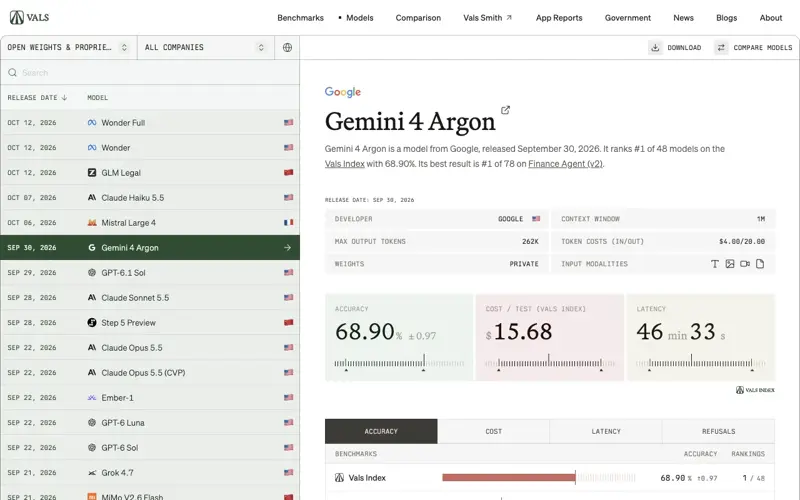
- Strong on professional tasks. Google says it ranks #1 on the Vals Index, a benchmark that weights finance, coding, legal and tax work. Vals’ own page confirms the number, which I’ll come back to.
- Cheaper than it looks at launch. The API costs $2 per million input tokens and $10 per million output tokens until November 30, then $4 and $20.
- Not for everybody on purpose. Logan Kilpatrick, one of Google’s Gemini product leads, reportedly said in a post on X that it has a “big model smell,” meaning it’s expensive to serve, so access is limited for now and broader Gemini 4 access is planned. That’s per Grok’s summary of his post, and The Decoder reports the same direction: Google says more Gemini 4 models are coming, which could eventually bring newer Flash models to free and Plus users.
That last point is the useful one if you’re on the free plan. The Gemini 4 generation isn’t just Argon. Smaller, cheaper models in the same family are expected, and those are the ones that would reach you. Google hasn’t given a date.
Who gets Argon: the plan-by-plan answer
Here is the access picture, built from Google’s launch post, the Google One plans page and The Decoder. The page I read is the US English version.
| Plan | US price | Argon in the Gemini app | Argon in AI Mode (Search) | Argon in Antigravity | What you get instead |
|---|---|---|---|---|---|
| Free | $0 | No | No | No | Flash-Lite (the free tier became Flash-Lite only on October 9) |
| Google AI Plus | $4.99/mo | No | No | No | Flash models and Deep Research |
| Google AI Pro | $19.99/mo | Yes | Yes | No | Argon, plus Gemini 3.1 Pro and Flash |
| Google AI Ultra (5x) | $99.99/mo | Yes, higher access | Yes | Yes | Everything, highest limits |
| Google AI Ultra (20x) | $199.99/mo | Yes, highest access | Yes | Yes | Everything, 20x Pro limits |
| Gemini API (developers) | Pay per token | Not applicable | Not applicable | Not applicable | Argon via AI Studio and the Gemini API, paid tier only |
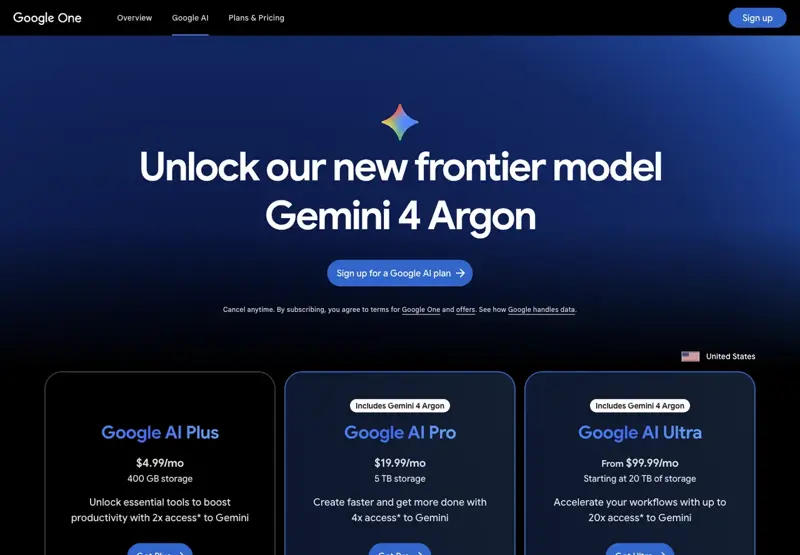
The Decoder puts the free-and-Plus situation bluntly: “Free Gemini users and paying Plus subscribers now only have access to the weaker Flash models.” Google’s own plans page agrees by omission. Look at the screenshot below. The Pro and Ultra cards carry an “Includes Gemini 4 Argon” label. The Plus card doesn’t.
The Pro-versus-Ultra confusion, settled
The loudest complaint on X this week sounds like this: “Argon is out but not for Pro users.” It’s real, and it’s about one product. A post from @Layton_Gott on October 13 got a lot of attention for putting it this way: Argon is available to Pro users in Gemini, but you need Ultra to use it in Antigravity. If you’re on Pro, the model is locked inside the chat app.
Both halves of that are accurate, and they don’t contradict each other:
- Pro subscribers can use Argon today in the Gemini app and in AI Mode. This is on Google’s launch post and on the plans page.
- Pro subscribers can’t use Argon in Antigravity. Google’s launch post says “for Google AI Ultra subscribers in Google Antigravity.” Perplexity’s research, which read Google’s Antigravity announcement, says the same thing: Antigravity has its own entitlement.
If you want to write, research, summarize and chat, you’re on the Pro side of this and nothing is missing. If you want an AI that edits files in your codebase for hours at a time, that’s the product with the Ultra gate, and that’s why developers are the ones complaining loudest.
There’s one more source of confusion that’s Google’s own doing. The browser tab title on the launch post reads “Gemini 4 Argon is now available for everyone,” while the first paragraph of the same page lists Pro and Ultra subscribers and paying API customers. “Everyone” there means “everyone who pays,” and I’d bet a lot of the confusion started with that headline.
What the limits really mean
The plan names include multipliers: Plus is “2x,” Pro is “4x,” and Ultra is “5x” or “20x.” People read those as message counts. They aren’t.
Google’s help page describes Gemini app limits as compute-based rather than a fixed number of prompts. How fast you use up your allowance depends on how complex the prompt is, which model and features you use, and how long the conversation gets. A few specifics from the page:
- The allowance refreshes every 5 hours until you hit a weekly limit.
- Multipliers are relative. Plus gets 2x the standard (free) limit, Pro gets 4x, Ultra gets 5x or 20x the Pro limit.
- A short email subject-line request uses very little. Long chats, big file uploads, Deep Research and video generation use much more.
- If a subscriber reaches the limit, they fall back to Flash-Lite and get a notice saying when the limit refreshes.
- Google can change limits without notice because of capacity. It doesn’t say which day or time zone the weekly reset happens.
What Google does not publish is an Argon-specific count. There is no “Pro gets N Argon messages a day” number anywhere in Google’s documentation I could find, and neither did Perplexity’s pass. So if anyone tells you exactly how many Argon prompts Pro includes, they’re guessing.
The reports of tight limits on X (one user said the 5-hour limit on Pro feels tight for coding) are consistent with this: coding sessions are the heaviest kind of use. They don’t tell us much about how limits will feel for emails and research.
To check your own situation, open the Gemini app, go to Settings, and look under Usage limits. Google’s help page points there for the current state of your allowance.
Argon versus GPT-6 and Claude Opus 5.5
Every launch comes with a chart where the new model wins. Here’s what independent sources say, with the caveats that matter.
| Test | Gemini 4 Argon | GPT-6 Astra | Claude Opus 5.5 | What it tells you |
|---|---|---|---|---|
| Vals Index (professional work) | 68.90% | 63.13% | 66.97% | Argon leads |
| Artificial Analysis Intelligence Index | 53 (High) | 53 (Max) | 58 (Max); 54 (High); 51 (Medium) | Argon ties Astra, trails Opus at its top setting |
| Arena Agent Overall (Oct 8 snapshot) | Rank 8 | Rank 3 | Rank 1 | Argon trails both on agent tasks |
| AA-Omniscience hallucination rate | 15% | 51% | not compared | Argon makes things up less often |
| AA-Omniscience accuracy | 50% | 63% | not compared | …but answers fewer questions correctly |
Three things to take from this table, in plain language.
First, nobody wins everything. Argon is on top of Vals’ professional-work benchmark. It’s roughly level with GPT-6 Astra on Artificial Analysis’ overall index, at about 60% of the cost per task according to Artificial Analysis, and behind Claude Opus 5.5 at Opus’s maximum reasoning setting. The Decoder says the same thing in one sentence: Argon holds the top spot on the Vals Index but trails Opus 5.5 in independent overall rankings, and sits behind Meta’s Muse Wonder Full, which launched the day before.
Second, the settings change the answer. Artificial Analysis scores Claude Opus 5.5 at 51, 54 or 58 depending on how hard it’s told to think. “Argon beats Claude” and “Claude beats Argon” are both defensible headlines. Be suspicious of either.
Third, a low hallucination rate isn’t the same as being right more often. Artificial Analysis’ test found Argon made false claims 15% of the time versus 51% for Astra, but Argon also got fewer questions right (50% versus 63%). It seems to be more willing to say “I don’t know,” which is good for trust and bad if you wanted an answer. Whether you prefer that depends on your use.
One more caveat on the Arena row: it’s Arena’s agent leaderboard, which measures tool use, reliability and task completion. It is not the general chat-preference vote people usually mean by “LMArena.” And “GPT-6” is a family. The most directly comparable model here is GPT-6 Astra, and sources also list GPT-6 Sol and GPT-6.1 Sol separately.
What people who’ve actually tried it say
The benchmark story is the official one. The hands-on story from X, per a Grok search of posts from October 13 and 14, is more mixed. I haven’t opened each of these posts myself, so treat the quotes as Grok’s reading of X rather than verified citations.
- Theo (@theo), who had early access: “It is a huge jump for Gemini, and pretty good value for the price,” followed by “It’s still a Gemini model though. Does weird shit regularly and I don’t feel like I can trust it at all.” He later reported a high false-claim rate on a codebase-analysis test.
- @PawelHuryn ran 105 real bugs from two repositories. Reported results: GPT-6 Astra 45, Fable 5.1 43, Claude Opus 5.5 41.7, Argon 33. The suggestion from commenters: use Argon for cheap, fast bulk work and keep the others for code you’re going to ship.
- Cost and speed were the bright spot. Several people ran the same 3D scene prompt and reported Argon finishing far faster and cheaper than Opus (one example: $2.74 and 24 minutes versus $18.20 and two hours), with mixed opinions on the final quality.
- A health anecdote also made the rounds, someone saying Argon “diagnosed” their knee issue. That’s one person’s experience, and it’s not a reason to swap a doctor for a chatbot.
Separately, Startup Fortune, citing Bloomberg, reports that some Google employees with early access found Argon weaker on real coding tasks, especially front-end design, than its benchmark scores suggested. That’s secondhand reporting about early users, not a controlled test.
My read: Argon looks like a strong, cheaper-than-rivals model that hasn’t clearly beaten the best from Anthropic and OpenAI. For a person choosing a $20 subscription, that matters less than it sounds, which is the next section.
A worked example: three people, one $19.99 decision
I haven’t run a controlled Argon-versus-Flash test, and I won’t pretend to have. What I can do is run the numbers, because the price gap is concrete.
| Free | Plus | Pro | Ultra (5x) | |
|---|---|---|---|---|
| Per month | $0 | $4.99 | $19.99 | $99.99 |
| Per year (12 months) | $0 | $59.88 | $239.88 | $1,199.88 |
| Extra cost vs the plan below | n/a | $59.88 | $180.00 | $960.00 |
Moving from Plus to Pro costs $180 more a year. Pro also bundles 5 TB of storage and a handful of other things (Google’s page lists YouTube Premium Lite, Chrome auto browse and Tasks in Gemini), so the real question isn’t only “is Argon worth $180.” For some people the storage alone settles it. For others it’s irrelevant.
Here are three hypothetical people with different answers:
Dana, a freelance copywriter on the free plan. She writes 800-word drafts and email replies, and uses Gemini to tighten sentences. Flash-Lite handles every one of those. Argon would be a nicer drafting partner on a long proposal that combines scattered sources, but she does two of those a month. Verdict: stay free, or add Plus ($4.99) if she hits limits. Spending $19.99 for two proposals a month isn’t obviously worth it. Upgrading for one month when a big proposal is due is.
Marcus, an operations manager on Plus. He pastes in contracts, spreadsheets and long email threads and asks for summaries and risks, a few times a day. Context length is the thing that matters to him: Plus gives him 128,000 tokens, Pro gives him 1 million. A long contract bundle can fit in Pro that doesn’t fit in Plus. Verdict: try Pro for a month, and track how often a task fails on Plus.
Priya, a solo developer on Pro who wants Argon in Antigravity. She’s the person the X complaints come from. Argon in the coding agent needs Ultra at $99.99, which is $80 more per month than Pro, or $960 a year. Argon is also available through the API, which is pay-per-token. Verdict: don’t buy Ultra for one model. Use the API in whichever tool she already uses and see what a month actually costs.
Which brings up the API math, since it’s the one place the numbers are published exactly. At the introductory price of $2 per million input tokens and $10 per million output tokens, a task that reads 10,000 tokens (roughly 7,500 words) and writes 2,000 tokens costs $0.02 for the input plus $0.02 for the output, or about 4 cents. From December 1, at $4 and $20, the same task costs about 8 cents. Cached input is 95% cheaper. So the intro pricing window is a bargain for anyone with API access who wants to try Argon at scale before December.
Should you upgrade? A decision table by reader
Based on the evidence above, here are my recommendations. They’re editorial judgments, not measurements.
| If you’re… | My recommendation | First thing to do |
|---|---|---|
| A casual user: recipes, trip ideas, quick answers | Stay on Free | Do nothing. Flash-Lite is enough |
| A student writing essays and studying | Free or Plus | Use Gemini for outlining and quiz-making, check facts yourself |
| A professional who writes emails and short documents daily | Plus is plenty | Keep Plus. Argon’s edge shows up on long, complex work |
| Someone who analyzes long documents (contracts, reports, research) | Try Pro for one month | Run the three-prompt test below, then decide |
| A small business owner already living in Gmail, Docs and Drive | Pro is worth a look, mostly for the bundle | Count whether you’d use the 5 TB and the extras |
| A developer who wants Argon in Antigravity | Ultra, or skip and use the API | Price a month of API use first |
| An enterprise or Workspace admin | Check your admin console | Google’s plan limits page excludes work and school accounts, so don’t assume the consumer table applies |
The three-prompt test (30 minutes, one month of Pro)
If you’re tempted, don’t decide on benchmark charts. Decide on your own work. Take three tasks you really do and run each on Argon and on a Flash model, then score the answers blind.
- The long document. Take a 20-30 page document you actually need to understand. Ask: “Summarize this in 10 bullets, then list the five claims that are most likely to be wrong or need verification, and quote the sentence each one comes from.”
- The messy email thread. Paste a long thread with several people and conflicting asks. Ask: “List every commitment anyone made, who made it, and the date. Then draft a reply that resolves the conflicts.”
- Your hardest writing task. Take a draft you’re stuck on. Ask: “Rewrite this for [audience]. Keep my facts. Cut it by a third and tell me what you removed.”
Score each answer from 1 to 5 for accuracy, usefulness and how much editing you’d need. If Argon doesn’t beat Flash by at least a point on two of the three, you don’t need Pro for the model. Cancel before the month ends.
One caution about the test. Selecting Argon in chat picks the model for that chat. It doesn’t mean every feature switches to it. Google’s plan page still describes Deep Research as using a Pro model and image generation as running on Nano Banana. And access to Argon in the app doesn’t mean the Gemini helper inside Gmail or Docs is running it. Test the chat model, and don’t assume more than that.
Which everyday tasks actually benefit
Perplexity’s research was careful on this, and I’ll echo it: there’s no independent consumer study showing Argon is better than Flash at everyday writing, email or research. What exists is Google’s description of what Argon is good at and independent benchmarks that reward depth on complex tasks. So this table is a practical inference, not a measurement.
| Task | Flash is probably fine for | Argon might be worth it for |
|---|---|---|
| Writing | Subject lines, short rewrites, simple drafts | A long proposal built from scattered sources, with strict style rules |
| Research | A quick explanation or a summary of a few sources | Comparing dense documents or resolving conflicting evidence |
| Polite replies, shortening messages | Reconstructing commitments across long threads and attachments | |
| Images | Ordinary generation and editing | Planning a complex visual workflow (the image generator is still Nano Banana) |
| Everyday questions | All of them | Almost none |
The pattern is consistent: the harder and longer the job, the more the bigger model matters. Google itself frames Flash for “everyday document analysis” and Argon for deep, multi-step work. The practical rule is to use Flash for routine jobs and spend your Argon allowance on the tasks that need many pieces of evidence held together at once.
Edge cases and troubleshooting
These are the problems people are hitting, from the X reactions and the rollout documentation.
1. “I’m on Pro and I don’t see Argon.” Argon is rolling out in stages. One post on October 13 said Argon was live for some users and told people to check their model picker. Google’s release notes say it’s “rolling out globally,” while its plans page qualifies consumer availability as “in select countries.” Open the Gemini app, tap the model picker, and look. If it isn’t there, force-close and reopen the app, check that you’re signed into the account that holds the Pro subscription, and then wait a day. I wasn’t able to verify a widespread outage, so most cases appear to be the staged rollout.
2. “I’m on Plus and Argon doesn’t show up.” It won’t. Plus is a Flash plan. Pro is the cheapest plan with Argon. One user on X put it bluntly (Plus subscribers “are useless right now”) and, whatever you think of the tone, the facts line up with Google’s own page.
3. “I’m on Pro and I can’t find Argon in Antigravity.” Also expected. Antigravity needs Ultra for Argon. There’s an extra wrinkle: independent rollout coverage says the older, separate Antigravity IDE is not covered by current model documentation, so a missing model there isn’t proof something broke.
4. “I’m hitting my limit fast.” Argon is a heavier model, and coding sessions and long files burn allowance quickly. Shorten the conversation (start a new chat instead of continuing a long one), split big files, and save Deep Research for when you need it. When you hit the cap you drop to Flash-Lite until the 5-hour refresh.
5. “An article says it’s only for cyber defenders.” That was true on September 30 and isn’t now. Check the date on any article.
6. “The model list on my plan page doesn’t match what I see.” Google’s pages disagree with each other in small ways. The plans page names Gemini 3.6 Flash for Plus, while independent app coverage on October 13 listed a different Flash version in the Pro and Ultra picker. Model names inside the app change often. Look at what’s in your picker rather than trusting any one page.
7. “I’m using a work or school account.” Google’s personal-plan limits documentation explicitly doesn’t cover work and school accounts. Your admin controls which models appear.
8. “I’m outside the US.” Pricing and availability differ. Google’s Vietnam page, for example, shows local prices (₫489,000 a month for Pro) and still lists Argon on Pro. Google also marks consumer availability as “in select countries,” so check your own country’s plans page.
What Argon can’t do
A few honest limits, so nobody buys a plan for the wrong reason.
- It can’t be the free upgrade people want. There’s no free way to use Argon in the Gemini app. The API’s paid tier is the only developer route. Argon is on the paid API tier only.
- It doesn’t make everything better. Selecting Argon in chat doesn’t automatically upgrade Deep Research, image generation or the Gemini helper in Gmail and Docs.
- It doesn’t win every test. It trails Claude Opus 5.5 on Artificial Analysis at Opus’s top setting and trails both rivals on Arena’s agent ranking. In one real-bug test on X it scored lowest of the four models tested.
- It can still be wrong. A lower hallucination rate isn’t zero. Theo’s note that it “does weird shit regularly” is a reminder to check anything that matters, the same as with any model.
- Google hasn’t published the rest. There’s no Argon-specific message count, no weekly-reset day and no confirmed date for newer Flash models reaching free users. Anything specific you read on those points is a guess.
FAQ
Is Gemini 4 Argon free? No. Free and Plus accounts don’t get it. In the Gemini app it needs Google AI Pro ($19.99/month) or Ultra. For developers it’s pay-per-token only.
When was Gemini 4 Argon released? October 13, 2026, for consumers and developers. A limited release to cyber defenders and security partners started on September 30.
How much does Gemini 4 Argon cost? For consumers, Pro is $19.99/month and Ultra starts at $99.99/month ($199.99 for the 20x tier). For developers, the API is $2 per million input tokens and $10 per million output tokens until November 30, 2026, then $4 and $20. Cached input is 95% cheaper.
Is Gemini 4 Argon better than GPT-6 or Claude Opus 5.5? It depends on the test. It leads the Vals Index (68.9% versus 67.0% for Opus 5.5 and 63.1% for GPT-6 Astra), ties Astra on Artificial Analysis’ overall index, and trails Opus 5.5 there at Opus’s highest setting. On Arena’s agent ranking it’s behind both.
Can I use Gemini 4 Argon in Google Search? Yes, if you have Pro or Ultra. Google says AI Pro and Ultra subscribers get it in AI Mode in Search. Google hasn’t published a Search-specific limit.
Do I need Ultra to use Argon? Only for Antigravity. Pro covers the Gemini app and AI Mode. Ultra is also required for Argon in the coding agent.
How many Argon messages does Pro include? Google doesn’t say. Limits are compute-based and refresh every 5 hours until a weekly cap. Pro gets 4x the free allowance and Ultra gets 5x or 20x of Pro. Heavier tasks use more.
Will free users get a newer Gemini model? Probably, eventually. The Decoder reports that Google says more Gemini 4 models are coming, which could bring updated Flash models to free and Plus users. There’s no date.
Is Argon worth $19.99 for everyday use? For most people doing emails, quick research and drafting, probably not on the model alone. It’s more likely to pay off if you work with long documents or if you’d use the bundled storage and extras. Run the three-prompt test above for a month before committing.
The bottom line
Gemini 4 Argon is real, it’s strong, and most people reading about it this week can’t use it. That’s by design: Google put its best model behind the $19.99 plan and the $99.99 plan and left the Flash models for everyone else. The anger on X is mostly about one split, Pro in chat versus Ultra in the coding agent, and it only matters if you code with Antigravity.
If you’re on Free or Plus, you haven’t lost anything today. If you’re on Pro, you have Argon in the app and in Search, and the honest way to find out whether that helps is to give it your three hardest tasks and compare. And if you’re deciding between AI assistants, remember that on current independent tests Argon sits near the top group, not clearly above it. The best choice is the one that fits the tools you already use.
If you want to get better at picking the right model for the job, our Google Gemini course walks through the Gemini app’s models, limits and workflows, and AI Fundamentals covers how to judge any model without getting lost in benchmark charts. If you’re also weighing Gemini against the others, ChatGPT vs Claude is the comparison to start with. For what changed on the free tier last week, see what you keep after October 9, and for the older free-versus-Pro question, Gemini Flash vs Pro: do you need to pay?.
Sources
- Google: Gemini 4 Argon: Built to solve your hardest problems (October 13, 2026)
- Google One: Google AI plans and pricing (US)
- Google Help: Gemini Apps limits and upgrades
- The Decoder: Gemini 4 Argon is now available worldwide as Google’s most capable frontier model
- Vals AI: Gemini 4 Argon benchmarks, cost and capabilities
- Artificial Analysis: Gemini 4 Argon, Google is back as one of the top three labs
- Arena: Agent leaderboard
- VentureBeat: Google makes Gemini 4 Argon broadly available with limited-time low API pricing
- PPC Land: Google prices Gemini 4 Argon at $2 per million tokens, paid users only
- eesel AI: Gemini 4 Argon pricing, $2/$10 promo, $4/$20 after
- Google Antigravity: Gemini 4 Argon in Google Antigravity
- Reactions from X on October 13 and 14, 2026, gathered through a Grok search (@theo, @Layton_Gott, @PawelHuryn, @OfficialLoganK)