Is ChatGPT private? Here’s the honest one-line answer: your chats are private from the public, but they’re not confidential the way a conversation with a doctor or lawyer is. They’re stored on OpenAI’s servers, they can be used to train future models unless you turn that off, and in the right circumstances a court or your employer can get to them.
That’s the whole thing in a sentence. But “is my ChatGPT private” is one of the most-searched AI questions of 2026 for a reason — the details actually matter, and most of the answers online are either fear-bait from VPN ads or five years out of date. So let’s do this properly, in plain English.
First: “private” and “safe” are two different questions
People smush these together, and they shouldn’t.
“Is ChatGPT safe?” is about attacks — can your account get hacked, are there scams using the ChatGPT name, should you turn on stronger login. That’s a real topic with its own fixes, and we covered the six settings to change in a separate guide on whether ChatGPT is safe. Go read that if login security is your worry.
“Is ChatGPT private?” — this post — is a different question: what happens to the words you type in. Not “can a hacker break in,” but “what does OpenAI itself do with my conversations, and who’s allowed to see them.” Nobody has to break any rules for your data to travel further than you’d expect. It’s just how the service works by default.
Keep those two apart and everything gets clearer.
What actually happens to your chats
Here’s the life of a message after you hit send, on a free or Plus account with the standard settings.
It gets stored. Your conversations are saved to your account until you delete them. That’s not sinister — it’s how you get your chat history back. But it does mean the words live on a server, not just on your screen.
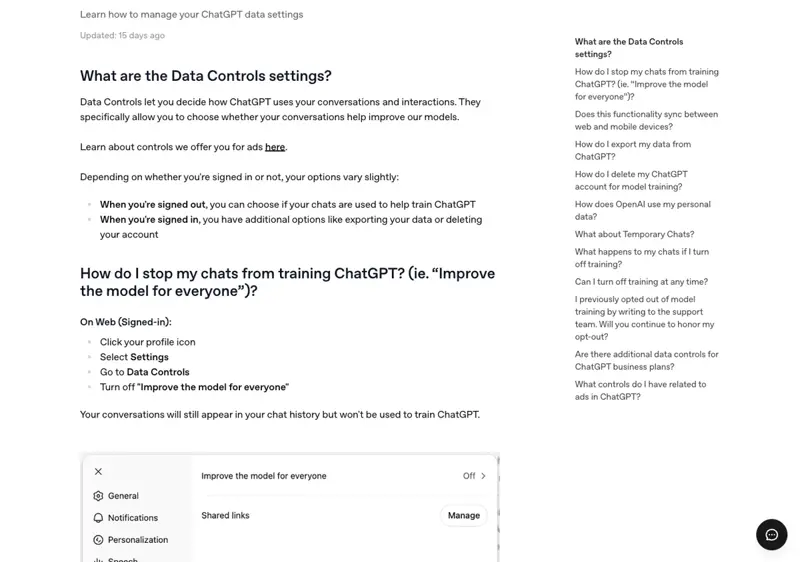
It may train the next model — by default. On free and Plus accounts, OpenAI can use what you type to help improve its models unless you say no. The off switch lives in Settings → Data Controls → “Improve the model for everyone.” Flip it off and your future chats stop feeding training. Two honest caveats: it only affects chats going forward, and anything already used is already used — you can’t pull it back out. (Business plans like Team and Enterprise are the exception: they’re kept out of training by default.)
It sticks around after you delete it — for a while. When you delete a chat, OpenAI removes it from your account right away and says it’s scheduled for permanent deletion from its systems within about 30 days. That window exists so the company can catch abuse and keep backups. So “delete” isn’t instant vanishing — it’s “gone from your view now, wiped from the back end within a month,” unless there’s a legal reason to hold it longer.
A human might read it — in specific cases. Not for fun, and not routinely. But OpenAI’s own policies say authorized staff can look at conversations to investigate abuse, to help recover your chats if you ask, or to comply with the law. On a work-managed account, an administrator can have much broader access.
It has no legal privilege. This is the one that surprises people. Tell your lawyer or doctor something and it’s legally protected. Tell ChatGPT the same thing and it isn’t. OpenAI’s own CEO, Sam Altman, has said plainly that they haven’t figured out any confidentiality privilege for ChatGPT conversations — it’s not like talking to a professional who’s bound to keep your secret.
And it can show up in court. In January 2026, a federal judge ordered OpenAI to hand over a sample of 20 million de-identified ChatGPT conversations as evidence in a lawsuit (the New York Times case). The point isn’t that your specific chat is being read by a judge. The point is that these logs exist in bulk and can become evidence — so “I typed it into ChatGPT” is not a private diary entry. It’s more like sending an email: usually nobody looks, but it’s on a server somewhere, and under the wrong circumstances it can resurface.
So, are your ChatGPT conversations private?
Private from the public? Yes — assuming you never hit “share” on a chat. (If you have used the share button, that’s a separate exposure, and we walk through how to check and unshare it here.)
Confidential? No. Treat a ChatGPT conversation like a cloud service that keeps logs — closer to Gmail than to a locked diary. Fine for most of what you do. Not the place for your deepest secrets.
What this means for you
If you’re the anxious daily user: breathe, then do two small things. Open Data Controls and turn off “Improve the model for everyone.” Then adopt one rule (below) about what not to paste. That covers 90% of the real risk. You don’t need to quit ChatGPT — you need to stop treating it like a vault.
If you paste work documents into it: slow down here. Client contracts, a colleague’s salary, a customer’s contact list, unreleased financials — once that’s in the training pile you can’t claw it back, and on a personal account it may be feeding the model. If your job involves other people’s confidential info, use a work account (Team or Enterprise, which stays out of training) or don’t paste the sensitive parts at all. Strip names and numbers first.
If you’re a professional bound by confidentiality — a therapist, lawyer, accountant, nurse: remember there’s no privilege here. Pasting a client’s or patient’s details into ChatGPT could breach the duty you’re held to, and “the AI did it” won’t cover you. Anonymize everything, or keep it out entirely.
If you’re a parent: the lesson for kids is simple and it sticks. Whatever you type into an AI, imagine it saved on a computer far away that you don’t control. So no full names, no address, no photos of the house, no secrets about friends. Homework help, yes. A diary, no.
What this post can’t promise you
A few honest limits, because the internet loves to oversell this.
- Turning off training isn’t a delete button. It stops your future chats from feeding the model. It doesn’t retroactively remove what’s already been used, and it doesn’t stop OpenAI from storing your chats for the normal retention window.
- “Delete” has a lag and exceptions. Most deleted chats are wiped within about 30 days — but if there’s a legal hold (like that court order), some data gets kept longer, no matter what your settings say.
- Privacy settings don’t protect a shared link. If you made a chat public, no data control fixes that. You have to go unshare it.
- The rules can change. Data policies get updated, and court decisions can shift what’s retained. The safe move isn’t memorizing today’s fine print — it’s building the habit below and re-checking your settings once in a while.
The one rule that beats all the settings: never paste anything into ChatGPT you’d be uncomfortable seeing stored, reviewed, or subpoenaed. Passwords and one-time codes. Bank and card numbers. Government IDs. Medical records. Anything covered by a professional confidentiality duty. If it belongs in a locked drawer, it doesn’t belong in a chatbot. Stanford’s Institute for Human-Centered AI makes the same point — think twice before feeding sensitive personal information into any AI chat, because those inputs can be collected and used.
The bottom line
Is ChatGPT private? Private enough for everyday use, not private enough for your secrets. Your chats are stored, used to improve the model unless you opt out, kept for a while after you delete them, readable by staff in specific cases, and reachable by a court. None of that makes ChatGPT dangerous. It makes it a tool with a memory — and once you know that, you use it smarter.
The real fix isn’t fear. It’s understanding how these tools handle your data so you can decide what’s safe to type — which is exactly what our plain-English AI Fundamentals course is built to teach. Learn how AI really works once, and questions like this one stop being scary and start being obvious.
Do the 60-second version right now: open Settings → Data Controls, turn off “Improve the model for everyone,” and pick your one “never paste this” rule. Done. You’re more private than you were a minute ago.
Sources
- OpenAI Help Center — Data Controls FAQ
- OpenAI Help Center — How your data is used to improve model performance
- NordVPN — Is ChatGPT private? A 2026 guide to your data privacy and security
- Stanford HAI — Be careful what you tell your AI chatbot
- Ars Technica — OpenAI’s Sam Altman on the lack of legal privilege for ChatGPT conversations
