On Thursday, October 1, a law took effect in Maryland that says a big grocery store, or a grocery delivery app, can’t use your personal data to charge you a higher price for food. It’s the first law of its kind in the country. The same week, Walmart’s CEO published a letter promising “We price the product, not the person,” and a Reuters report said McDonald’s runs an AI engine that picks an “optimal price” for every menu item at each of its roughly 14,000 U.S. restaurants.
If that sounds like a lot of noise around one question, it is. The question is simple: can two people standing in the same store, or opening the same app at the same minute, be shown different prices for the same thing, because of who they are? This guide walks through what “surveillance pricing” actually means, what Maryland’s new law does and doesn’t cover, what the best evidence says (it’s more mixed than the headlines), and a practical routine you can use to check your own prices.
I’ll be upfront about how this was put together. I didn’t run price tests myself. This guide is built from the text of Maryland’s House Bill 895, law-firm and regulator summaries, the Federal Trade Commission’s own documents, Consumer Reports’ investigations, company statements, and reporting by outlets like Reuters. Where sources disagree, or where I couldn’t confirm a claim that’s going around online, I say so.
What “surveillance pricing” actually means
Surveillance pricing is the practice of using personal data about you to set the price you see. The data can be your location, your device, your browsing, your past purchases, how you move your mouse, or even what you left sitting in a shopping cart. The goal, in the words of the FTC’s own description, is to charge each person the amount a company believes that person will tolerate.
You’ll also hear it called personalized pricing, individualized pricing, or (in Maryland’s law) dynamic pricing based on surveillance personal data. These terms overlap but they’re not identical, and mixing them up is where most of the confusion starts. Here’s a plain-English way to separate them.
| Term | What it means | Example | Is it surveillance pricing? |
|---|---|---|---|
| Dynamic pricing | The price changes over time based on demand, supply, or season | Surge fares, holiday hotel rates, airline seats | No, not by itself. Everyone sees the same price at the same moment |
| Location pricing | The price depends on the store, city, or ZIP code | A Big Mac that costs more in one neighborhood than another | Not individual, but it can be “personalized to a market segment” |
| A/B price testing | A company randomly shows different prices to different shoppers to learn what works | Instacart’s price tests that Consumer Reports caught in 2025 | Not by definition, because the assignment is random. But you still pay different prices |
| Personalized discounts | A coupon or deal targeted to you from your history | A “just for you” offer in a store app | It can be, depending on whether it’s honest |
| Surveillance pricing | Your personal data is used to set your price | You see a higher price because the system thinks you can afford it or you’re in a hurry | Yes. This is the thing regulators are going after |
The distinction matters because a lot of viral posts treat any price difference as proof of surveillance. It isn’t. A price difference is a symptom. Surveillance pricing is one possible cause, and it’s the hardest one to prove from the outside. We’ll come back to that.
What just changed
Four things landed within a few weeks of each other, which is why this topic is suddenly everywhere.
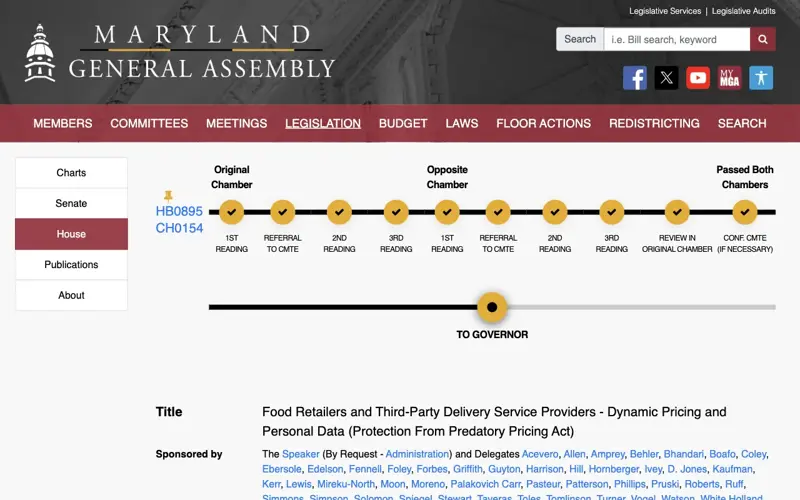
- Maryland’s ban took effect on October 1, 2026. House Bill 895, the Protection From Predatory Pricing Act, was passed as an emergency measure and applies from October 1.
- Walmart made a public promise. On September 25, CEO John Furner published “A Letter From Our CEO” saying Walmart prices “the product, not the person.”
- Reuters reported on McDonald’s pricing engine in September, and the story spread widely on social media.
- The FTC proposed a policy statement. On August 19, the Commission voted 2-0 to seek public comment on how it intends to treat personalized pricing. Comments closed September 25.
Each one is a different kind of event. One is a law with penalties. One is a corporate promise with no enforcement behind it. One is a news report that explicitly says it couldn’t prove the thing people assume it proved. And one is a regulator saying what it plans to treat as deceptive. Keeping those apart is most of the work of understanding this story.
What Maryland’s law covers
I read the enrolled text of HB 895 and cross-checked it against summaries from the law firms Skadden, Morgan Lewis, and Hunton. Here is the short version, then the details.
Who’s covered
The law applies to two kinds of businesses.
- Food retailers, defined as a business establishment with at least 15,000 square feet that sells food exempt from Maryland’s sales tax. In Maryland, the exemption covers groceries sold by a food vendor that runs a “substantial grocery or market business” at that location, for eating off the premises. Think full-size supermarkets and big-box stores that sell groceries.
- Third-party food delivery services, meaning an app or platform that facilitates delivery of that same tax-exempt food. A grocery delivery app counts. A retailer that is already covered as a food retailer isn’t double-counted.
What’s banned
A covered business may not:
- use “dynamic pricing” to set a higher price for tax-exempt food for a specific consumer, or
- use “surveillance personal data” (the bill points to the state’s definition of personal data, meaning information linked or reasonably linkable to an identifiable consumer) to set a higher price for that food for a single consumer or a group of consumers.
The bill defines the banned “dynamic pricing” as offering or setting a personalized price that is specific to a consumer based on the consumer’s personal data, whether the seller collected or bought the data, including through artificial intelligence or models that retrain themselves in near real time. That AI language is why this law gets described as an “AI pricing” law.
There’s a second, separate rule: a covered business can’t use protected-class data (information tied to a legally protected characteristic) in a way that withholds or denies a consumer an accommodation, advantage, or privilege others get.
What’s allowed
This part matters as much as the ban. The law carves out a long list of things that remain legal:
- Promotional pricing, loyalty-program benefits, and temporary discounts related to keeping existing customers
- A loyalty, membership, or rewards program that any consumer may voluntarily join
- Differences based on objective costs, such as shipping or taxes tied to where you are
- Differences based on costs, supply, or demand in different locations
- Price changes tied to the availability or supply of the product
- Subscription-based pricing
- A price offered to a consumer who consents to provide personal data in exchange for that price
- Price corrections after an error, and resetting a price after a system outage
In other words, the law bans a higher price aimed at you from your data. It doesn’t ban the thing most people think of as “personalization,” a coupon you opted into. And it doesn’t stop a store from changing the price of an item for everyone, because electronic shelf labels and ordinary price moves remain allowed.
How it’s enforced
- The Maryland Attorney General’s Consumer Protection Division enforces it.
- Before it can file an enforcement action, the Division must send a notice of violation and give the business 45 days to cure. If the business fixes the problem in time, there is no action.
- The law says it should not be read to create a private right of action. Individual shoppers can’t sue under it.
- Law-firm summaries put penalties at up to $10,000 per violation, and up to $25,000 for repeat violations.
What it doesn’t cover
- Restaurants and fast food. The law refers to the sales-tax exemption for groceries, and Maryland’s tax code excludes food for immediate consumption. So as best I can tell from the bill text, a McDonald’s menu board isn’t covered. People on social media were asking this exact question, and the answer is “probably not.”
- Stores under 15,000 square feet, such as a corner market.
- Non-food products. The ban is on a higher price for tax-exempt food. A TV at a big-box store isn’t food.
- Ride-hailing, travel, or online shopping outside food delivery.
- People outside Maryland. It’s a state law.
One claim I can’t confirm: you’ll see posts saying the law also requires shelf prices to stay fixed for a full business day. Earlier drafts of the bill did define dynamic pricing around changes “within the same business day.” In the enrolled version I read, the operative definition is about personalized prices set from personal data. I couldn’t find a price-hold requirement in the text. If you rely on that claim, check the current statute first.
The evidence: what’s been caught, and what it proves
Here’s where it gets interesting. There are real, documented cases of people seeing different prices. But the reason for the difference is contested, and the strongest evidence says less than the strongest headlines.
Instacart: the clearest controlled test
In late 2025, Consumer Reports, the Groundwork Collaborative, and More Perfect Union recruited 437 shoppers in four cities. The volunteers opened Instacart at the same time, shopped for the same items at the same stores, and recorded what they were shown.
What they found:
- About 74% of tested products appeared at more than one price.
- A single item could show up at as many as five different prices.
- The biggest gap on one item was 23%. The typical high-to-low gap on an affected item averaged around 13%.
- Whole carts varied by roughly 7% on average. In one Seattle-area Safeway, the same basket cost $114.34 for some shoppers and $123.93 for others.
- It happened across stores including Albertsons, Costco, Kroger, Safeway, Sprouts Farmers Market, and Target.
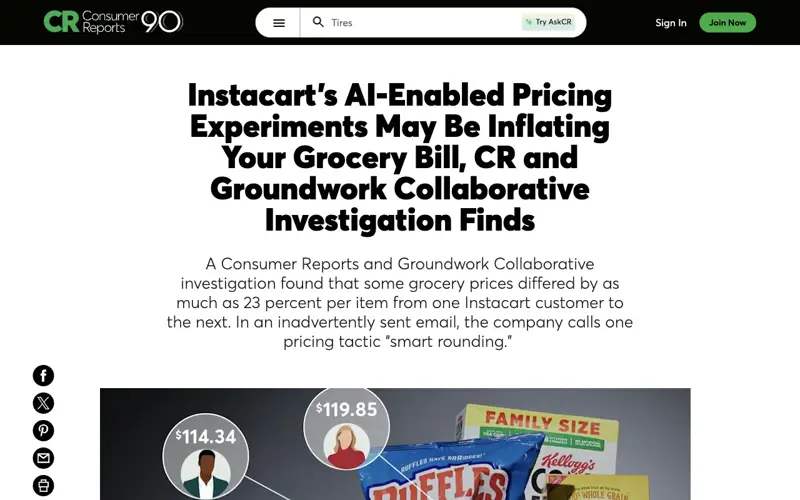
You’ve probably seen the $1,200 a year figure. It’s worth knowing where it comes from, because it’s often repeated as a measured loss. It isn’t one. Researchers took the roughly 7% average basket difference and applied it to Instacart’s own estimate of what a typical household of four spends on groceries in a year. (My arithmetic: $1,200 divided by 7% implies a grocery spend of about $17,000 a year.) So $1,200 is a “cost swing” scenario, not a number any family was shown to have lost.
How did Instacart respond? It acknowledged the tests but described them as short-term, randomized experiments run for ten retail partners, and denied using income, demographics, or personal shopping history to decide who got which price. It also argued Consumer Reports used an atypical basket and extrapolated too far. After the backlash, Instacart said it was ending item-level price tests and that shoppers viewing the same item, from the same store, at the same time would see the same price.
Both sides can be partly right, and that’s the point to hold onto:
- What the study proves: different people were shown materially different prices for identical items at the same time.
- What it doesn’t prove: that those prices were set from each person’s profile. Random A/B testing produces the same pattern. The shoppers still paid different prices, and arguably that’s the problem. But it’s a different problem from being targeted.
Uber and Lyft: big gaps, disputed cause
In spring 2026, Consumer Reports ran a similar exercise with roughly 174 volunteers checking fares for the same trips within minutes of each other. In its published account, every one of 30 virtual routes across 17 states showed at least two price clusters, with a median gap of about 50% between the highest and lowest quotes. On one Kansas City Lyft route, 55 people received 29 different quoted prices.
Uber and Lyft denied using surveillance pricing for base fares. Uber argued separate requests made seconds apart under changing marketplace conditions aren’t truly identical; Lyft noted that many volunteers checking at once can itself shift demand. Consumer Reports acknowledged it couldn’t control driver availability, routing, or exact location precision. So again: strong evidence of price dispersion, weaker evidence of why.
McDonald’s: local optimization, not (yet) personal
Reuters reported in September that McDonald’s pricing portal uses machine learning on millions of daily transactions across nearly 14,000 U.S. restaurants to recommend an “optimal price” for each item at each location, including an estimate of local customers’ “willingness to pay.” Reuters also found a Big Mac at one company-operated Fresno restaurant for $5.69 and at another two miles away for $6.89, a 21% gap.
Two cautions from the same reporting. Reuters said it couldn’t establish that the AI engine caused the Fresno difference. And McDonald’s said franchisees make the final call, though several told Reuters they felt pressure to follow the recommendations. Setting a price by neighborhood demand is “location pricing.” It’s what the FTC would call personalized to a market segment, not necessarily to you.
Walmart: a promise, not a proof
Walmart’s September 25 letter says it will not change a shopper’s price based on income, shopping history, urgency, perceived ability to pay, identity, or time of day. It also says the same promise covers Sparky, its AI shopping assistant: information you give the assistant won’t be used to raise a price or hide a cheaper option. Walmart says prices can still change when its costs change, and it’s expanding digital shelf labels.
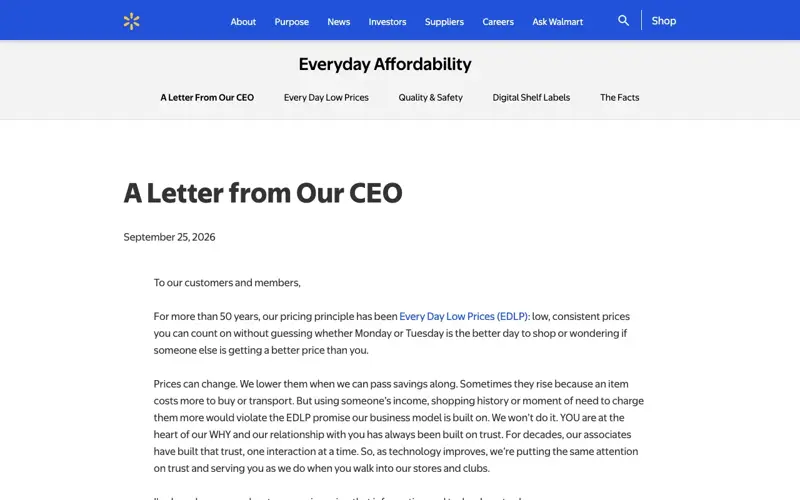
That’s a meaningful public commitment. It’s also voluntary, not audited, and not a legal guarantee. It tells you where one company says the line is. It doesn’t tell you whether anyone checks.
What does the research say about how common it is?
This is the part the viral posts skip. Researchers who study this generally separate four different claims:
- Algorithmic and dynamic pricing are widespread. Prices move fast based on demand, competition, and inventory. No personal data needed.
- Location and segment pricing are well documented. Studies of online grocers have found prices changing by delivery ZIP code, and multiple times a day.
- Personalized pricing is technically and economically feasible. Field experiments and economic models suggest detailed customer data can raise a seller’s profits.
- How often it’s actually happening, market-wide, is not known. The FTC’s own August 2026 proposal says the extent of current use “is not well understood.”
That last one is a notable contrast with the FTC’s January 2025 release, which said retailers “frequently” use personal information to target prices. That earlier statement was based on documents from six pricing-technology firms (Mastercard, Accenture, PROS, Bloomreach, Revionics, and McKinsey), which together worked with at least 250 clients. The public summary used aggregated, anonymized examples and didn’t say which clients used which data to individualize final prices. In other words: the tools exist, and companies sell them, but nobody has published a full picture of who is using them to set one-to-one prices.
A worked example: reading one piece of evidence
Let’s use the real numbers from the Seattle Safeway basket and walk through how to think about a price gap, because this is the skill that carries over to your own checks.
The facts: Same store, same basket, same time. One shopper saw $114.34. Another saw $123.93.
Step 1: Measure the gap. $123.93 minus $114.34 is $9.59. As a share of the lower price, that’s about 8.4%. (The study-wide average basket gap was around 7%, so this is a little higher than typical.)
Step 2: Ask what the gap would be if it repeated. If a household spent that much a week on groceries and always landed in the higher group, the gap would run to hundreds of dollars a year. But “if it repeated” is doing a lot of work. In the study, the assignments weren’t shown to persist. That’s why the $1,200 figure is a scenario.
Step 3: List the explanations. Random test? Location signal? Account history? New-versus-returning customer? One item in the cart on promotion for some people? Each leads to a different next question.
Step 4: Decide what you can actually conclude. The honest conclusion from one gap is: “I saw a different price than someone else.” It is not “I’m being targeted.” To get closer, you need repeated checks with one thing changed at a time. That’s exactly what the routine below is built for.
How to check your own prices: a practical routine
Here’s a method that stays within what you can reasonably verify. None of it is guaranteed to reveal anything. But it produces evidence, which is more useful than a hunch.
Step 1: Pick something specific and boring
Choose a staple you buy often: a dozen eggs, a gallon of milk, a store-brand cereal. Specific beats general. Write down the exact product, size, and store (or store location in the app).
Step 2: Record the baseline
Open the store’s website or app the way you normally do. Note the price, the time, and whether you’re logged in. Take a screenshot with the time visible. If the app shows a “was” price and a “now” price, capture both. Consumer Reports found that different users were sometimes shown different supposed “original” prices even when the final price matched.
Step 3: Change exactly one thing
This is the step that makes the test mean something. Pick one variable:
- Login: logged in versus logged out of the same app or site
- Device: your phone app versus a laptop browser
- Channel: app delivery versus store pickup versus walking in to look at the shelf tag
- Membership: with versus without a loyalty account (many “member prices” are legal and disclosed)
- Location: home Wi-Fi versus mobile data, or the app with location access on versus off
If you change three things at once, you won’t know which one mattered.
Step 4: Compare, then repeat on another day
One gap is a data point. Two gaps on different days, in the same direction, from the same single change, is a pattern. If the difference vanishes on the second try, you likely saw a random test or a normal price move.
Step 5: Know where to go if it looks real
If you’re in Maryland and believe a grocery store or delivery app is charging you more because of your data, the state Attorney General’s Consumer Protection Division is the enforcer. Nationally, you can file with the FTC at ReportFraud.ftc.gov. Include your screenshots, times, stores, and what you changed. Keep in mind that Maryland’s law is enforced by the state, not by individual lawsuits, so a complaint helps the agency spot patterns rather than getting you a personal payout.
What actually changes the price, and what doesn’t
Here’s what the sources support about the usual countermeasures. The honest summary: the popular tricks are plausible, but no broad study shows they usually lower prices.
| Tactic | What it can change | What the evidence supports |
|---|---|---|
| Incognito/private window | Starts a session without your stored cookies | May stop some cookie- or history-linked treatment. It doesn’t hide your IP address, your login, or device fingerprints. The FTC’s proposal lists it as something an informed consumer might try, which isn’t evidence it lowers prices |
| Logging out | Removes the clearest account identifier | Can change account-specific discounts. Sites can still recognize a browser by other signals. No broad study shows logging out usually lowers prices |
| VPN | Changes your apparent location | Can change prices, taxes, currency, and offers tied to region. That shows location pricing, not necessarily individual pricing |
| Turning off location for apps | Limits precise GPS access | May affect ride-hail, delivery, and local offers. Apps can still infer location from your delivery address or IP |
| Loyalty card or account | Changes member pricing, coupons, and personalized deals | The mechanism most clearly tied to different effective prices, but usually through disclosed membership rules. A loyalty discount isn’t automatically surveillance pricing |
| Paying cash, no phone | Avoids app-only and account-based offers | Plausibly avoids “your price” in apps. It won’t stop a store changing the shelf price for everyone |
Two things are worth saying out loud. First, a rigorous test needs synchronized devices, the same item, store, and time, repeated runs, and enough observations to separate real identity effects from random testing. A single person in a single afternoon can’t fully do that, so treat your own results as a lead, not a verdict. Second, a lower price from a VPN is not proof you were being surveilled. It may just mean you found a region with a different price list.
Beyond Maryland: the state and federal picture
If you’re not in Maryland, your protection depends on where you live and what you’re buying. Here’s where things stood as of early October 2026, based on bill texts and law-firm summaries.
| Place | Status | What it does |
|---|---|---|
| Maryland (HB 895) | In effect Oct 1, 2026 | Bans using personal data to set a higher price for tax-exempt food at large stores and delivery apps |
| New York (General Business Law § 349-a) | In effect since Nov 10, 2025 | Disclosure, not a ban. Businesses using personalized algorithmic pricing must display “THIS PRICE WAS SET BY AN ALGORITHM USING YOUR PERSONAL DATA.” A federal judge dismissed the retail industry’s First Amendment challenge on Oct 8, 2025 |
| Connecticut (PA 26-130) | Signed June 4, 2026; operative July 1, 2027 | Generally bars surveillance pricing by retail sellers (including food establishments) and food delivery services; some online sellers must disclose a personal-data price increase |
| New Jersey (Fair Price Protection Act) | Signed July 23, 2026; main ban Aug 1, 2027 | Bars personal-data-based pricing for groceries and other food; also pauses new electronic shelf-label deployments for a year starting Feb 1, 2027 |
| Colorado (HB 26-1210) | Vetoed June 2, 2026 | Would have restricted individualized pricing and wages. The governor said it was too broad |
| California (AB 2564) | Failed in 2026 | Missed the final deadline. The state Attorney General opened an investigative sweep of retailers in January 2026 under existing privacy law |
| Federal (FTC) | Proposed, non-binding | August 19 proposal says failing to disclose personalization is likely deceptive or unfair where consumers expect posted prices not to vary. It’s a statement of enforcement intent, not a rule |
A word of caution about dates. Connecticut changed its effective date three times during the 2026 session, which is why you’ll find articles saying October 1, 2026, or February 1, 2027. Those describe earlier versions. The final operative date is July 1, 2027. The same goes for California: some early reports said its bill was headed to the governor, but it never got there.
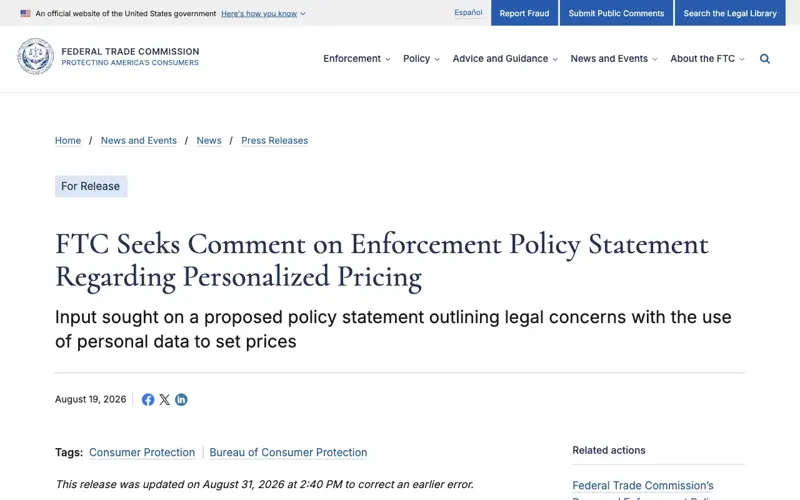
Here’s what the FTC’s proposal says, in plain terms. It argues that Congress hasn’t given the agency power to ban personalized pricing outright, but that where shoppers reasonably expect a posted price not to vary by who they are, not telling them is likely a deceptive or unfair practice. A good disclosure, per the proposal, should say that the price is personalized, what the personalization is based on, and what types of data it uses. It also warns that dressing up a personalized increase as a “loyalty discount” may itself be deceptive. The Commission left open whether a fully disclosed personalized price could still be unfair. Since it’s a proposed policy statement, it wouldn’t bind courts or businesses on its own; in an actual case, the FTC would still have to prove a violation of existing law.
What this means for you
Not everyone needs the same response. Here’s a practical take by situation.
If you live in Maryland. The ban is in effect, but the practical enforcement runs through the Attorney General, with a 45-day cure period for businesses. Your move: if you notice a pattern (same item, same store, repeated higher price in the app), document it with the five-step routine and report it. First action this week: take a baseline screenshot of three staples in your regular store’s app, so you have a “before” if something changes.
If you live somewhere without a ban. You’re mostly relying on disclosure laws (New York), company promises, and FTC enforcement. Your move: treat app prices as one data point, not the price. First action: compare your most-bought item across app, website, and the shelf tag the next time you shop in person.
If you use grocery delivery apps. Delivery apps are covered in Maryland and are the setting for the best-documented price-gap test (Instacart’s). They also commonly show higher prices than the shelf, which is a separate and common practice. Your move: compare delivery to pickup for the same cart before you commit to a big order. First action: build your usual cart, then price the same items for pickup.
If you’re on a tight grocery budget. A single-digit percentage gap on a weekly cart adds up, and this group is least able to absorb it. Your move: use the free tools stores give you (unit prices, digital coupons, store-brand swaps), but understand loyalty pricing is a trade of data for savings. First action: write down what you give up (purchase history) for the member price, and decide if it’s worth it.
If you run a small retail or e-commerce business. You’re probably using pricing software, promotions, or an ad platform that personalizes. Your move: separate the three things regulators treat differently: ordinary price moves for everyone, disclosed discounts people opt into, and prices set from individual data. Law firms advising on these bills point to disclosure, consent, and avoiding personal-data-based increases as the safer lines. First action: ask your pricing or marketing vendor in writing what customer data feeds the price a given shopper sees. (This isn’t legal advice. Talk to a lawyer before changing anything.)
If you work in marketing, pricing, or product at a larger retailer. The pattern across states is the same: disclosure, consent, and no higher price from personal data in groceries. Your move: inventory every place personal data touches a price or promotion and document the purpose. First action: map which loyalty and app promotions are voluntary, publicly available, and disclosed, because those carve-outs rely on exactly that.
If you use an AI shopping assistant. ChatGPT’s shopping results and retailer assistants like Walmart’s Sparky put a conversational layer on top of prices. Walmart says Sparky won’t use what you tell it to raise prices or hide cheaper options. Your move: use assistants to compare, then verify the final price on the retailer’s own page. First action: ask the assistant for the price at two retailers and click through to confirm both. If you’re curious about the privacy side of AI shopping features, our guide to ChatGPT’s Try On feature covers what you hand over.
Edge cases and troubleshooting
These are the situations that come up most when people try to check prices, along with what to do about them.
The app price and the shelf price don’t match. That’s common and not necessarily surveillance. Delivery and pickup prices often include markups, and shelf labels can lag. Compare like with like: app pickup price versus shelf price, not app delivery versus shelf.
You saw a lower price when you logged out, so you assume you were being overcharged. Not necessarily. Logged-in accounts can get loyalty prices, and logged-out visitors can get introductory offers. Repeat the check on another day before drawing conclusions.
Your VPN showed a different price. That’s location pricing or a different regional price list. It’s real, but it’s not the same as individual targeting. And note that some airlines and retailers behave differently for private browsers or VPNs.
The same item has two different prices in the same cart-building session. Could be a pending promotion, a quantity discount, or a timing change. Refresh, wait a minute, and check again. If the price changes only when you refresh with no other change, you may be seeing a live test.
You’re certain the price rose as you walked into the store. That claim circulates a lot, and it’s possible in principle if an app uses location. But nobody in the sources I reviewed posted a controlled test showing it, and the major examples that circulate are older. Document it properly, with screenshots and timestamps, before assuming.
A “was” price looks inflated. Consumer Reports, in its ride-hail work, classified roughly 11% of the discounts it saw as unsupported, usually because the crossed-out comparison price looked inflated. A fake discount is a different problem from surveillance pricing, and regulators treat it differently, but it’s worth catching.
You’re in Maryland but it’s a restaurant or a small shop. Those aren’t covered. Maryland’s ban applies to large grocery-type stores and delivery services.
A friend says Maryland “froze shelf prices for a day.” I couldn’t find that in the enrolled bill. Check the statute or the Attorney General’s guidance rather than a social media summary.
What this can’t fix
- It can’t tell you whether you are being targeted. Even in the best controlled tests, researchers could show different prices but not prove why.
- Maryland’s law is narrow. It covers higher prices for grocery food from large stores and delivery apps. It doesn’t touch restaurants, ride-hailing, travel, or most online shopping.
- There’s no private lawsuit under it. If a store breaks the law, the state decides whether to act.
- The FTC proposal isn’t a rule. It signals what the agency considers deceptive, but it doesn’t create new legal prohibitions by itself.
- Company promises aren’t audits. Walmart’s letter is a significant public commitment. It’s still a promise.
- Price-checking can’t stop a store changing a price for everyone. Shelf labels that update prices for all customers remain legal, and so do ordinary demand-based changes.
FAQ
What is surveillance pricing in plain English? It’s when a company uses data about you, like your location, device, browsing history, or past purchases, to decide what price to show you. The aim is to charge each person about what the company thinks they’ll pay. It’s different from ordinary price changes that apply to everyone.
Is surveillance pricing legal? It depends on where you live and what’s being sold. In Maryland, using personal data to set a higher price for grocery food at large stores and delivery apps has been illegal since October 1, 2026. Connecticut and New Jersey have passed bans that start in 2027. New York requires a disclosure label. Elsewhere, there’s no general ban, though the FTC has proposed treating undisclosed personalization as deceptive.
Does Maryland’s law ban all personalized pricing? No. It bans a higher price for tax-exempt food set from your personal data, at stores of 15,000+ square feet and at delivery apps. Loyalty programs anyone can join, disclosed promotions, location-based cost differences, subscription pricing, and prices offered in exchange for consent to share data are all carved out.
Does using incognito mode get me a lower price? There’s no broad evidence it does. Private windows clear your stored cookies, but sites can still see your IP address, your login, and other device signals. It’s a reasonable thing to try as part of a comparison, but don’t assume a lower result means you were being targeted.
Is Instacart still charging different prices? Instacart said it ended item-level price tests after the Consumer Reports investigation and that shoppers viewing the same item from the same store at the same time would see the same price. That’s the company’s statement. It doesn’t cover store-level markups, which are separate.
Does Walmart use surveillance pricing? Walmart’s CEO says it doesn’t and won’t use income, shopping history, urgency, or perceived ability to pay to set a price. That’s a public commitment, not an independent audit. An advocacy-group TV test of Walmart prices circulated on social media, but I couldn’t verify its methodology, so I haven’t relied on it here.
Is a loyalty card price a form of surveillance pricing? Not automatically. A member price offered under public rules that anyone can join is generally treated as a legitimate discount, and Maryland exempts it. The concern is higher when your individual purchase history secretly determines a nonuniform price, or when a personalized increase is presented as a discount.
Can I sue a store under Maryland’s law? No. The law says it doesn’t create a private right of action. The Attorney General’s Consumer Protection Division enforces it, after notice and a 45-day window to fix the problem.
What’s the difference between dynamic pricing and surveillance pricing? Dynamic pricing changes prices over time based on demand or supply and typically applies to everyone at the same moment, like surge fares. Surveillance pricing sets your price based on your personal data. Maryland’s law is aimed at the second, though it uses the term “dynamic pricing” in its text to describe personalization.
Does AI make this worse? It makes it cheaper and faster to do, which is why lawmakers wrote AI into the Maryland definition. But the research so far shows the tools are available and being sold, while market-wide use for one-to-one prices isn’t well documented. The FTC itself says current use “is not well understood.”
How do I report a suspected overcharge? In Maryland, to the Attorney General’s Consumer Protection Division. Anywhere in the U.S., to the FTC at ReportFraud.ftc.gov. Include screenshots with timestamps, the store, the item, and what you changed between checks.
The bottom line
Surveillance pricing is real as a technology, real as a legal category, and unproven as a widespread practice. The best evidence shows people paying different prices for identical goods. It doesn’t yet show, in most cases, that those prices were set from their personal data. That gap is exactly why lawmakers in Maryland, New Jersey, Connecticut, and New York wrote rules about disclosure and consent instead of waiting for proof.
For you, the practical takeaway is modest and useful: treat any single price as one data point, change one variable at a time when something looks off, keep the screenshots, and know who to tell. If you want to understand what personal data apps collect and how to limit it, our AI Privacy 101 course walks through it step by step, and the Personal Finance course covers building a grocery budget that holds up whatever the price tag says.
Sources
- Maryland General Assembly: HB 895 (2026), Protection From Predatory Pricing Act and the enrolled bill text
- Morgan Lewis: Maryland Enacts HB 895, Becoming First State to Restrict Personalized Pricing in the Food Sector
- Skadden: Maryland Becomes the First State to Restrict Surveillance Pricing in the Food Industry
- Hunton: Maryland Enacts First-of-its-Kind Ban on Surveillance Pricing for Grocery Sales
- Federal Trade Commission: FTC Seeks Comment on Enforcement Policy Statement Regarding Personalized Pricing (Aug. 19, 2026)
- FTC: Proposed Enforcement Policy Statement Regarding Personalized Pricing (PDF)
- FTC: Surveillance Pricing 6(b) Study initial findings (Jan. 2025)
- Consumer Reports: Instacart’s AI-Enabled Pricing Experiments May Be Inflating Your Grocery Bill
- Walmart: A Letter From Our CEO (Sept. 25, 2026)
- Fox Business: Walmart vows not to use customer data for personalized pricing
- Bloomberg Law: NY Algorithmic Pricing Law Decision Provides Map for Compliance
- Venable: Maryland Leads Wave of State Surveillance Pricing Regulation, with Colorado and Connecticut Quickly Following
- Multistate.ai: State Surveillance Pricing Laws Spread as Maryland Leads the Way
- American Bar Association: When Pricing Gets Personal (April 2026)
