

Your phone rings during the lunch rush. The voice says it is an AI assistant calling for a customer, and it wants to know whether you have a table for four on Friday, or the price of a cut and color, or how soon you can look at a car that is making a noise.
That call is no longer a curiosity. On November 17, Google made Tasks in Gemini free in the US and five other countries, and its announcement says Gemini can call businesses on a customer’s behalf. Calling is one of the features starting in the US. A free assistant that can phone businesses means more of these calls reaching front desks, and one request can mean more than one shop: Android Authority describes Google’s own example as Gemini calling two dealerships.
This guide is for the person who answers that phone: a restaurant host, a salon owner, a dental or vet receptionist, a service writer at an auto shop. It says which AI callers exist and how they differ, what Google has written down about them, what little evidence we have about how businesses answer, and a plan you can set up in an afternoon. It also covers the two different ways to opt out, because they are not the same switch.
The short answer
TL;DR. Treat an AI caller like a customer’s assistant: answer the question, give only what you would publish, and never give a card number, a code or private information on the strength of a call. Keep your Google Business Profile accurate, because that is where calls start. If you want fewer calls, there are two separate controls: a Business Profile setting for Google’s automated calls, and a phone-number opt-out for Gemini.
- Gemini says who it is. Google’s announcement says Gemini discloses that it is an AI, and the release notes say it won’t share payment or sensitive account details over the phone.
- Businesses can opt out, in two places. Google’s announcement says businesses can opt out whenever they want. Google’s Business Profile help page gives one route, and Gemini’s own opt-out page gives another.
- Calling starts in the US. Google’s November 17 announcement says Gemini calling is one of the features starting in the US, and its footnote says calling through Gemini is not currently available in Indiana, Louisiana, Minnesota, Montana and Nebraska.
- The “1 in 4 go unanswered” statistic is old and not about Gemini. It comes from a 2025 study of Google’s earlier AI price calls, and I could not open the study itself. More below.
- This is a different post from our plumber and HVAC guide. For that trade, read Google’s AI calls and the 15-minute check for plumbers and HVAC.
Which AI is calling? Three different callers
“An AI called us” can mean at least three different things, and the right response depends on which.
| Caller | What it is | Who it calls for | How you can stop it |
|---|---|---|---|
| Gemini Tasks calling | The feature Google made free in the US on November 17, 2026 | A customer who asked Gemini to call you | Gemini’s calling opt-out page, by phone number |
| Google’s automated calls for customers | Google “might contact your business on their behalf through an automated phone call” to book an appointment, check a restaurant wait time or confirm a price or availability | A customer using Google Search or Maps | Business Profile settings, or tell the caller to stop |
| Data-collection agents from other companies | Software that phones many businesses to ask basic questions | The company running the software, not a customer | Not a Google call, so neither Google control is documented to apply |
The first row is new on November 17. The second is older and is documented on Google’s Business Profile help page, which does not mention Gemini or Ask for Me by name. The third is real: in early October, an AI-agent startup called Voygr made 848 calls to San Francisco businesses to test its software, according to the San Francisco Standard. Those calls were not customers trying to book.
You cannot tell which one you have from the ring. The first sentence is where to listen, which is why the answer plan below starts there.
What Google has written down
I read Google’s announcement, the Gemini release notes, and two help pages, one for Gemini calls and one for Business Profile.
From the Gemini announcement and release notes (November 17, 2026):
- Gemini can call businesses for the customer.
- It discloses that it is an AI. The release notes say it “identifies itself as an AI assistant”.
- It “won’t share payment or sensitive account details over the phone”.
- The customer can “review, approve the call plan before Gemini dials”, and gets “a crisp summary and full transcript right in chat”.
- “Businesses can opt out whenever they want.”
- Calling is not currently available in Indiana, Louisiana, Minnesota, Montana and Nebraska.
- The announcement’s example is Josh Woodward, Google’s Vice President of Labs, booking a minivan service appointment, which the post says took less than five minutes.
From Google’s Gemini help page “Ask Gemini to handle your everyday phone calls”: this page describes a narrower, phone-based version of calling, with conditions such as a Pixel phone and a subscription. Google’s announcement does not say those conditions apply to Tasks, so use it for what it says about the call itself. It says calls open by identifying “an AI assistant from Google calling on a recorded line on your behalf” and stating the customer’s name. It says Gemini cannot make emergency calls, make payments, relay sensitive information such as Social Security numbers, passwords or health information, or be used for telemarketing. It says there are daily limits on the number of calls Gemini can make, and that calls go to US phone numbers.
From Google’s Business Profile help page, “About automated calls and texts from Google to your business”:
- Google “might contact your business on their behalf through an automated phone call to complete the request”, for example to book appointments, check restaurant wait times, or confirm prices and availability.
- Google “limits the number of calls for the same info and avoids calling during late night or early morning hours”.
- Calls made for customer requests are “monitored and recorded for quality assurance”.
- The page says this is available in all US states except Indiana, Louisiana, Minnesota, Montana and Nebraska.
- It says nothing about whether turning the calls off affects your visibility in Search or Maps.
One practical consequence of “recorded line”: do not say anything on that call you would not say in front of a customer.
What the evidence says about how businesses answer
Not much, and I want to be exact about how much.
The 26% figure. The figure going around is that about one in four AI-placed calls goes unanswered. I traced it. The source is a post by Zoca, dated October 7, 2026, which attributes it to Invoca’s “Google’s AI is calling” (Blair Symes, December 10, 2025). As Zoca reports it, 26% of Google’s AI price calls went unanswered, another 49% of the answered calls ended with no price, the study covered July to November 2025 across industries including hair salons, and Invoca does not publish a sample size. I tried to open Invoca’s page and got a 404, so I have not read the study. Treat the number as “a 2025 figure for Google’s price calls, reported secondhand”, not as a measure of Gemini Tasks this week.
The San Francisco test. The San Francisco Standard (October 29, 2026) reported that Voygr made 848 calls in early October, asking questions like the price of a salon’s cheapest haircut or whether a dentist was accepting new patients. As reported, about 1 in 3 respondents stayed on the phone after learning they were speaking to an AI agent, and about 1 in 25 of those had their own AI agent answering. The article does not give the overall counts for answered or hung-up calls, and does not clearly state the base for the 1 in 3. It says veterinarian and dentist offices were the most likely to keep talking, and dry cleaners and bars the least.
The people quoted were not of one mind:
- Kash, of Warm Planet Bikes, strongly opposed the calls, calling them an intrusion that “smack[s] of trying to get between business and the customer”.
- Colleen Booth, COO of Lazy Bear Restaurant Group, said she knows of no AI agent that has successfully booked at Lazy Bear, True Laurel or Jou Jou, and said agents stall at payment, book last minute, repeat themselves and misread human replies.
- Jason Ford, of The New Wheel, an e-bike shop with locations in Marin, Oakland and San Francisco, said he gets one or two agent calls a week, found them quick and responsive, and wants agents to say which company built them.
These were data-collection calls, not Gemini customers, so they tell you how people react to AI callers in general, not how Gemini bookings go.
Reddit and X. I had Grok search both for owners’ reactions to the free Gemini rollout. It found almost none. It found a November 2 r/smallbusiness thread that cited the San Francisco test and suggested a simple rule (answer questions about hours and prices normally; for new bookings or changes, take the details and confirm directly with the customer on a known number), and a November 12 thread about Google’s “Call” and “Book” buttons for home-service businesses, where a commenter noted that calls ring the number on the Business Profile, so a missed call loses the lead. I did not open those threads myself, so treat them as leads, not evidence.
| Source | What it covers | What it does not cover |
|---|---|---|
| Google’s help pages and announcement | What the call is designed to do and how to opt out | How often front desks answer, or what it does to bookings |
| San Francisco Standard test | AI agents from one startup, calling in early October | Customer bookings through Gemini |
| Invoca figure, reported by Zoca | Google’s AI price calls, July to November 2025 | Gemini Tasks, and it has no published sample size |
| Reddit and X, found by Grok | A few threads and posts, from November 2 to 17 | Owners’ experience of the free rollout |
So the honest summary is: Google tells us what the call is supposed to do, and as of November 18 I found nothing published on how front desks fare with Gemini’s calls.
The front-desk plan
These steps come from what Google’s pages say, from Zoca’s and Local Falcon’s advice, and from common sense. None is proven to win bookings. They are cheap, so do them.
1. Make your Business Profile the source of truth. Google’s Business Profile page says its automated calls contact the phone number on your Business Profile, and a commenter in a November 12 Reddit thread (as Grok summarized it) made the same point about missed calls losing the lead. Check three fields: the phone number, the hours (including holiday hours), and the services. A wrong number means the AI reaches the wrong person, or no one.
2. Make sure the number gets answered. A call that goes to voicemail is a lost lead. If you cannot answer, route to someone who can, or to a voicemail that states hours and a booking link.
3. Keep the phone menu short. Local Falcon’s summary of Gemini’s calling says it can navigate phone menus and wait on hold. A tree with five layers still costs human callers time. Put “press 1 for reservations” at the top.
4. Publish prices and openings in plain text. Zoca’s advice is to publish a price for each service before a call arrives, give a starting price and what changes it, and offer two openings within the days the caller asked about. That reads as good practice for human callers too.
5. Prepare a 90-second answer. Staff should know what to say before the phone rings. Examples by trade are below.
6. Do not hang up on it. If a call opens with an AI introduction from Google or Gemini, Google’s pages describe it as a customer’s request. Zoca notes that Google’s help page says Google “limits the number of calls for the same info”, so telling the caller to call back may make the request fail.
7. Never give out what you would not publish. No card numbers, no verification codes, no account changes, no deposits and no private patient or client information on the strength of a call you cannot verify. Google’s release notes say Gemini “won’t share payment or sensitive account details over the phone”, so a deposit or card number should be collected from the customer through your normal channel, not on the call.
8. Write down what happens. For two weeks, keep a tally: how many AI calls, which kind, what they asked, and whether a booking came of it. It is the only data about your own shop that anyone will have.
By trade: what to say and what to watch
The sample scripts below are ones I wrote to show the shape. I have not tested them on an AI caller.
Restaurants and cafés
Google’s Business Profile page lists “checking restaurant wait times” as one of the reasons Google calls, and booking appointments and confirming availability are two more. For a restaurant, expect questions like a table for a party size on a date, the hours, or the wait.
A sample script, written by us:
Yes, we have a table for four on Friday at 7:00 or 8:30. Which would you like? Reservations are held for fifteen minutes. You can also book at the link on our Google listing.
Watch for: Colleen Booth’s point that agents stall at payment. If you take deposits for large parties, say how the customer finishes the booking: a link, a text, or a call to the customer. Google’s release notes say Gemini won’t share payment details over the phone, so plan for the customer, not the assistant, to handle the deposit. Our course on restaurants and the AI front door (first 2 lessons free) is about getting discovered by diners who ask AI, which is the other half of this story.
Hair and nail salons, barbers and spas
Google says its automated calls can confirm prices and availability, and the San Francisco test’s example question was the price of a salon’s cheapest haircut. So expect price and opening questions. If you are mid-service, someone else needs to be able to answer.
A women's cut starts at $55 and a cut with color starts at $120, depending on length. I have Thursday at 11:00 or Friday at 2:30. Book at the link on our listing, or I can hold a slot for you.
Watch for: Zoca’s advice to give a starting price with what changes it, and two openings. Our salon and beauty course (first 2 lessons free) covers scheduling, client retention and pricing.
Dental offices and veterinary clinics
The San Francisco test found dentists and vets the most likely to keep talking after learning the caller was an AI. The questions in that test included whether a dentist was accepting new patients. For a clinic the extra care is privacy.
Yes, we are accepting new patients. The first openings are Tuesday at 9:00 or Wednesday at 1:00. I cannot discuss anyone's health information on this call. The patient can book on our website or call us directly.
Watch for: no patient names, appointment details for existing patients, insurance details or health information. Give only what you would put on your website. Our dental practice course (first 2 lessons free) covers patient engagement and marketing.
Auto repair and detailing shops
The question is often “how soon can you look at it” and “what does it cost”. Woodward’s own example in the announcement is an appointment for a minivan service.
We can look at it Thursday morning. A diagnostic is $95 and we apply it to the repair. Bring the car by 8:00 or I can book a time on our listing.
Watch for: a quote you cannot stand behind. A price over the phone for a problem nobody has seen should be a starting price, with what changes it. Our auto repair course (first 2 lessons free) covers shop management and diagnostics.
A worked example: one salon, one call
This is a made-up call, written by us to show the shape. It is not a recording and not a real business.
Sample call, written by us. AI: “This is an AI assistant calling on a recorded line on behalf of a customer. She would like to know the price of a haircut and the next opening this week.” Front desk: “Thanks for telling me. A cut starts at $55. I have Thursday at 11:00 or Friday at 2:30.” AI: “Thank you. I will pass that on.” The call lasts under a minute.
What went right: the front desk answered, gave a starting price and two openings, and stopped. What it did not do: ask the AI for a card number, a deposit, or the customer’s address. The customer gets a summary and transcript, per the release notes, and decides.
Now suppose the front desk had said “Can she call back after 5?” Per Zoca’s reading of Google’s help page, Google limits repeat calls for the same information, so the request may not be retried. That is a possible cost of not answering, and it is why the plan puts the answer first.
Opt out or stay: two controls, not one
If you would rather not take these calls, there are two separate controls. Google’s announcement says businesses can opt out whenever they want, and the two pages describe different things.
1. Google’s automated calls: Business Profile settings
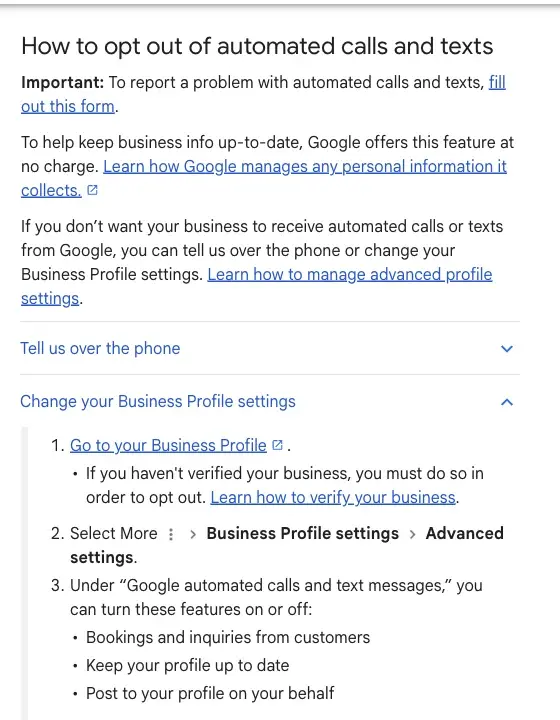
This is for the calls Google makes for customers through Search and Maps. Google’s page gives these steps:
- Go to your Business Profile. If your business is not verified, you must verify it to opt out.
- Select More, then Business Profile settings, then Advanced settings.
- Under “Google automated calls and text messages”, you can turn off any of: Bookings and inquiries from customers; Keep your profile up to date; Post to your profile on your behalf.
The page also says you can tell a caller “Please stop calling my business”, and that after opting out you may still occasionally get manual calls from Google to confirm your business information.
2. Gemini’s calls: the Gemini calling opt-out page
Google’s Gemini help page links to g.co/gemini/calling-opt-out. The shorter g.co/gemini/opt-out redirects to android.com/ai/gemini/calling-opt-out, which I opened. It is a form for a phone owner: choose a country, enter a phone number, verify with a six-digit code sent by text, and opt out. The page says that once you opt out, “your number will be added to a block list and you will no longer receive automated calls from Gemini.”
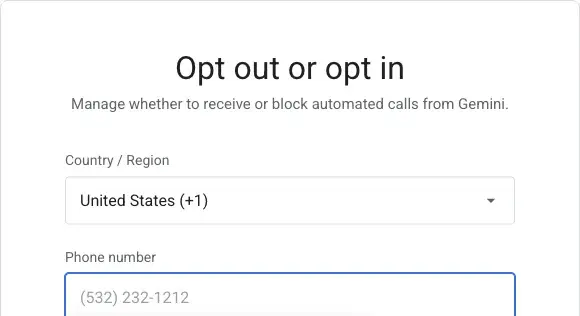
Two honest notes. First, the page does not say it is for businesses. Google’s help page describes it as for people who “don’t want to get automated calls from other Gemini users”. It works by phone number, so if you want to try it, the number to enter is the one customers’ assistants would dial, which in most cases is the number on your Business Profile. That is my inference, not a statement from Google. Second, Local Falcon and Zoca give the address g.co/gemini/opt-out, which sent me to the same page with a redirect.
Each control is separate. Zoca notes that each opt-out is separate, and Google’s Business Profile page does not mention Gemini.
Should you opt out?
Zoca advises against it, arguing that opted-out businesses are left out of the results customers see. Local Falcon’s article notes that opting out could mean turning away customers who choose this method of calling. I could not find Google saying anything about visibility either way: its Business Profile page is silent on it. So the trade-off is real but unmeasured.
How I would decide, as a reasoning aid and not a rule:
- If you have enough staff to answer and a clear price list, stay in, and measure with the log from step 8.
- If your phone is your bottleneck (one person, a cutting chair, a procedure room), consider turning off “Bookings and inquiries from customers” and sending those customers to an online booking link instead.
- If you have privacy duties (a clinic), the call script above, which gives only what you would publish, is the safer first move, and opting out is a second.
- Whatever you choose, review it in a month, because the volume is unknown.
Is it a scam? How to tell
AI voice scams exist, and our guide to AI voice cloning scams covers the family version. Here is a short checklist for a business line, from what Google says a legitimate caller does.
A Gemini call, per Google, identifies itself as an AI assistant calling for a customer, asks things like hours, availability or a quote, and, per the release notes, won’t share payment or sensitive account details. A call that does the following is not behaving like that:
- It asks you for a card number, a verification code, a password, or to “confirm” an account.
- It claims to be your bank, your landlord, or a utility.
- It pressures you to act immediately.
- It asks you to read out a number sent to your phone.
If in doubt, take their details, hang up, and call back on a number you already have. Our guide on AI call screening apps covers the other direction: your own phone screening calls.
What this means for you
If you own a restaurant or café. Check Business Profile hours and phone first, set up one person to answer reservation calls at peak times, and decide how large-party deposits are finished.
If you run a salon, barbershop or spa. Put a starting price for each service on your listing and website. Keep two openings in mind for each day. If you are mid-service, let someone else pick up.
If you manage a dental or vet front desk. Write the “I cannot discuss health information on this call” line into your script, and decide with your practice manager whether to opt out.
If you run an auto shop. Quote a starting price and what changes it. Offer the next opening. Avoid a firm price for a problem nobody has seen.
If you are a solo owner with no one else to answer. Voicemail with a clear message and a booking link is better than a ring that goes nowhere. Consider whether the Business Profile booking toggle is worth turning off.
If you are a customer. Our Gemini Tasks guide covers what the assistant does on your side, and how to tell it not to book.
Edge cases and troubleshooting
- The call comes from a number that looks like a customer’s. One of the secondary sources says Call for Me dials from the customer’s own number. I did not see that in Google’s pages, so I would not rely on it. If you do get a call that looks like a normal customer, listen for the AI introduction.
- The AI keeps calling. Google’s Business Profile page says Google limits the number of calls for the same information and avoids calling during late night or early morning hours. If the calls continue, use Google’s “report a problem” form, which the page links.
- A caller asks for a deposit or card number. Google’s release notes say Gemini “won’t share payment or sensitive account details over the phone”. A request to take or give card details on the call is not what Google describes, so treat it as a possible scam and call back on a number you already have.
- You opted out and still got a call. Google says that after opting out you may still occasionally get manual calls to confirm your business information.
- You are in one of the five states. Google says calling through Gemini is not currently available in Indiana, Louisiana, Minnesota, Montana and Nebraska, and its Business Profile page lists the same five.
- A caller says it is an AI but will not say for whom. Jason Ford, an e-bike shop owner quoted by the San Francisco Standard, wants agents to say which company built them. Google’s own calls say they are calling on behalf of a customer; other callers may say less. Say politely that you can only discuss what is on your website.
- The AI cannot understand your answer. Colleen Booth said agents misread human replies. Zoca recommends reading the booking link slowly; short sentences and one fact at a time are my addition.
- The phone is busy and staff cannot answer. A commenter in the Reddit thread Grok found said a missed call loses the lead. A second line or a call-forward is the fix.
What this can’t fix
- It cannot make you the AI’s first choice. I found no source on how Gemini picks which businesses to call. Local Falcon’s article does not explain it, and neither do the Google pages I read.
- It cannot guarantee the booking. The customer reviews the summary and transcript and decides.
- It will not settle a deposit on the call. Google says it won’t share payment details over the phone, so deposits and card holds are still yours to handle with the customer.
- It does not replace your listing. If your Business Profile is wrong, the call goes wrong.
- We do not know the effect on ranking. Zoca says opting out leaves you out of results; Google’s page says nothing. I could not confirm either.
- We have no numbers for Gemini calls to businesses. The 26% and the San Francisco test are about other callers.
FAQ
Can an AI really call my business? Yes. Google’s announcement of November 17, 2026 says Gemini can call businesses for customers, in the US, and the Business Profile help page describes Google’s separate automated calls for customers.
Will the AI say it is an AI? Google says so. Its announcement says Gemini discloses that it is an AI, and the release notes say it identifies itself as an AI assistant.
Is the call recorded? Google’s Gemini help page says calls open by saying it is calling “on a recorded line”, and the Business Profile page says calls for customer requests are “monitored and recorded for quality assurance”. Assume it is recorded.
What can the AI not do? Per Google, Gemini will not share payment or sensitive account details over the phone. The Gemini help page for the Pixel calling feature also says it cannot make emergency calls, make payments or relay sensitive information such as Social Security numbers, passwords or health information, and cannot be used for telemarketing.
How do I stop Google’s automated calls? In Business Profile, go to More, Business Profile settings, Advanced settings, and turn off the options under “Google automated calls and text messages”. You must verify your business first. You can also tell a caller to stop.
How do I stop Gemini’s calls? Use Gemini’s calling opt-out page and enter your phone number, then verify with the code sent by text. The page says the number is added to a block list.
Will opting out hurt my Google ranking? I could not find Google saying. Its Business Profile page is silent on visibility. Zoca argues opting out leaves you out of results, but that is a claim, not a Google statement.
Is it true that one in four AI calls goes unanswered? That number traces to a 2025 figure for Google’s AI price calls, reported by Zoca from Invoca. It is not a measurement of Gemini calls, and I could not open the study.
Does this affect me outside the US? Gemini’s calling starts in the US, per Google’s announcement, and Google’s Gemini help page says calls go to US phone numbers.
What if the caller asks for a card number? Do not give it. Google’s release notes say Gemini won’t share payment or sensitive account details over the phone, so that is not what a Gemini call is described as doing.
The bottom line
The new part on November 17 is not that businesses can be called by software. It is that the software became free for what Google calls hundreds of millions of people in six countries, and Google has written down the rules: it says it is an AI, it won’t share payment or sensitive account details over the phone, and you can opt out. What is not written down is how many calls you will get, what they will cost you if you miss them, or whether opting out changes how you appear. So the sensible plan is cheap and reversible: make the listing accurate, answer fast with what you would publish, keep a two-week log, and decide with your own numbers.
To go deeper on being found and chosen by AI assistants, try AI Visibility for Local Businesses (first 2 lessons free): Start lesson 1 free →
Your first step today: open your Google Business Profile and read the phone number and hours out loud as if you were the AI hearing them for the first time.
Sources
- Josh Woodward, “Put Gemini to work for you”, Google, November 17, 2026
- Gemini Apps release notes, November 17, 2026 entries
- Gemini Apps Help, “Ask Gemini to handle your everyday phone calls”
- Google Business Profile Help, “About automated calls and texts from Google to your business”
- Gemini Calling Opt-out
- San Francisco Standard, “AI agents calling local businesses”, October 29, 2026
- Zoca, “Google AI is calling your business. What it is, and what to say”, October 7, 2026
- Local Falcon, “Google’s Gemini Is Starting To Call Local Businesses for Customers”, October 9, 2026
- Android Authority, “Gemini can now handle task requests for free, including calls to businesses on your behalf”
- Reddit threads in r/smallbusiness of November 2 and November 12, 2026, and a post by @iguptapankaj on X of November 17, as summarized by Grok on November 18, 2026 (not opened individually)