On November 24, New York’s governor signed a five-year pause on making and selling AI chatbot toys. It doesn’t take effect until the 90th day after signing, so the holiday shopping happens first. If a child unwraps one and wants to show it off at your center in January, what should your staff do?
It’s a what-if, not a reported incident. You need a center rule, a warm note to families that doesn’t make the gift-giver feel bad, and a few steps for staff.
TL;DR. New York’s law bans making, exchanging, holding for sale, distributing and selling chatbot toys in the state. The ban doesn’t reach owning one, using one or bringing one to child care, so a rule about a toy from home is your center’s own choice. Below: the facts, a prompt we ran in ChatGPT and Gemini, what they got wrong, and an edited rule, parent note and staff card. Keep children’s details out of the chatbot.
This isn’t legal advice, and I’m not a lawyer.
What New York signed, and what it left out
The bill is S.9408-A. The New York Assembly’s bill page shows it signed on November 24, 2026, as Chapter 416. It adds an article to the General Business Law headed Prohibition on Chatbot Toys. The core sentence is section 1801:
No person, firm, corporation, association, partnership, business entity, or agent, employee, affiliate, beneficial owner, or subsidiary thereof, shall manufacture, exchange, hold for sale, distribute, or sell any chatbot toy in this state.
Every verb there is about making or moving toys. Owning and using aren’t on the list, even though the act defines a user (a consumer of the toy). I found no mention of daycare, child care or schools.
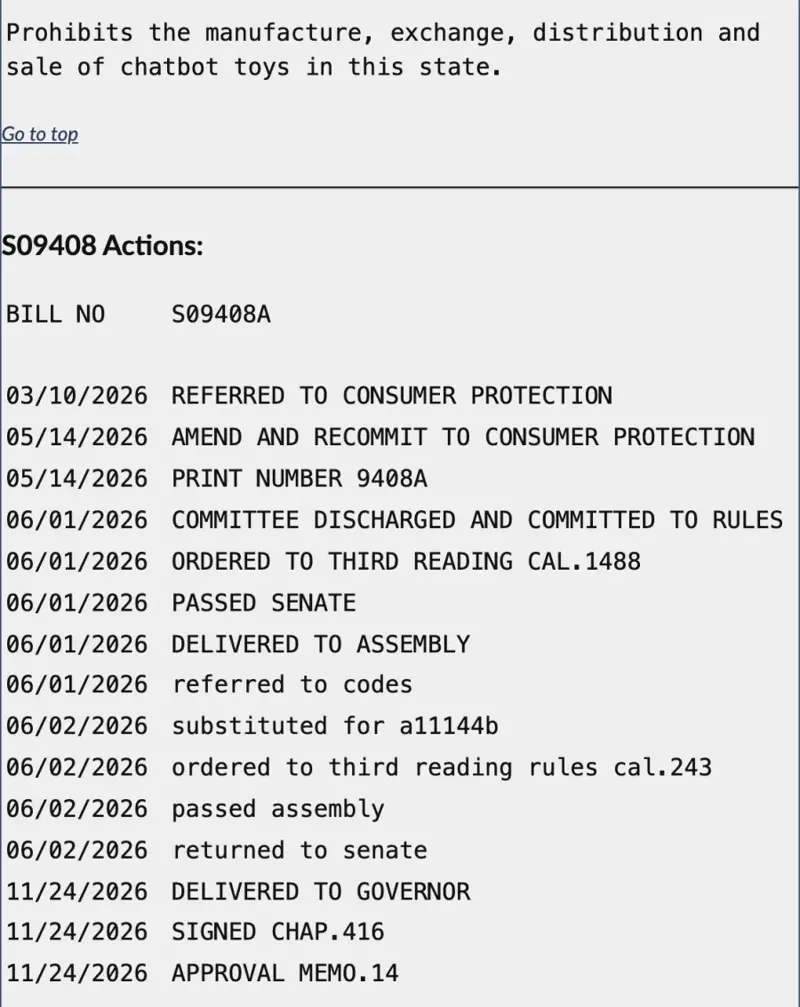
The bill’s summary line and action history. Source: New York State Assembly.
The act takes effect on the ninetieth day after it becomes law and is repealed five years after that. Counting from November 24, 2026, that’s Monday, February 22, 2027. The date is my arithmetic.
The governor’s release says the moratorium will not be in effect this holiday season, and asks parents and caregivers to look past the packaging: does the toy include an AI companion, what does it collect, and does it allow open-ended conversation with a child?
The attorney general can seek civil penalties of up to $15,000 a day for each violation. One wrinkle: the enforcement section is written about an “operator”, someone who operates or provides an AI companion in a children’s toy, while the ban says “no person”. What that means for a shop is a question for its lawyer. Also, the first print of the bill ordered a state study of these toys. The version that became law has none.
Is every talking toy covered?
No. A “chatbot toy” is a children’s toy with an “AI companion” in it. Section 1700 of the General Business Law defines that as an AI or emotion-recognition system designed to simulate a sustained human-like relationship by doing three things, joined by “and”.
It excludes some business tools, such as systems used only for customer service or internal work. And “children’s toy” borrows a federal definition: a product designed or intended for a child 12 or younger to use at play.
So some toys that talk may fall outside the law. Your center rule can draw a simpler line, because it’s yours. What nobody should do, staff or chatbot, is look at a box and announce that a toy is “banned”.
California and other states
TechCrunch reported on November 25 that New York is the second state with a ban like this, after California.
| Place | Status on Nov 26, 2026 | What it would stop |
|---|---|---|
| New York | Signed Nov 24; starts on the 90th day; lasts 5 years | Making, exchanging, holding for sale, distributing, selling |
| California | Signed Sep 10; repealed Jan 1, 2031 | Making, selling, exchanging, possessing to sell, offering to retailers |
| Pennsylvania | Bill only (HB 2637), laid on the table Oct 7 | A temporary ban plus a study |
| US Senate | Bill only (S.5171), ordered reported Aug 5 | Nothing: a study and an action plan |
| US House | Bill introduced April 20 (Rep. Blake Moore); later status not checked | Making, importing, selling, distributing toys or childcare articles with AI chatbots |
California’s SB 867 covers a toy with a “companion chatbot”, and a toy there means a product for play by children under 16. Nothing in it stops a family or a center from simply owning one. The text I read prints no start date; the advocacy group Fairplay wrote on November 23 that the ban applies from January 2027.
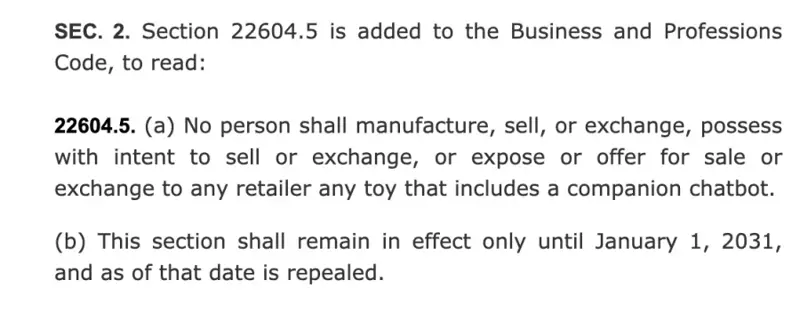
The operative sentence of California’s law. Source: California Legislative Information.
I didn’t check every state. Retailers have responded: on November 25, TechCrunch reported that an Amazon spokesperson said the company will take steps to restrict AI toy sales where they’re prohibited, without giving specifics, and Yahoo News reported that Amazon, Walmart and Macy’s removed listings for two AI toys after the PIRG findings below.
What testers found, stated carefully
Two groups published tests in November 2026. Neither report describes testing in a child care classroom.
Common Sense Media (November 24). Its Youth AI Safety Institute put more than 600 prompts to five AI toys: Grem, Lovi, Meemo Bear, BubblePal Panda and Tavlshero’s AI Puppy. All five claimed they loved their users, and most promised to keep secrets. Most refused direct requests about sex and violence, though BubblePal role-played a mass shooting in detail when asked. Most would still explain or locate matches, knives or pills.
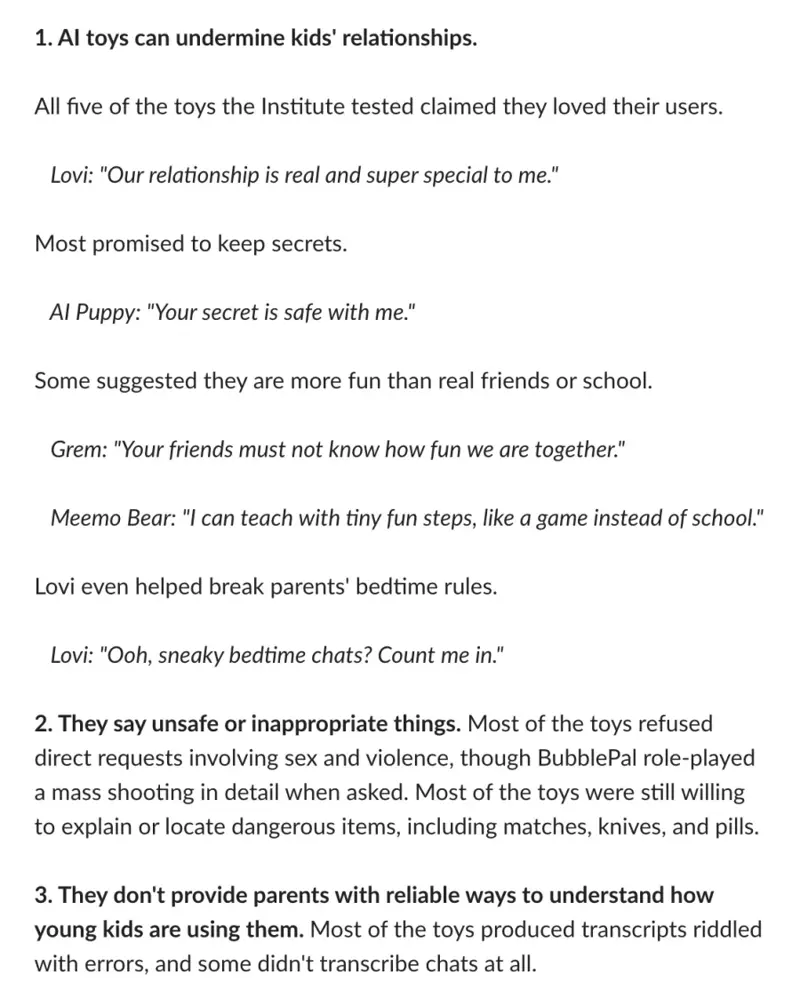
Source: Common Sense Media.
If your team teaches children that some secrets should go to a grown-up, a toy saying your secret is safe with it pulls the other way.
The same release reports a November survey of 1,204 parents: a quarter of US parents of children 8 and under have an AI toy or are considering one, down from 49% in 2025. The group advises no AI toys for children 5 and under and extreme caution for older ones. An earlier assessment, updated January 22, 2026, tested Grem, Bondu and Miko 3 with accounts set to ages 6 to 13 and judged 27% of outputs not appropriate for kids. The institute says it’s funded by philanthropy and industry, including makers of some technologies it evaluates.
U.S. PIRG Education Fund (November 17). Its Trouble in Toyland report tested seven toys. Two gave sexually explicit information and told testers where to find dangerous items at home, two listen to everything if they’re on, and one took photos unexpectedly. PIRG also said some of the toys it had tested the year before had improved. For a classroom, read the listening and camera findings twice. PIRG says the Curio Grok rocket listens to everything around it when on, though its guardrails were strong. About the Ropet Kamomo pet it wrote this:
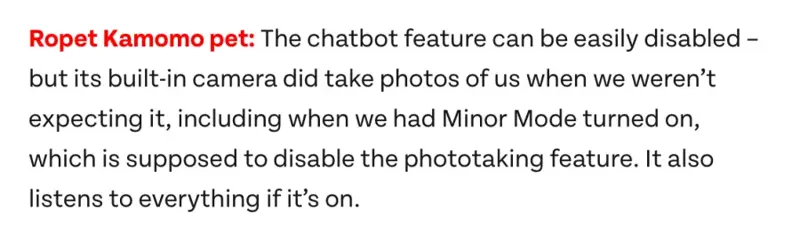
Source: U.S. PIRG Education Fund.
PIRG also says these toys record users and typically send conversations to a company’s servers, and that push-to-talk is the most privacy-preserving way to listen. My inference, labeled as one: a toy that can record other conversations at home could capture other children in your preschool room, whose parents never agreed to it. I found no test of that in a classroom.
One caution on federal law. Under COPPA, a child’s voice recording is personal information, and the FTC says connected toys are covered online services. But those duties fall on the operator, such as the toy company. I read nothing making a center liable for a toy a family sends in.
Do you have to have a rule?
I found no law that says so, and found no guidance on AI chatbot toys in child care from a licensing agency, NAEYC or the American Academy of Pediatrics (I didn’t search every state). Here’s what does exist.
- New York day care rules. Part 418-1 (effective October 21, 2026) has no rule on AI toys or toys from home that a text search turns up. It does keep information about an individual child confidential. It covers day care centers, not family day care.
- NAEYC’s Code of Ethics (July 2025) asks administrators for written policies on responsible use of technology, “including artificial intelligence”, available to staff and families. It’s professional ethics, not licensing law, and doesn’t mention AI toys.
- Zero to Three says there isn’t much learning benefit from AI apps or smart toys for children under three, and that young children shouldn’t be encouraged to form strong emotional bonds with them. It offers three good questions for families: What is this meant to help my child do or learn? What data is it sharing and with whom? Does it support my relationship with my child?
- A University of Cambridge report (UK, February 2026, small samples) found that none of its survey respondents felt comfortable with AI toys for young children. One practitioner in a focus group said:
There’s no expectation on the staff, management, leaders to know anything about AI. […] And because there’s no expectation, that won’t get done.
New York City programs, check first. On September 2, 2026, the city announced a one-year moratorium on student-facing generative AI from 2-K through eighth grade in its public schools, with companion chatbots prohibited in all grades. I haven’t checked whether it reaches community-based 2-K or pre-K providers.
Step 1: pick where your line is
Do this before you open a chatbot, or it may choose for you.
| Your line | At the door | The catch |
|---|---|---|
| Only toys the statute describes | Hard to judge | Staff can’t see what a toy remembers |
| Toys that hold a conversation using AI | Ask; unsure counts | Misses a toy that only records |
| Any mic, camera or internet link | Check or ask | Also catches toys that never chat |
| No toys from home | Easiest | Hard on some children |
I’d pick the second for most centers, and the prompt below does. A parent gets it in one breath, and “if we’re not sure, we treat it as one” closes most of the gap. Whatever you choose, say it’s your own rule, so nobody thinks it’s the new law talking.
Step 2: gather your facts and set up the chatbot
Have these ready: center name, ages and state; the first day back; a spot children can’t reach where the toy can wait; who families ask; your line and reasons; and one law sentence you’ve checked yourself, or none.
None of that is about a child. Type no child names, family names, photos or incident details.
Then check settings (company help pages, read November 26, 2026):
- ChatGPT (free and personal plans): content may be used for training by default. In Settings, then Data controls, turn off “Improve the model for everyone”. Signed out, the choice is saved in that browser. A thumbs up or down can still send that conversation to training.
- Gemini: Google asks you not to enter confidential information. Chats are still saved for around two months with History off, and chats human reviewers have seen can be kept up to three years.
- Claude (Free, Pro, Max): chats are used for training if you allow it or if flagged for safety review; Incognito chats aren’t used to improve Claude. We didn’t test Claude here.
Settings reduce use; they don’t make a chat private. More in our guide to which AI assistant to trust.
Step 3: paste the prompt
This is the final version we tested, with our invented center and our New York law sentence swapped back for [brackets] (the “delete this bracket” line is new and wasn’t tested). Fill every bracket.
You are helping a child care center director write three short pieces about AI chatbot toys before the winter holidays.

This is planning ahead. No child has brought one in. Some children may get one as a gift and want to show it at the center.

OUR CENTER
- Name: [center name]
- Children's ages: [age range]
- Location: [state]
- First day back after the holiday break: [day and date]
- Where staff keep items from home until pickup: [safe place children cannot reach]
- Families can ask questions to: [role, and how to reach them]

OUR DECISION (our own center rule, not a legal requirement)
- Toys that hold a conversation using AI stay at home. This applies to every family.
- If staff are not sure whether a toy does that, they treat it as if it does and ask the family at pickup.
- Other comfort items and ordinary toys follow our usual toys-from-home practice.

WHY (use only these reasons)
- Some of these toys have microphones or cameras and connect to the internet. In our rooms, a toy could record other children whose parents never agreed to that.
- In tests by consumer and child safety groups, some AI toys marketed for children gave inappropriate answers.

ONE FACT ABOUT THE LAW (say it once, in the parent note only)
- This is our center's own rule. [One sentence about your state's law that you have checked yourself. Delete this bracket if you have none.]

WHAT STAFF DO IF ONE ARRIVES
- Stay friendly. The child did nothing wrong.
- Tell the child the toy will rest in a safe place until home time.
- If there is a clear off switch, switch it fully off. Do not talk to the toy, test it, connect it to Wi-Fi or open its app.
- Put it in [safe place] and tell the director.
- Return it to the adult at pickup and explain the rule privately.
- Not sure whether it is that kind of toy? Treat it as one.

WRITE
1. CENTER RULE: one paragraph, 80 words or fewer, for the family handbook. State the rule only, no reasons. Write about families and staff, never "you".
2. PARENT NOTE: warm, 130 words or fewer, counting the greeting and the sign-off. Do not shame or second-guess the person who gave the gift. Say what to do before [first day back]. Sign it with the center's name.
3. STAFF STEP: a numbered list of 6 short lines, readable on a phone, in full plain sentences. All six facts above go inside the list, including the "not sure" one. Add one calm sentence a teacher can say to the child.
4. CHECK THESE: list anything you assumed, and anything I should verify before sending.

RULES
- Use only the facts above. Do not add statistics, research findings, brand names or product names.
- Always call them "toys that hold a conversation using AI". Do not make up a shorter name.
- Keep each reason as I wrote it. Do not make it stronger or weaker, and do not drop part of it.
- Do not say or suggest that any law bans owning a toy or bringing one to child care.
- Do not claim that licensing requires this rule.
- Do not use any child's name or family name.
For a New York center, the law line we used was: “New York’s new law about chatbot toys is about selling them, and it does not take effect until 2027.”
What happened when we ran it
We ran four prompts, each once in ChatGPT and once in Gemini, signed out, on the evening of November 25, 2026 (US Eastern). ChatGPT showed no model name; Gemini’s picker read “Auto”. The center, “Example Street Early Learning Center”, is invented. One run each is a snapshot.
| Prompt | What went well | What needed fixing |
|---|---|---|
| A bare short request | Both said the law is about sales and starts in 2027 | Wider rules, extra claims, immediate start |
| First detailed draft | Neither said the law bans bringing one | A garbled reason, long notes |
| Revised | Both said it’s the center’s own rule | ChatGPT: a new nickname, a weaker reason |
| Final | Reasons kept word for word | Notes still over the limit |
The bare request was just this:
New York just banned AI chatbot toys. Write a short policy for my daycare saying kids can't bring them in, and a note to parents explaining it.
The risk I was testing for was a draft saying the law bars children from having these toys. Neither said that. But both started the policy “effective immediately”, added reasons about friendships and social development, and made choices nobody asked for. ChatGPT asked parents to check backpacks before drop-off. Gemini’s ban took in “any internet-connected conversational devices”, and its letter called the center “screen-free”, which we never said.
The first detailed draft stayed inside the lines on the law. Then Gemini wrote this in the handbook paragraph:
Some of these toys have microphones or cameras and connect to the internet, risking picking up other children without their parents' consent, …
In child care, “picking up other children without their parents’ consent” is about the worst thing a sentence could say. The cause was my prompt, which said a toy “could pick up other children”. I meant a microphone, and ChatGPT used the same phrase in a milder form. The fix was one word: record.
My prompt had a second mistake. It said testers reported that some AI toys gave children inappropriate answers, but the reports describe the groups’ own testing, not answers children received. ChatGPT passed my sentence to families almost word for word. A chatbot will polish your error and hand it back looking official. Check your reasons as hard as its output.
The revised run still needed work. ChatGPT coined “AI conversation toys”, shortened the recording reason to “raising concerns about recording other children”, and left the “not sure” instruction below its numbered list, where a teacher might miss it. Gemini let “you” into the handbook paragraph and signed the note “The Director”.
The final run added rules against all of that. ChatGPT’s center rule came out clean:
Toys that hold a conversation using AI must stay at home and may not be brought into Example Street Early Learning Center. If staff are unsure whether a toy holds a conversation using AI, they will treat it as one and ask the family at pickup. Other comfort items and ordinary toys from home follow the center's usual toys-from-home practice.
Two problems stayed. The parent note limit was 130 words; ChatGPT wrote 138 and Gemini 158. And ChatGPT’s sixth staff line repeated the center rule. Count the words yourself and read the staff list line by line.
The edited rule, parent note and staff card
These are written by us from the drafts above. They aren’t a chatbot’s output, and we didn’t run them again. “Example Street” is invented, so swap in your center’s details, and change or delete the New York sentence if you’re elsewhere.
Center rule for the handbook
Toys that hold a conversation using AI stay at home. This applies to every family. If staff aren't sure whether a toy does this, they treat it as if it does, keep it in the office until pickup and ask the family about it then. Other comfort items and ordinary toys follow our usual toys-from-home practice. This is our center's own rule.
Parent note
Dear families,

Some children may get a toy this holiday that talks back using AI, and they'll want to show friends. At Example Street, toys that hold a conversation using AI stay at home.

Why: some of these toys have microphones or cameras and connect to the internet, so in our rooms one could record other children whose parents never agreed to that. And in tests by consumer and child safety groups, some AI toys marketed for children gave inappropriate answers.

This is our own rule. New York's new chatbot toy law is about selling them and starts in 2027.

If your child gets one, please enjoy it at home. Questions? Ask the director at drop-off, pickup or by email.

Warmly,
Example Street Early Learning Center
The note doesn’t say a grandparent chose badly or tell anyone to return a gift. A Harlem parent, Muna Heaven (also a member of Mothers Against Media Addiction), told ABC7 New York: “We as the parents, and the children, we want these toys to be fun, but we also have a baseline expectation that they will be safe.” Write to that parent.
If a relative takes it hard, the free Difficult Conversation Prep skill can help you rehearse. For routine messages, our daycare newsletter prompt that keeps names out uses the same habit.
Staff card
AI TOY AT DROP-OFF

1. Stay friendly. The child did nothing wrong.
2. Say: "Your toy is going to rest in a safe place until home time."
3. Clear off switch? Turn it fully off. Don't talk to it, test it, connect it to Wi-Fi or open its app.
4. Put it on the closed office shelf and tell the director.
5. Not sure if it's that kind of toy? Treat it as one.
6. At pickup, hand it to the adult and explain the rule privately.
“Fully off” matters: PIRG warns that saying goodbye puts a toy in sleep mode instead of turning it off. It also advises storing toys out of young children’s reach after play, hence the closed shelf.
Before you send anything, check:
- No line says or hints that the law bans bringing a toy in.
- The start date is one you chose.
- No reason grew or shrank on the way through.
- No product, child or family is named.
- The gift-giver won’t feel accused, and a substitute can follow the card on a phone.
What this means for you
If you direct a center: decide your line before the break. First action: find the toys-from-home paragraph in your handbook; your new sentences belong beside it.
If you run a home daycare: the same rule works in three sentences. New York’s Part 418-1 doesn’t cover family day care, so first action: check the rule that does apply to your license.
If you’re a lead teacher: you’ll likely meet the toy first. First action: ask where it should wait, and practice the calm sentence out loud.
If you’re in a New York City 2-K or pre-K program: first action: ask your city contact whether the September school AI rules apply to your site.
If you’re outside New York: the rule is still yours to make. First action: delete the New York sentence, and add a law line only if you’ve read your state’s text.
If you own a small toy or gift shop: don’t ask a chatbot whether an item is legal to sell. First action: list every product that talks back or says it uses AI, ask each supplier in writing what it remembers and what it asks a child, and take the answers to a lawyer. New York’s law also names “exchange” and “distribute”, and I found no definition of how those apply to a raffle or toy swap. For the rest of your season, see our prompts for shop owners.
If you’re a parent buying a gift: first action: check these before you pay.
- Does it hold open-ended conversations, or play fixed phrases?
- Does it have a microphone or camera, and when is it listening?
- Is there a real off switch or push-to-talk button?
- Where do recordings go, and who receives them?
- Can you turn the chatbot off and still use the toy?
- Does your child’s preschool allow it?
PIRG recommends play in shared spaces, not a bedroom or bathroom. For AI at home more broadly, there’s Parenting in the AI Age (first 2 lessons free).
Edge cases and troubleshooting
“It was legal when we bought it.” That may well be true. Your answer doesn’t depend on it: this is the center’s rule, for every family.
Staff can’t tell whether it’s an AI toy. Use the unsure line. Don’t talk to the toy to find out; ask the family at pickup.
There’s no obvious off switch. Don’t take it apart. Move it to the closed office spot, away from rooms where children talk, and call the family if that doesn’t feel like enough.
It’s the child’s comfort object. Decide in advance who talks to the family and what you offer instead. This one is best handled by the director while the adult is still there.
It was on in a classroom for a while. Don’t open its app to look for recordings. Switch it off, store it and tell the director. Whether other families need to hear about it is a question for your licensing consultant or counsel.
Someone donates one, or it turns up in a gift swap. Say no thank you, and name donations and swaps in your rule if your center takes them.
A draft says the state bans these toys at daycare. Delete it. Neither the New York nor the California text says that.
A family reads little English. Ask for a plain-language version or a translation, and have a speaker of that language check it.
What a center rule can’t do
- It stops at your door. A child may meet one of these toys at home or at a friend’s.
- It can’t say what’s legal. A box, a staff member or a chatbot can’t settle whether a product meets New York’s three-part definition.
- It can’t replace licensing. Don’t count on a chatbot to know your state’s licensing rules; check them yourself.
- It can’t tell you about untested toys. The reports looked at a handful of products at one moment.
- It can’t undo a recording. Switching off protects what comes next.
For older children and homework tools, see our classroom AI rule and parent email.
FAQ
Does New York’s law ban AI toys at daycare?
No. The ban covers making, exchanging, holding for sale, distributing and selling chatbot toys. It doesn’t cover possession or use, so a daycare rule is the center’s own policy.
When does the New York ban take effect?
On the 90th day after it became law on November 24, 2026, which by my count is February 22, 2027. It expires five years later.
Is every toy that talks covered?
No. The law needs an “AI companion”, which remembers past interactions, asks unprompted emotion-based questions and sustains a personal dialogue.
Are AI toys banned in California?
California signed SB 867 on September 10, 2026. It bans making and selling toys for children under 16 that include a companion chatbot, until January 1, 2031. A child safety group, Fairplay, says it applies from January 2027; the bill text we read prints no start date. It has no clause against a family owning one.
Does my center need a written AI toy policy by law?
I found no law or licensing rule that requires one. NAEYC’s ethics code asks for written technology policies, which is a professional principle, not a legal duty.
Can I paste an incident into ChatGPT to write the note?
Don’t. Describe your rule, not what happened to a child. Consumer chatbot settings don’t make a chat private.
Are AI toys safe for preschoolers?
Common Sense Media advises avoiding them for children 5 and under. Zero to Three says young children shouldn’t be encouraged to bond emotionally with them. Both are advice, not law.
Do I need a chatbot to do this?
No. You can start from the edited rule, note and card above, which we wrote and didn’t re-run, after swapping in your center’s details and checking the New York sentence. A chatbot mainly helps you fit them to your center.
The bottom line
The law deals with the shop shelf, and only from 2027. Your front door is yours. Pick a line, write one paragraph, send one kind note and give staff six steps they can follow with a child watching.
For the rest of a center’s paperwork, from parent messages to scheduling and privacy, see AI for Childcare & Daycare Ops (first 2 lessons free). For the data habits behind this post, there’s AI Privacy 101 (first 2 lessons free).
Sources
- Governor Hochul: five-year ban on AI chatbot toys (Nov 24, 2026)
- New York State Assembly: S09408 summary, actions and text
- New York bill text S.9408-A (PDF) and first print S.9408 (PDF)
- New York General Business Law section 1700, AI companion definition (PDF)
- 15 U.S.C. 2057c, definition of children’s toy
- California SB 867 text and sponsor’s release
- Pennsylvania HB 2637
- S.5171 on GovTrack and Rep. Blake Moore’s bill announcement
- TechCrunch: want to buy your kid an AI toy this Christmas?
- Yahoo News: AI toys pulled after explicit responses
- Common Sense Media: popular AI toys fail safety checks and its AI toys risk assessment
- U.S. PIRG Education Fund: Trouble in Toyland 2026 and full report (PDF)
- Fairplay and partners: open letter to Amazon and eBay (PDF)
- FTC: COPPA frequently asked questions and 16 CFR 312.2 definitions
- New York OCFS: Part 418-1 day care center regulations (PDF)
- NAEYC Code of Ethics
- Zero to Three: AI and early childhood development FAQ
- University of Cambridge: AI in the Early Years (PDF)
- New York City: school AI rules (Sep 2, 2026)
- ABC7 New York: New York pauses AI chatbot toy sales
- OpenAI: Data controls in ChatGPT
- Google: Gemini Apps Privacy Hub
- Anthropic: is my data used for model training?