GivingTuesday this year is Tuesday, December 1. That’s 47 days from today, and if you’re the person who writes the year-end appeal at a small nonprofit, a church, or a volunteer-run charity, you already know what the next seven weeks look like. The appeal letter, the email version, the Giving Tuesday sequence, the thank-yous. Probably all by you, probably alongside your real job.
Free AI can take a real chunk of that off your plate, and you don’t need a paid plan or a nonprofit discount to do it. It can also get you in trouble, in two specific ways: by sending a donor’s private information to a company that shouldn’t have it, and by producing a letter that sounds like a machine wrote it, which some of your donors will notice. This post is about doing the first thing and avoiding both of the second.
Here’s what’s in it: a copy-paste prompt that turns a five-line brief into a draft appeal, variations for different kinds of donors, a three-email Giving Tuesday sequence, a thank-you workflow, the one rule about donor data, and what the research says about how donors actually respond to AI-written appeals. That last part is more mixed than the confident opinions you’ll see online.
A note on how this was put together. I used a Perplexity research pass with the Academic connector (588 sources, including peer-reviewed experiments, the FTC, the IRS and fundraising benchmarks), a Grok search of X posts from small nonprofits and fundraisers, GivingTuesday’s own AI guidance for 2026, and the vendors’ privacy pages. I haven’t run a real appeal through these prompts on a live donor list, and I’m not a lawyer, so the legal sections are a map of what to check, not advice. Where the evidence is thin I’ll say it’s thin.
The short answer
- Use AI for structure, drafts, subject-line options and reading-level versions. Don’t use it for donor names, gift amounts, addresses, or your CRM export.
- Give it facts, not people. “Our pantry served 2,140 households this year” is a fact. “Maria Lopez gave $500 in March” is a donor record.
- Edit every draft by hand. In the studies I found, AI-written fundraising copy performed about the same as human copy when readers couldn’t tell who wrote it. Believing a message was AI-written, though, lowered giving among some readers.
- Test against your best human letter, not against a weak one, and judge by gifts, not opens.
- GivingTuesday itself says to follow your organization’s AI use policy and keep confidential information and personally identifiable donor information out of tools your organization hasn’t approved.
Why now: when the money actually arrives
Year-end isn’t one date. It’s a ramp with a spike at the start (GivingTuesday), a long middle, and a surprisingly big finish. These are the best-documented numbers I found, and they measure different groups of organizations, so don’t mix them.
A few more numbers worth having:
- Blackbaud’s data put the fourth quarter at about 34% of all recorded giving in 2024. That’s a different universe from M+R’s online-only figure.
- GivingTuesday 2025 was estimated at $4.0 billion given in the US by 38.1 million participants, up about 13% in dollars and 6% in participation from 2024, according to GivingTuesday’s own figures. It’s an estimate, not an audited census.
- Email is a slow game. M+R’s 2026 report puts the median participating nonprofit at about $54 per 1,000 fundraising emails delivered in 2025, with a 0.59% click-through rate and a 0.05% response rate, which works out to about one gift for every 2,000 delivered messages. Open rates of 25% to 29% get quoted a lot, but inbox privacy features inflate opens, so don’t judge anything by them.
- Donor retention was 43.3% overall in the Fundraising Effectiveness Project’s 2025 year-end results, with the total donor count down 3.6%.
There’s also a figure you’ll see everywhere that I couldn’t support: that “30% of all giving happens in December.” The research I read says there’s no stable, current methodology behind it. The 34% and 37% numbers above are better documented.
What this means for your calendar: the writing is the bottleneck, not the sending. Every hour you save on drafting is an hour you can spend on the part AI can’t do, which is making the letter true and specific.
What the research says about AI-written appeals (it’s more mixed than you’ve heard)
You’ll find two confident camps online: “donors can’t tell and it works” and “donors hate AI.” Neither one holds up cleanly. Here’s what I found, with each study’s limits.
Aggregate giving looked similar when readers didn’t know. A preregistered multilingual study (on arXiv) commissioned human-written, human-and-AI co-written, and fully AI-generated advertisements for WWF and tested them with 720 participants who split a £1.50 endowment between themselves and the charity. 568 donated, £518 in all, and donations were broadly stable across the three writing conditions. Participants mostly couldn’t identify the source correctly.
What people believed mattered. In the same study, pooled donations were lower when readers believed the ad was AI-generated. The strongest effect was in one subgroup (Spanish-speaking women, who gave about 22% less and chose zero more often when they believed AI was behind the ad), and the authors’ own caution applies: that shouldn’t be generalized without replication.
Disclosure can cost credibility. A peer-reviewed study in the International Journal of Advertising found that disclosing AI generation initially produced less favorable evaluations of prosocial ads, with lower perceived credibility explaining the effect, and the effect was smaller among people who see AI as relatively human-like.
Voice matters. A 2026 set of three experiments (345, 355 and 663 participants), summarized by Chicago Booth, found that third-person stories worked better when attributed to humans, and first-person stories did better when attributed to AI. The pattern disappeared when the beneficiary was an anonymous group instead of an identifiable person, which points to empathy as the mechanism.
Emotional response isn’t the same as giving. A preregistered experiment with 1,654 US parents found that AI-written “letters from the future” raised empathic concern but produced no detectable increase in actual donations to an environmental charity.
What donors say they want. A 2026 donor survey reported by Neon One found 71.6% rated real human involvement as moderately or very important and 63% rated AI disclosure as important; 19% said disclosure would reduce their trust and another 25% said it depends on the message. That’s self-reported, vendor-published data.
The biggest caveat. I could not find a large peer-reviewed field experiment comparing AI-written and human-written year-end letters on real donor files. Most of this evidence comes from simulated ads, donation intentions or small online games. So any claim that AI copy “outperforms” or “alienates” real donors is premature, and anyone who sounds sure is overreaching.
Social media is where the confident claims live. One X user, @bee_my_girl, wrote on September 29 that a charity her company works with tested a human-written email against several AI-generated ones and the human one “got more donations than all of the AI-generated emails combined” (143 likes, about 1,266 views). It’s a single anecdote with no published method, but it matches the research’s most consistent warning: unedited, generic AI copy is the risk, not AI as a drafting tool. Another user, @blindandb0ujee, said the quickest way to make sure they don’t donate to a marathon fundraiser is to “use AI slop to promote it.” Both are about copy that reads as machine-made, which is an editing problem more than a tool problem.
The practical standard that follows from all this:
- Use AI for outlines, subject-line options, reading-level alternatives, audience hypotheses and first drafts.
- A human verifies every story, quote, statistic, program claim, deadline, match and tax statement.
- Keep a clearly human point of view, especially for messages in the voice of an executive director, board member or beneficiary.
- Test AI-assisted copy against your strongest human version.
- Judge by gifts, revenue per delivered message, average gift, unsubscribes and complaints, and later retention, not opens.
The one rule: facts in, people out
GivingTuesday’s own 2026 AI guidance is blunt about this. On its participation page it says to follow your organization’s AI use policy and always keep confidential information and personally identifiable donor information out of tools your organization hasn’t approved, and to verify AI output, since “context makes output more relevant, not more true.” It also suggests standing instructions in your AI project, such as “Don’t invent statistics” and “Flag anything that needs verification.” I’m borrowing both in the prompt below.
Why does the rule exist? A free chatbot is a third-party service. What you paste in goes to that company, and what happens next depends on its retention and training settings, which differ by product and change over time. A small nonprofit’s donor list is a small nonprofit’s most valuable and most private asset.
Don’t place these in a consumer AI prompt (adapted from the research’s minimum-data rule):
- Donor names, addresses, emails, phone numbers, birthdays, signatures or account numbers
- Gift amounts connected to identifiable donors
- Wealth, property, employment, health, family, political or religious profiles
- Payment card or bank information
- Beneficiary, client, patient, volunteer or case records
- Confidential grant applications, board materials, contracts, passwords or security details
- Raw CRM exports, even when you only want a summary
De-identification is harder than removing names. “The only $50,000 donor from our town of 900” identifies a person without a name. If you have to describe a segment, keep it broad: “donors who gave once last year and haven’t since,” not “our three biggest donors.”
Check your settings before you start
Settings differ by product, change often, and I couldn’t verify every label on the vendors’ current pages, so treat this as a checklist of where to look, not a guarantee.
| Tool (consumer account) | What to check | What I could verify |
|---|---|---|
| ChatGPT | Settings, Data Controls, the “Improve the model for everyone” switch; Temporary Chat | OpenAI’s help page says turning the switch off keeps your chats in history but stops them being used to train models. I couldn’t confirm the Temporary Chat retention period from the official page. |
| Claude | Settings, Privacy, the model-improvement toggle (labeled “Help improve Claude” in several reports); incognito chats | Secondary reports say consumer chats can be used for training unless you opt out and that retention is longer for users who allow training. Check the label and defaults on Anthropic’s privacy page yourself. |
| Gemini | Keep Activity, Temporary Chat | Google’s privacy page says with Keep Activity off, future chats aren’t used to train models unless you send feedback, are kept for 72 hours, and temporary chats follow the same 72-hour retention and aren’t used for training or human review. Google still uses chats to respond and to protect its users. |
Two honest caveats. First, “turned off training” is not the same as a confidentiality contract, zero retention, or zero human access. Don’t treat it as one. Second, nonprofit pricing doesn’t equal nonprofit-grade privacy: the question is which product terms govern your data, whether prompts can train models, how long they’re kept and who can review them. If your organization pays for a business or nonprofit plan, ask for those terms in writing before putting anything sensitive in.
Step by step: a five-line brief to a draft appeal in about 15 minutes
Everything below works on the free tier of ChatGPT, Claude or Gemini. Use whichever you already have.
Step 1: Write the brief (5 minutes, no AI). Five lines, in your own words:
- Who you are and what you do, in one sentence.
- Three things that happened this year, with real numbers.
- One short story, with consent, that doesn’t identify anyone.
- What this year’s appeal funds, specifically.
- The ask, the deadline, and how to give.
Expected result: a half-page of plain facts. If you have your three best past appeals, put them in a file. You’ll paste one of them in as a voice sample in Step 2, with any donor names removed.
Step 2: Paste the prompt below, with your brief.
You are helping the development staff of a small nonprofit write a
year-end appeal letter. Rules:
- Use ONLY the facts I give you below. Do not invent statistics,
  quotes, names, programs or deadlines. If you need something I
  didn't provide, ask me or write [NEED: ...] in the text.
- Flag any claim that needs verification with [VERIFY].
- Write in plain, warm language at about an 8th-grade reading level.
  Short sentences. No fundraising cliches ("make a difference",
  "your generosity", "together we can"). No exclamation marks.
- Structure: a first sentence that states the need, one short
  story, what the money does, a specific ask with a deadline, a
  simple closing, a P.S. that repeats the ask.
- Length: about 300 words.

VOICE SAMPLE (one of our past appeals, names removed):
[paste]

WHO WE ARE: [one sentence]
THIS YEAR: [three facts with real numbers]
STORY (consented, no identifying details): [3-4 sentences]
WHAT THIS APPEAL FUNDS: [specific]
THE ASK: [amount ideas or "any amount", deadline, how to give]
Expected result: a first draft, usually with a few [NEED] and [VERIFY] flags. That’s the prompt working as intended.
Step 3: Fix the facts. Resolve every [NEED] and [VERIFY]. Check every number against your own records. If a sentence sounds good and you can’t back it up, cut it.
Step 4: Make it sound like you. Read it out loud. Replace anything you’d never say. Add one detail only someone inside your organization would know. If you used a voice sample, compare the rhythm of the draft to it.
Step 5: Ask for variations, still with no personal data. See the next section.
Step 6: Send from your own email or mail tool, where merge fields add each donor’s name from your system. The AI never sees the names.
A worked example, start to finish
This example is fictional. “Riverbend Community Pantry” and all its numbers are made up to show the process. The draft below was written by me to show what a good result looks like; your tool’s output will differ, and I did not generate this with a live run.
The brief (what you’d paste in):
- Who we are: Riverbend Community Pantry gives free groceries to families in one county.
- This year: 2,140 households served (up from 1,780), 38 volunteers, we started a Saturday evening pickup.
- Story: A volunteer noticed that evening hours let one parent pick up groceries after a late shift. (No names.)
- What it funds: $25 stocks one family’s cart for a week; $2,500 covers a month of evening hours.
- The ask: any amount by December 31, at the website, or by check.
A raw first draft, as AI tools often produce it:
Dear Friend, As the year draws to a close, we are reminded of the incredible power of community. Thanks to your generosity, we served over 2,000 families this year, making a real difference in countless lives. Together, we can ensure no one goes hungry. Please give today!
What’s wrong with it: “Dear Friend,” “incredible power of community,” “your generosity,” “making a real difference,” “countless lives” and “together, we can” are the cliches the prompt banned. It says “over 2,000 families,” when you said 2,140 households. “Please give today!” has no deadline and no amount. There’s no story.
After the Step 3 and 4 edit pass:
This year, 2,140 households walked out of Riverbend Community Pantry with groceries. Last year it was 1,780.
One reason for the jump is a change we almost didn’t make. In March a volunteer pointed out that parents coming off a late shift couldn’t reach us before we closed. So we opened on Saturday evenings. Since then, those evening hours have become some of our busiest.
That’s what a gift does here. $25 stocks one family’s cart for a week. $2,500 pays for a month of evening hours.
If you can, please give before December 31, at riverbendpantry.example or by check to the address below. Any amount helps, and we’ll tell you what it did.
Thank you for reading this far.
P.S. We’re still opening Saturday evenings in January. Your gift by December 31 keeps the lights on for them.
It’s shorter, specific, states real numbers, and keeps the ask concrete. The editing, not the draft, is where the letter became Riverbend’s.
Variations for different donors, without any donor data
Ask for versions of the same facts aimed at a type of reader, described generally:
- Lapsed donors (“gave once, more than a year ago, not since”): a shorter letter that opens with what’s changed, with no guilt.
- Recurring donors (monthly givers): not an ask at all. A “here’s what your monthly gift did” update with an optional upgrade line.
- First-time donors from this year: a warm, brief welcome with the second-gift reason spelled out.
- Major-gift prospects: don’t use a chatbot for personal research on named individuals. Use it for a one-page “case for support” of facts, and write the personal note yourself.
A prompt that works: “Rewrite the letter above for people who gave once last year and not since. Keep every fact. Cut to 150 words. Don’t mention that they stopped giving.” No names, no amounts, no data.
The research also says to treat these groups separately when you measure: first-time donors, repeat donors, monthly donors, lapsed donors and GivingTuesday-acquired donors behave differently, and mixing them hides what worked.
Your Giving Tuesday sequence: three emails in an afternoon
A Giving Tuesday campaign needs fewer emails than people fear, and each one needs a different job. Here’s a sequence with a prompt for each. The timing is a starting point, not a rule I can back with data, so adjust it to your list.
| When | Job | What to give the AI | |
|---|---|---|---|
| 1. The heads-up | Late November | Tell people what’s coming and why it matters | Your goal, what it funds, any match (real ones only) |
| 2. The day-of ask | December 1 | One clear ask, easy to give | Same facts, the shortest version of the story |
| 3. The last push | Late on December 1, or December 2 morning | Progress and a final ask | Your real progress number, filled in by you |
Prompt for each email (same rules as the appeal prompt, plus):
Write email [1/2/3] of a 3-email GivingTuesday sequence using only
the facts below. Give me 5 subject lines of different styles
(plain, question, number, urgent-but-honest, warm). No misleading
subject lines. Keep the email under [120/90/70] words. One link,
one ask.
FACTS: [goal, what it funds, real match terms if any, progress as of now]
Notes that come from the research and general email guidance, not from my own testing:
- Put the point first. Short emails with the ask near the top suit how people skim.
- Only claim a match that is real, with real terms. This is one of the places AI most often invents detail.
- Pick a winner on gifts, not opens. Split your list randomly between your strongest human version and the AI-assisted version, keep audience, send time and landing page the same, and compare gifts, revenue per delivered email, unsubscribes and complaints.
- Staff the last week. In the M+R data, 10% of annual online revenue arrives in the final week of December and 4% on December 31. Check your payment page and your inbox, not just your drafts.
The thank-you: where AI saves the most time and costs the most if you skip the edit
Thank-yous are the job nobody has time for, and the most important for next year. Here is what the research says, and it’s less tidy than the usual “thank within 48 hours” rule.
- An observational analysis of DonorsChoose found that acknowledgments in the first 24 hours were correlated with higher donor return, especially for teacher-referred donors. Correlated, not shown to cause it.
- A randomized field experiment with about 500,000 new donors at public television stations and a national nonprofit found that standard thank-you phone calls had no effect on retention, subsequent gift size or giving over several years, though fundraising professionals had predicted a big boost. Those calls came three to seven months after the gift, so the study doesn’t test prompt thank-yous.
- Content may matter more than timing. Experiments found more favorable giving intentions when the acknowledgment came from beneficiaries rather than the charity, and when the language focused on impact rather than praising the donor.
A sound operating standard from that: send the receipt right away (your donation platform probably does this), then send a human-reviewed, specific thank-you within a day or two as a service goal, not as a proven retention formula. Don’t put a new ask inside a thank-you.
A thank-you workflow with no donor data in the AI:
- Write three short “impact lines” about what gifts did (real, specific).
- Ask the AI for a 60-word thank-you template with merge fields like {{first_name}} and {{gift_purpose}}, using only your impact lines.
- Merge names and amounts in your own email tool.
- Hand-write the first line for gifts your team knows personally.
Tax receipts are a separate legal item. For US donors, a written acknowledgment is generally needed for contributions of $250 or more, stating the cash amount and whether goods or services were provided (see IRS Publication 526). Many organizations send year-end acknowledgments by January 31. Your accounting system should handle the receipt. Don’t hand it to a chatbot.
What this means for you: seven readers, seven first actions
| If you are… | What to do | First action |
|---|---|---|
| A one-person development office | Use AI for first drafts and subject lines, nothing else | Write the five-line brief today, run the appeal prompt once |
| A church or ministry with volunteers | Same workflow, with extra care about member privacy | Use “our congregation” in prompts, never names or giving records; see our church guide below |
| A founder-run small charity | Tell your board you’re using AI, in a sentence | Write a one-paragraph AI use note (what’s allowed, what isn’t) |
| A board member or volunteer drafting | Stick to facts and stories you’ve personally confirmed | Ask the executive director which facts are approved to use |
| A grant writer pivoting to appeals | Appeals are shorter and more personal than grants | Start from a past appeal’s voice, not a grant template |
| A nonprofit with a CRM and a paid AI plan | Get the written terms before connecting data | Ask the vendor for the data-processing terms before any donor data goes near AI |
| A professional fundraiser or agency | Your clients’ data rules, not yours, govern | Check each client’s AI policy before you paste anything |
Compliance basics: a map, not legal advice
I’m not a lawyer. These are the things the research says to check. Your state’s rules may differ.
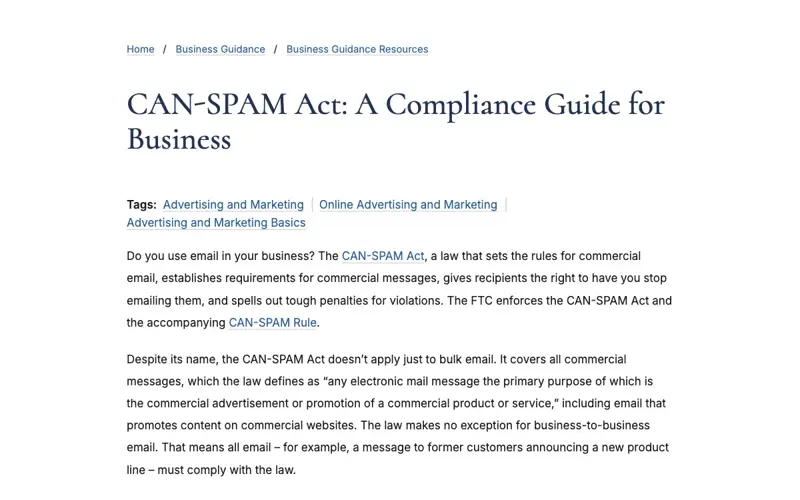
Email law. The CAN-SPAM Act regulates commercial email and gives recipients the right to stop covered messages. Whether a pure charitable appeal is a covered commercial message can depend on its primary purpose and content, and mixed messages (merchandise, event sales, corporate promotions) deserve a legal review. If your emails count, the FTC’s rules include accurate sender information, a subject line that doesn’t mislead, a valid postal address, a working opt-out, and honoring opt-outs within 10 business days. Putting a postal address and an unsubscribe link in every appeal is a cheap habit regardless.
Truthful claims. AI can invent beneficiary details, outcomes, matches, deadlines or financial claims. The FTC’s 2025 fundraising guidance stresses that fundraisers must clearly and truthfully explain who receives the money. In September 2025, the FTC and 19 states challenged a charity’s claims that vehicle donations would fund breast-cancer screenings; the complaint alleged only 0.28% of more than $45 million raised went to those screenings. An invented sentence in an AI draft is the same kind of risk, on a smaller scale.
State solicitation registration. About 40 states regulate charitable solicitation, generally requiring registration before soliciting residents, though exemptions and rules vary. The National Council of Nonprofits reports 39 states and DC have registration requirements, and online and written solicitations count. If you email donors in other states, verify your registration or exemption in those states before a national campaign.
Disclosure. There’s no consensus rule that you must say AI helped. If you choose to, the research suggests a provenance-based line over silence or a flat “written by AI”: something like “Our staff drafted this with AI assistance and reviewed every word.” That’s my wording, not a legal standard.
Edge cases and troubleshooting
1. The AI invents a statistic. It happens, which is why the prompt says “[VERIFY]” and “[NEED].” Delete any number you can’t source to your own records or a source you can link.
2. It still sounds like AI. The tell is usually the cliches and the evenness. Paste a voice sample (one of your own past appeals, names removed). One X post from @CoworkStack made the same point: donors can tell when an appeal came from a template, so save your three best appeals in one folder and start every draft from them. Then do the read-aloud pass.
3. It writes a beneficiary quote that nobody said. Cut it. Invented quotes are a trust and compliance problem. Only use a quote if you have the person’s consent to the exact words.
4. The draft is too long. Ask for “a 150-word version” and “a 60-word version for social.” Don’t send the 400-word draft because it’s already written.
5. You hit the free tier’s message limit mid-campaign. Free limits reset on a schedule, and they vary by tool and by model. Draft the appeal on one day and the sequence on another, or use two tools (one for drafting, one for subject lines). Don’t paste sensitive data to work around it.
6. Your board wants to know if this is safe. Give them a one-page note: what you use it for, what you never put in it, who reviews every message, which settings you’ve turned off. The Center for Effective Philanthropy’s research found that more than 90% of organizations it surveyed in 2024 had no official AI policy, so having a page puts you ahead of most.
7. A donor asks whether the letter was written by AI. Answer honestly. If staff reviewed and approved it, say that. Don’t deny it.
8. You volunteer for a church and aren’t sure what members would be comfortable with. Ask. In one X post, a congregant guessed that 95% of his church was against AI. That’s a single voice, but it’s a reminder that “allowed” and “welcome” aren’t the same. Keep AI use in the drafting room and tell your leadership.
What this can’t do
- It can’t know your donors. It has the facts you gave it and nothing else. That’s a feature for privacy and a limit for personalization.
- It can’t verify itself. GivingTuesday’s guidance is right that context makes output more relevant, not more true. You are the fact-checker.
- It can’t replace the relationship. Notes from the executive director, a phone call to a long-time giver, a handwritten line on a letter. None of that is a prompt.
- It can’t make an unclear need compelling. If you can’t say in one sentence what the money does, a better prompt won’t help.
- It can’t prove it works for you. The studies are mostly simulated or small, and no one has published a large test on real year-end letters. Your own split test is the only evidence that counts for your list.
FAQ
Can nonprofits get ChatGPT for free? The free ChatGPT plan is open to anyone, nonprofit or not. Nonprofit discounts, where they exist, usually apply to paid business plans, and the terms vary across sources and change often. Check OpenAI’s nonprofit page before relying on a number from a blog.
Is it safe to paste donor names into ChatGPT, Claude or Gemini? Not on a consumer account. GivingTuesday’s guidance says to keep personally identifiable donor information out of tools your organization hasn’t approved. Use facts and aggregates in the prompt, and add names in your own mail system.
How do I write a year-end appeal letter with AI? Write a five-line factual brief, paste it into the prompt above, fix every [NEED] and [VERIFY], then edit until it sounds like you. Send it from your own email tool with names merged in there.
Will donors know it was written by AI? In the WWF study, participants mostly couldn’t tell. But readers who believed a message was AI-written gave less in pooled results. Edit for your voice, keep it specific, and don’t assume nobody will notice.
Should we tell donors we used AI? There’s no consensus. In a 2026 donor survey, 63% said disclosure was important and 19% said it would reduce their trust. A short, accurate line about staff drafting with AI and reviewing every word is a reasonable middle path.
Does Claude have a nonprofit discount? Several sources say Anthropic offers nonprofit discounts on its team plans, but figures differ, and at least one 2026 guide says there’s no formal program. Check Anthropic’s page.
How many emails should a Giving Tuesday campaign have? There’s no proven number. The three-email structure here (heads-up, day-of ask, last push) is a starting point. Judge results by gifts and complaints, and adjust.
Can AI write donor thank-you letters? It can draft a template from your impact lines. Merge names and amounts in your own tool, and have a person read it. Don’t paste a gift list into the chatbot.
Do we need to send a tax receipt? In the US, donors generally need written acknowledgment for contributions of $250 or more (IRS Publication 526). Your accounting or donation platform should handle that. Don’t leave it to a chatbot.
What if we don’t have an AI policy? Write one page: what you use AI for, what you never put in it, who reviews messages, and what settings you’ve changed. Most nonprofits don’t have one, according to the research.
The bottom line
The best use of free AI at year-end is narrow and unglamorous: take your own facts, get a structured first draft and a few subject lines in minutes, and then spend your time on the true, specific parts a machine can’t supply. Keep donor names, amounts and records out of the chatbot, because a free tool is somebody else’s server. Test what you write against your best human letter, and judge it by gifts.
If you only do one thing this week, write the five-line brief. It takes ten minutes, it’s useful with or without AI, and it’s the thing every good appeal starts from.
For more, our Fundraising with AI course covers appeals, donor communications and the privacy rules in more depth, and AI for Nonprofits covers the broader toolkit. If your next big deliverable is a grant, see AI Nonprofit Grant Writing. For a board report or donor deck with the same donor-data rule up front, read free Claude Slides for nonprofits, and if you work in a congregation, see AI for churches: safe uses and what never to paste.
Sources
- GivingTuesday: Participate in GivingTuesday 2026 (date, AI guidance)
- GivingTuesday: Generosity AI
- GivingTuesday: 2025 results
- Nonprofit Quarterly: Making Sense of GivingTuesday 2025
- Streetlight Digital: Reading the 2026 M+R Benchmarks From the Trenches
- Group36: 1% of Donors Equal 37% of December Revenue
- Blackbaud Institute: 2024 charitable giving data
- Chicago Booth: Who’s Asking? Using the “Right” Voice in AI Fundraising
- Effect of disclosing AI-generated content on prosocial advertising evaluation (International Journal of Advertising)
- Mind the Gap! Choice Independence in Using Multilingual LLMs for Persuasive Co-Writing Tasks (arXiv)
- AI-Generated Letters from the Future: A Randomized Test of Personalized Climate Communication (arXiv)
- Center for Effective Philanthropy: State of Nonprofits 2024
- Neon One: How to Write an AI Policy for Your Nonprofit
- Do Thank-You Calls Increase Charitable Giving? (American Economic Journal: Applied Economics)
- Donor Retention in Online Crowdfunding Communities: DonorsChoose.org (arXiv)
- IRS Publication 526: Charitable Contributions
- FTC: CAN-SPAM Act compliance guide for business
- FTC: Professional fundraisers, don’t skimp on your due diligence or truth (2025)
- FTC and 19 states act to stop a deceptive cancer charity fundraising scheme (2025)
- National Council of Nonprofits: Does my nonprofit really have to register before asking for money?
- Google Gemini Apps Privacy Hub
- OpenAI Help: Data controls FAQ
- Reactions from X, September to October 2026, gathered through a Grok search (@bee_my_girl, @blindandb0ujee, @CoworkStack, @BelieveOnJesus)